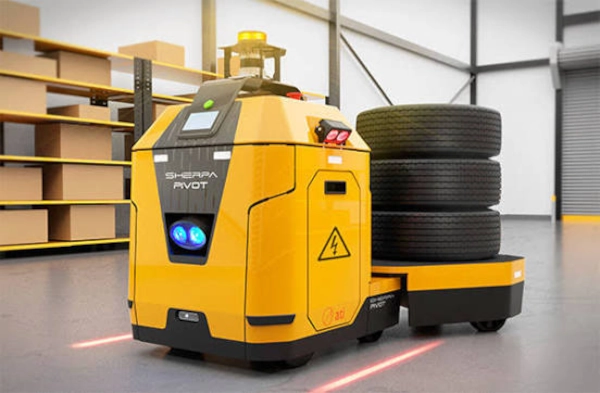
Ati Motors is one of India’s most significant industrial-robotics companies, developing autonomous mobile robots that move heavy materials through factories, warehouses and production facilities. Founded in Bengaluru in 2017, the company built its reputation around the Sherpa family of electric industrial vehicles—compact robots capable of carrying pallets, lifting loads and towing trains of trolleys weighing several tonnes.
In April 2026, Ati Motors formally changed its name to Ati Robotics. The rebranding reflected its evolution from a manufacturer of autonomous vehicles into a broader industrial-automation company combining robots, fleet-management software, factory data and artificial-intelligence systems. Existing Sherpa product names, customer contracts and deployments continued under the new identity.
The company’s most powerful commercial robot, the Sherpa 10K, can tow loads of up to 10,000 pounds, equivalent to approximately 4,600 kilograms. It is designed to operate autonomously across factory floors, warehouses, loading zones and outdoor routes between industrial buildings. Rather than following rails, magnetic strips or painted floor markings, the robot maps its surroundings and determines its position through sensors, cameras and navigation software.
Ati’s larger objective is to automate one of the most persistent and labour-intensive activities inside manufacturing: the movement of components, pallets, tools and partly assembled products between different stages of production.
How Ati Motors Began
Ati Motors was founded by Saurabh Chandra, V Vinay and Saad Nasser. The three founders came from very different backgrounds but shared an interest in building a sophisticated engineering product from India.
V Vinay had previously worked in technology research, education and entrepreneurship. Saurabh Chandra had founded software-services company Neev Technologies, which was acquired by Publicis. Saad Nasser was a young electronics and computer-architecture enthusiast who had begun working with Vinay as a child and later became involved in the autonomous-vehicle project.
The founders initially explored the possibility of creating a self-driving electric vehicle. Passenger cars, however, presented enormous regulatory, safety and financial barriers. A road-going autonomous car would have to respond to almost limitless combinations of traffic, pedestrians, road conditions and human behaviour.
Factories offered a more practical starting point. They are controlled environments with repeatable routes, defined safety procedures and clearly measurable work. A robot could be asked to move a particular load from one production station to another, repeat the journey hundreds of times and create immediate economic value.
The company therefore concentrated on an autonomous cargo vehicle that could operate inside private and semi-private industrial locations such as factories, warehouses and airports. An early Sherpa prototype was designed as a compact electric vehicle capable of moving approximately one tonne. The company also tested a proof-of-concept platform at the Indian Institute of Science campus in Bengaluru.
This decision shaped the company’s future. Ati would concentrate on industrial autonomy rather than consumer mobility.
Why Material Movement Matters
Factories depend on continuous material flow. A vehicle assembly plant, for example, may require seats, dashboards, electrical components, tyres and mechanical subassemblies to arrive beside the production line at precise times. A delay in delivering one component can interrupt an entire assembly operation.
Traditionally, this movement is performed by workers pushing carts, operating forklifts or driving electric tuggers. These methods can work effectively, but they create several challenges when material routes become frequent and predictable.
Human-operated vehicles require drivers for every shift. Forklifts create traffic and safety risks in spaces shared with workers. Manual trolley movement exposes employees to repetitive physical strain. Production can also become dependent on whether a driver or material handler is available at the required moment.
Ati’s robots are designed to take over these repeated journeys. Once a route and task have been configured, the machine can collect a trolley or pallet, travel to the required station, deliver the load and proceed to its next mission.
The company’s founder has described its principal competitor as the existing manual process rather than another robot manufacturer. Most deployments replace someone driving a vehicle, pushing material by hand or repeatedly moving goods along the same route.
Autonomous Mobile Robots Versus Traditional AGVs
Industrial automation has used automated guided vehicles, or AGVs, for decades. Conventional AGVs commonly depend on magnetic tape, embedded wires, reflectors or other fixed guidance infrastructure. They travel along predefined paths and may require physical changes to the factory when a route is altered.
An autonomous mobile robot, or AMR, uses onboard sensing and computing to understand its surroundings. It can map the facility, locate itself within that map, identify obstructions and modify its route.
The difference becomes important inside an active factory. Workers may leave a trolley in an aisle, a forklift may cross the robot’s path or a production zone may be temporarily closed. A traditional guided machine may simply stop until its route is cleared. An AMR can assess whether another safe route is available.
Ati says its Sherpa robots use natural-feature navigation, which allows them to operate without floor tape, rails, magnets or ceiling markers. Routes can be changed through software when a factory layout or production process changes.
The company has designed its robots for both newly constructed facilities and older “brownfield” factories containing existing machinery, narrow aisles and established workflows.
The Sherpa 10K: Ati’s Heavy-Duty Autonomous Tugger
The Sherpa 10K is the most powerful robot in Ati’s present commercial portfolio. It is designed to tow trolley trains carrying up to 4,600 kilograms.
The machine itself weighs approximately 700 kilograms and measures about 1.56 metres in length, 0.93 metres in width and 1.14 metres in height. It can tow as many as three trolleys, negotiate gradients of up to six degrees and turn within a radius of approximately 1.15 metres.
Its maximum listed speed is 1.2 metres per second when carrying a load and 1.4 metres per second when travelling without one. These speeds are modest compared with road vehicles, yet industrial robots are designed around predictable movement, precision and safety rather than high-speed travel.
The Sherpa 10K uses a 48-volt lithium iron phosphate battery. Ati lists an operating duration of approximately eight hours and charging from zero to 80 per cent in around one hour. The robot is intended to complete a normal industrial shift before charging or receiving a battery change.
The robot uses 3D LiDAR and cameras to detect the geometry of its surroundings. LiDAR sends laser pulses into the environment and measures their return, helping the machine create a three-dimensional representation of walls, racks, equipment and obstacles.
Cameras add visual information that can assist with localisation, lane recognition, docking and object detection. The robot combines the data from these sensors to determine where it is and how it should move.
The Sherpa 10K is rated for indoor and outdoor industrial routes. This allows it to tow components across production buildings, covered yards, receiving areas and inter-building pathways without transferring the load to another vehicle.
Its listed IPX4 protection provides resistance against water splashes, while its stated operating-temperature range extends from approximately 5°C to 45°C. It is also certified to ISO 3691-4, an international safety standard covering driverless industrial trucks and their systems.
Sherpa XT Lite
For medium-duty trolley movement, Ati offers the Sherpa XT Lite. It can tow loads of up to 1,500 kilograms and is intended for frequent stop-and-go operations in factories and warehouses.
The XT Lite uses dual 3D LiDAR systems to maintain spatial awareness around the vehicle. It can detect obstacles, reduce speed and stop when workers or equipment enter its safety zones.
The robot has an eight-hour stated battery runtime and uses a swappable 51-volt battery pack. Ati says the battery can be changed in less than two minutes, allowing the machine to return to service without waiting through a complete charging cycle.
The XT Lite can travel indoors and outdoors, handle gradients of up to six degrees and operate in aisles slightly wider than 1.2 metres. It is also certified to ISO 3691-4.
The XT Lite and Sherpa 10K can operate through the same fleet-management platform. A factory could therefore deploy the lighter robot for smaller component trolleys and use the 10K for heavy subassemblies or long trolley trains.
Autonomous Pallet Movement
Pallet handling is another major part of Ati’s product strategy. Pallets are generally moved through warehouses and factories by forklifts or pallet trucks. These vehicles are highly capable, although frequent, predictable pallet routes can be suitable for automation.
The Sherpa Pallet Mover autonomously lifts and transports pallets between receiving docks, storage areas, manufacturing lines and outbound staging zones. The company lists a carrying capacity of up to 1,500 kilograms and speeds reaching 1.5 metres per second.
LiDAR, cameras and mapping technology allow the machine to approach a pallet, align itself, lift the load and transport it to a designated destination. In-place turning helps the robot manoeuvre inside confined industrial spaces.
Such robots can reduce forklift traffic on repetitive routes while leaving human-operated forklifts available for irregular tasks, high stacking and complex loading operations.
Sherpa Lifter
Ati’s lifting platforms are intended for loads that may not arrive on standard pallets. Factories move racks, bins, magazines, wheeled carts, fixtures and other specialised containers.
The Sherpa Lifter 1000 can be configured with different upper modules for tunnelling beneath loads, lifting them from below or transferring them through roller systems. It has a listed lifting capacity of up to 1,000 kilograms.
This modularity allows one autonomous base design to be adapted to different production processes. A scissor-lift mechanism may raise a load to the height of a workstation, while a roller-top module can transfer a container onto a conveyor.
At its 2025 Product Day, the company also presented a Sherpa Lifter 500, with a 500-kilogram capacity and stated runtime of up to 16 hours. Another product, the Sherpa Monofork, uses a single-fork mechanism to lift and move wheeled trolleys weighing up to 500 kilograms.
How the Robots Navigate
Ati’s technology combines mechanical engineering, electric-vehicle systems, computer vision, artificial intelligence and autonomous-navigation software.
The robots first require a map of the operational area. During deployment, the system records walls, pillars, equipment, aisles and other permanent features. The robot then compares live sensor readings with the stored map to determine its position.
This process is generally known as simultaneous localisation and mapping, or SLAM. Ati describes its technology stack as incorporating lane-detection-based SLAM, visual place recognition and iterative closest point techniques for global localisation.
Visual place recognition helps the robot identify previously observed areas from camera data. Iterative closest point processing compares groups of measured spatial points with the existing map, allowing the system to refine its estimated position.
The machine must then plan a route. Its software considers the destination, available pathways, safety zones, surrounding traffic and temporary obstacles. Adaptive path planning allows the selected route to change as the environment changes.
At loading and unloading positions, greater precision is required. A robot approaching a pallet or trolley hitch must align itself accurately enough to engage the load. Ati uses machine-vision-assisted precision docking for these operations.
The company says its robots are trained and tested through simulation before being introduced onto factory floors. Simulated facilities allow engineers to test routes, traffic patterns and unusual situations before physical deployment.
Designed for Difficult Industrial Conditions
Factories are more demanding than controlled robotics laboratories. Floors may contain cracks, uneven joints, gradients, dust, water or small amounts of oil. Lighting conditions change, doors open and close, and people move unpredictably.
Ati has emphasised ruggedisation as a central element of its engineering. Investor NGP Capital noted that the company’s robots were refined in Indian manufacturing environments containing uneven surfaces, steep gradients, oil spills and extreme temperatures.
This experience can become an advantage when exporting robots. A machine built only for perfectly level warehouse floors may require extensive modification before operating in older manufacturing plants. Ati’s products are intended to work within existing facilities and across indoor-outdoor transitions.
The company also operates a Robotics Operating Centre for remote fleet monitoring, diagnostics and software updates, according to NGP Capital. Remote support allows engineers to investigate performance issues and deploy updates without travelling immediately to every factory.
Hardware and Software Built Together
Ati describes itself as a full-stack robotics company. Rather than supplying only autonomous-navigation software or purchasing a finished industrial vehicle from another manufacturer, the company develops the robot platform, electric drivetrain integration, controls, sensor architecture, autonomous software and fleet-management system.
Saurabh Chandra has said that Ati designs its robot hardware, software and sensor-fusion algorithms internally. The company uses Nvidia’s Jetson computing platform for edge processing, demonstrating that India-based product development can still incorporate globally sourced processors and specialised components.
This distinction is important when describing Ati as indigenous. The machines are conceived, engineered and integrated in India, while selected electronic components, sensors or processors may come from international supply chains.
Owning the complete design allows the company to optimise the mechanical system and autonomous software together. A change in wheel arrangement, battery position, sensor placement or braking performance can be considered alongside the navigation algorithm rather than handled by unrelated suppliers.
Fleet Manager and Material Orchestration
A single robot can automate one movement. A fleet-management platform is required to coordinate dozens of robots across an entire factory.
Ati’s Fleet Manager assigns tasks, monitors robot status and prevents traffic conflicts. It can decide which robot should collect a load, calculate routes and manage intersections where several machines may arrive simultaneously.
The platform provides live information on robot utilisation, battery status, task completion and operational exceptions. It also supports integrations with warehouse-management systems, manufacturing-execution systems and enterprise-resource-planning platforms.
These integrations allow robot missions to respond to actual production requirements. When an ERP or manufacturing system records that a particular component is needed, the software can create a movement request rather than waiting for a worker to dispatch a vehicle manually.
Ati says its Fleet Manager is built around VDA 5050, an open communication framework developed to improve interoperability between mobile robots, fleet-control systems and other industrial software. This approach could allow Ati’s software to coordinate robots from multiple manufacturers rather than locking a factory into one supplier.
The company is now extending fleet management into what it calls material orchestration. Its Ati Flow and Ativerse software concepts are designed to connect robots, production schedules, inventory records, IoT data and factory-management systems.
The aim is to create a continuously updated record of work-in-progress material. The system can track where a component is located, whether it is moving, which workstation requires it and whether a delay is likely to affect production.
Instead of treating every robot as an isolated machine, the software coordinates material flow as one factory-wide operation.
Artificial Intelligence on the Factory Floor
Ati uses artificial intelligence primarily for perception, decision-making and orchestration.
A robot must distinguish between permanent structures and temporary obstacles. It must estimate how people and vehicles are moving, select a safe path and adjust its speed. The system also has to decide when to stop, when to wait and when to reroute.
The company’s software uses the operational data generated by deployed robots to improve autonomous behaviour. Each completed mission contributes information about factory layouts, obstacle patterns, floor conditions and traffic interactions.
By January 2025, Ati said its Sherpa fleet had logged more than 500,000 kilometres of operation. Its latest corporate pages report more than two million completed autonomous missions across over 70 factories. These performance figures are company-reported and have not been independently audited in the public domain.
Ati currently reports a 99 per cent mission-success rate and an average deployment period of approximately four weeks. Actual performance and installation time will vary according to the factory layout, integration requirements and complexity of the workflow.
Industries and Customers
Automotive manufacturing has been Ati’s strongest early market. Vehicle plants contain frequent, precisely timed material routes and often operate across multiple shifts, making them suitable environments for autonomous transport.
Ati lists automotive manufacturers and suppliers such as Daimler, Hyundai, Suzuki and Valeo among organisations using or evaluating its systems. Earlier company announcements also identified Bosch, TVS Motor, CEAT, Airbus, Forvia and Samsung among customers or deployment partners.
The company is expanding into pharmaceutical production, food and beverages, consumer electronics, heavy equipment, agriculture-related machinery, energy and oil-and-gas facilities.
Pharmaceutical factories may use robots to move materials between controlled zones while reducing variations caused by manual traffic. Food-processing plants can automate timed ingredient, packaging and pallet movements. Heavy-equipment factories require the towing capacity to move large subassemblies and parts.
Ati says its machines are deployed across more than 70 factories and that its customer base includes 15 Fortune 500 companies. It operates across India, the United States, Mexico and Southeast Asia.
From Bengaluru to Global Manufacturing
Ati’s engineering and manufacturing operations were established in Bengaluru. The company later expanded internationally, creating a North American base in the Detroit-area manufacturing centre of Rochester Hills, Michigan.
It also established operations in Mexico and Southeast Asia, including a presence in Thailand. The company describes the United States, Mexico, India and Southeast Asia as its four principal operating regions.
Detroit provides proximity to automotive companies and component suppliers, while Mexico has become a major manufacturing centre for vehicles, appliances, electronics and industrial equipment.
The company reports a global workforce of approximately 250 people. Its Bengaluru operation remains central to research, engineering and product development.
Funding and Investor Support
Ati raised $3.5 million in pre-Series A funding in 2021 from investors including Blume Ventures, Exfinity Venture Partners and MFV Partners. It had also received earlier seed support from Village Global.
In July 2023, the company raised $10.85 million in a Series A round led by True Ventures. Athera Venture Partners joined the round, while Blume Ventures, Exfinity Ventures and MFV Partners participated as existing investors. The funding was intended to support research, new products and expansion into the United States, Southeast Asia, Japan and Europe.
Ati raised another $20 million in January 2025 through a Series B round led by Walden Catalyst Ventures and NGP Capital. Existing investors True Ventures, Exfinity Venture Partners, Athera Venture Partners and Blume Ventures also participated. The round brought the company’s reported cumulative funding to more than $37 million.
The Series B capital was directed towards product development and commercial expansion in North America and the Asia-Pacific region. Ati reported that its order book had tripled during the fourth quarter of 2024 and that it had added nine major customers.
Robots as a Service
Ati offers its machines through direct purchase and a Robots-as-a-Service, or RaaS, model.
Under direct purchase, the manufacturer owns the equipment and treats it as capital expenditure. Under RaaS, the factory pays for access to the robots and supporting services through a recurring commercial arrangement.
This can reduce the initial financial barrier to automation. The supplier remains responsible for robot availability, updates and support, while the customer evaluates the system through measurable operating results.
Ati presents RaaS as a way for manufacturers to adopt autonomous transport without assuming the full hardware and depreciation risk at the beginning of a project.
The model also places pressure on Ati to maintain uptime because its recurring revenue depends on the machines continuing to perform.
Sherpa Mecha: Moving Towards Humanoid Industrial Robotics
Ati’s most ambitious new product is Sherpa Mecha, a humanoid-inspired industrial robot unveiled in 2025.
The machine does not attempt to copy the entire human body. It combines a wheeled autonomous base with an adjustable torso and two robotic arms. This configuration gives it mobility and manipulation capability while avoiding the complexity and energy demands of walking on two legs.
The current product specification lists a payload of 12 kilograms at full reach, a reach of approximately 900 millimetres and 19 degrees of freedom across its two arms. Its height can extend from about 1.1 metres to two metres, while the mobile base can travel at speeds reaching 1.5 metres per second.
The robot is intended for light- and medium-duty industrial tasks such as moving materials between bins, shelves, conveyors and workstations. Ati is working with research institutions and manufacturing partners to develop specialised tools and software for individual applications.
Sherpa Mecha remains an emerging platform rather than a mature mass-deployed product. Its success will depend on whether the company can demonstrate reliable manipulation, safe human interaction and commercially attractive operating costs on real production floors.
The project nevertheless represents a logical extension of Ati’s existing capabilities. The company already has experience in autonomous mobility, factory navigation, fleet management, industrial safety and material handling. Mecha adds robotic arms and adaptable tooling to that base.
Safety and Reliability
Safety is central to industrial robotics because AMRs share space with workers, forklifts and valuable machinery.
The robot’s sensors establish protective zones around the vehicle. When an obstacle enters an outer zone, the machine may reduce speed. Entry into a closer zone can trigger a controlled stop.
Mechanical braking, emergency-stop controls and fault monitoring provide additional protection. The Sherpa 10K and XT Lite are listed as compliant with ISO 3691-4.
Fleet-level traffic management can also reduce the risk of two robots entering the same narrow space or intersection simultaneously.
Certification provides a framework for risk assessment and machine behaviour. Safe operation still depends on correct installation, operator training, route design and maintenance.
Challenges Facing Ati Robotics
Ati operates in a market containing established European, Japanese, American and Chinese automation companies. It must prove that Indian-designed robots can match international standards for reliability, safety and after-sales service.
Industrial customers expect equipment to operate for years. A robot failure can delay materials and interrupt production, making spare parts, field technicians, remote diagnostics and preventive maintenance essential.
Every factory also presents different challenges. Pallet dimensions, trolley hitches, floor gradients, wireless networks and management systems vary between customers. Excessive customisation can increase project costs and slow deployment, while insufficient flexibility can limit the number of suitable applications.
Ati must balance these pressures by using common robot platforms, modular hardware and configurable software.
Another challenge is proving financial return. Automation becomes attractive when robot leasing, maintenance and integration cost less than the operational expense, delays and safety exposure associated with the existing process. The strongest deployments will therefore be high-frequency routes where utilisation remains consistently high.
The company must also manage the transition from individual robot fleets to AI-driven factory orchestration. Manufacturers may hesitate to give one software platform control over material movement unless cybersecurity, interoperability and system reliability are clearly demonstrated.
Employment and the Changing Factory
Autonomous material-handling robots can reduce demand for repetitive driving and manual trolley movement. They can also create roles in robot deployment, maintenance, fleet supervision, software integration and production planning.
The technology is particularly suited to tasks described as dull, dirty, dangerous or highly repetitive. Workers can be moved towards activities requiring judgement, inspection, problem-solving and coordination.
The outcome depends on how the technology is introduced. Training existing employees to supervise and maintain autonomous systems can produce a more skilled industrial workforce. Treating automation only as a method of reducing headcount can create resistance and leave valuable operational knowledge unused.
Why Ati Matters for India
Ati is important because it represents a class of Indian company attempting to build complete physical technology rather than providing only software services.
Industrial robotics requires mechanical design, embedded electronics, batteries, motors, sensors, computer vision, autonomous-navigation algorithms, manufacturing, safety engineering and long-term field support.
Building these capabilities in India contributes to a broader ecosystem of component suppliers, robotics engineers, system integrators and industrial-software specialists.
Ati has also used India as a proving ground. Difficult floors, outdoor routes, high temperatures and cost-sensitive customers forced the company to build durable machines and maintain competitive economics. NGP Capital has cited India’s electric-vehicle supply chain and local supplier partnerships as contributors to Ati’s cost structure.
The company’s international growth shows that Indian engineering can be developed locally and deployed in factories across North America, Latin America and Southeast Asia.
Ati Motors began with the idea of creating an autonomous cargo vehicle. It has since developed a family of industrial robots capable of towing 4.6 tonnes, lifting pallets, navigating outdoor routes and coordinating material movement through factory-wide software.
Its 2026 transition to Ati Robotics signals a larger ambition: to become the intelligence and execution layer that controls how materials move through modern manufacturing.
The company’s future will be determined by reliability, commercial discipline and its ability to convert innovative prototypes into repeatable global deployments. Its journey already demonstrates that India can design and manufacture sophisticated autonomous systems for some of the world’s most demanding industrial environments.
REFERENCES
Ati Robotics. “About Ati Robotics.”
https://www.atirobotics.ai/company/
Ati Robotics. “Ati Motors Becomes Ati Robotics.” 22 April 2026.
https://www.atirobotics.ai/resources/educational-content/ati-motors-becomes-ati-robotics/
Ati Robotics. “Autonomous Tugger Solutions.”
https://www.atirobotics.ai/solutions/tugging/
Ati Robotics. “Sherpa 10K: 10,000-lb Autonomous Tugger.”
https://www.atirobotics.ai/products/trolley/sherpa-10k/
Ati Robotics. “Sherpa XT Lite: Indoor-Outdoor Autonomous Tugger.”
https://www.atirobotics.ai/products/trolley/sherpa-xt-lite/
Ati Robotics. “Automated Pallet Movement Solutions.”
https://www.atirobotics.ai/solutions/pallet-movement/
Ati Robotics. “Autonomous Lifting and Handling Solutions.”
https://www.atirobotics.ai/solutions/lifting-and-handling/
Ati Robotics. “Material Orchestration Software.”
https://www.atirobotics.ai/solutions/orchestration/
Ati Robotics. “Autonomous Material Handling Solutions.”
https://www.atirobotics.ai/solutions/
Ati Robotics. “Ati Motors Product Day 2025 Recap.” 23 July 2025.
https://www.atirobotics.ai/resources/educational-content/ati-motors-product-day-2025/
Ati Robotics. “Product Launch: Sherpa Mecha Humanoid Robot.” 29 September 2025.
https://www.atirobotics.ai/resources/educational-content/product-launch-sherpa-mecha/
Ati Robotics. “Sherpa Mecha: Industrial Humanoid Robot.”
https://www.atirobotics.ai/products/humanoid/sherpa-mecha/
Ati Robotics. “Ati Motors Raises $20 Million Series B.” 23 January 2025.
https://www.atirobotics.ai/resources/educational-content/20m-series-b-for-global-expansion-of-ai-powered-robotics-workforce/
PR Newswire. “Ati Motors Raises $20M Series B for Global Expansion of Its AI-Powered Robotics Workforce.” 23 January 2025.
https://www.prnewswire.com/news-releases/ati-motors-raises-20m-series-b-for-global-expansion-of-its-ai-powered-robotics-workforce-302357446.html
PR Newswire. “Industrial Robotics Company Ati Motors Secures US$10.85 Million in Series A Funding.” 21 July 2023.
https://www.prnewswire.com/in/news-releases/industrial-robotics-company-ati-motors-secures-us10-85-million-in-series-a-funding-led-by-silicon-valleys-true-ventures-301883016.html
NGP Capital. “Empowering Manufacturing with Autonomous Robots: Why We Invested in Ati Motors.” 23 January 2025.
https://www.ngpcap.com/insights/empowering-manufacturing-with-autonomous-robots-why-we-invested-in-ati-motors
Forbes India. “Sherpa: Wonder Wheels of Ati Motors.” 13 July 2018.
https://www.forbesindia.com/article/ai-work/sherpa-wonder-wheels-of-ati-motors/50731/1
TechCrunch. “Ati Motors Raises $20M as India’s Robotics Industry Grows.” 22 January 2025.
https://techcrunch.com/2025/01/22/ati-motors-raises-20m-as-indias-robotics-industry-grows/
You may also like
-
Koraput Kalajeera Rice of Odisha: The GI-Tagged Aromatic Heritage of India’s Ancient Rice-Growing Region
-
ICAR Scientists Develop Indigenous Protective Gloves for Cotton Farmers, Sign Commercial Manufacturing Agreement
-
India Moves Towards Five-Year Assured Orders for Defence Startups Under New Procurement Reforms
-
BHEL–Coal India Joint Venture Begins Construction of ₹25,016 Crore Indigenous Coal Gasification Project in Odisha
-
Zen Technologies Introduces Indigenous Hyper-Strike Falcon AI-Guided Counter-Drone Interceptor
