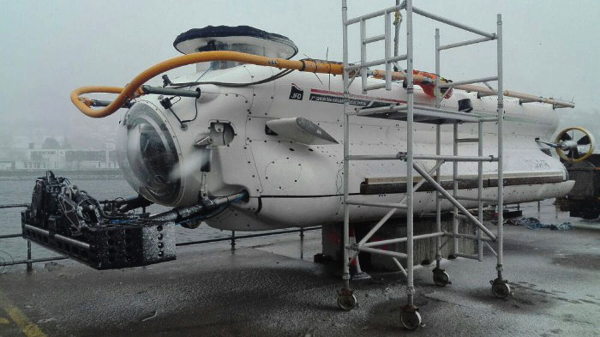
UK-based subsea engineering and services provider JFD has completed sea acceptance trials and training activities on the second of two fly-away submarine rescue systems built for the Indian Navy.
The activities were conducted on the east coast of India at Visakhapatnam, where the system will eventually be based. In 2018, the company carried out a similar set of sea trials and training activities with the first submarine rescue system, which has since been delivered to the Indian Navy’s west coast Submarine Rescue Unit at Mumbai.
Each system delivered comprises a DSAR-650L free-swimming deep submergence rescue vehicle (DSRV), launch and recovery system (LARS) equipment, a Transfer Under Pressure (TUP) unit, an SMD Atom intervention remotely operated vehicle, and an EdgeTech 4200 series towed sidescan sonar.
As part of the trials, JFD and the Indian Navy conducted multiple dives of the system’s deep search and rescue vehicle (DSRV) to both fixed and angled targets. The vehicle also underwent mating with Indian Navy submarines, during which transfer of personnel exercises were carried out.
Other activities that were conducted as part of the systems’ trials and acceptance process include multiple dives of the remotely operated vehicle (ROV) side scan sonar exercises, and a transfer under pressure operation, the last of which was followed by a safe decompression process.
“The trials programme proved the ability of the DSRV to operate effectively with multiple Indian Navy submarines, maximising the chances of a successful rescue operation”, said JFD in a statement on 8 July.
Source: Janes
Image Courtesy: Pacom
You may also like
-
India, Armenia Sign Defence R&D and Shared-Production MoU as Military Ties Deepen
-
India Unveils Sixth Positive Indigenisation List Covering 405 Critical Defence Items Worth ₹3,070 Crore
-
India Signs ₹1,943 Crore Deal to Lease Two MQ-9B Sea Guardian Drones for Navy
-
Indrajaal Ranger Signals India’s Shift From Static Counter-Drone Defence to Mobile Airspace Patrolling
-
India’s Super Sukhoi: How the Su-30MKI Is Being Rebuilt for the Next Era of Air Combat
