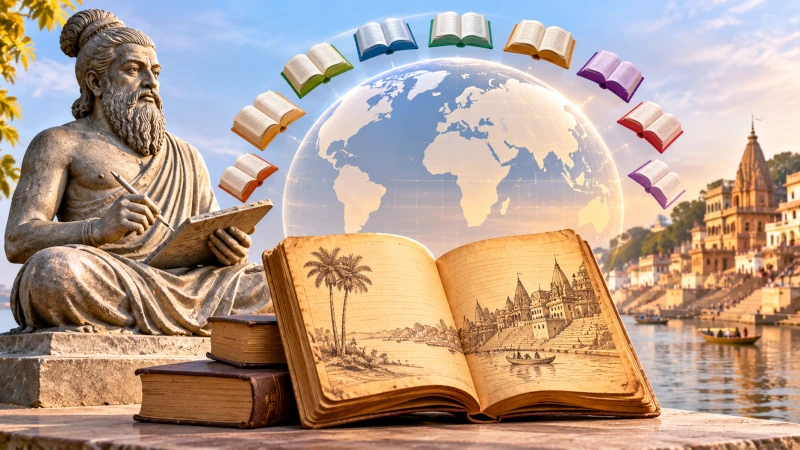
The Thirukkural, one of India’s most celebrated works of classical Tamil literature, is now available in 50 languages, marking a significant milestone in the dissemination of India’s civilisational wisdom. Vice-President C. P. Radhakrishnan highlighted this achievement during the inauguration of the fifth edition of Kashi Tamil Sangamam in Varanasi on 28 November 2026. The expansion from 13 languages during the inaugural edition of Kashi Tamil Sangamam to 50 languages reflects sustained efforts to make classical Tamil philosophical and ethical traditions accessible to a wider audience.
Thirukkural: An Enduring Repository of Indian Wisdom
Attributed to the celebrated Tamil poet and philosopher Thiruvalluvar, the Thirukkural occupies a distinguished position in India’s classical literary heritage. The work comprises 1,330 couplets organised into 133 chapters, addressing fundamental aspects of human conduct, governance, economic life, relationships and ethical responsibility. Its remarkable conciseness allows complex philosophical and practical principles to be expressed through a highly disciplined literary structure.
The Thirukkural is divided into three principal sections: Aram (virtue and ethical conduct), Porul (wealth, governance and material life) and Inbam (love and human relationships). Together, these sections present an integrated understanding of individual responsibility, social organisation and personal fulfilment. The work’s enduring relevance arises from its ability to address universal human concerns through principles that transcend geographical, linguistic and historical boundaries.
From 13 to 50 Languages: Expanding Access to Classical Literature
The expansion of the Thirukkural’s availability from 13 to 50 languages, as highlighted by the Vice-President, represents an important development in the accessibility of India’s classical literary heritage. Translation enables readers unfamiliar with Tamil to engage with Thiruvalluvar’s reflections on ethical conduct, leadership, justice, friendship and social responsibility. It also provides opportunities for comparative literary studies and philosophical engagement across different linguistic traditions.
Translating the Thirukkural presents a distinctive intellectual challenge because its original couplets convey considerable philosophical depth within an exceptionally compact poetic structure. Translators must balance linguistic accuracy with the preservation of cultural context, ethical meaning and literary expression. The growing availability of translations contributes to the preservation and dissemination of this knowledge while encouraging greater appreciation of the original Tamil composition.
Kashi Tamil Sangamam 5.0: Strengthening Civilisational Connections
The fifth edition of Kashi Tamil Sangamam places particular emphasis on promoting the teachings of the Thirukkural across India. The initiative brings together the cultural, educational and intellectual traditions of Tamil Nadu and Kashi, two important centres of India’s civilisational heritage. Through literary discussions, cultural programmes and educational exchanges, the event seeks to strengthen understanding of the historical connections between different regions of the country.
Kashi Tamil Sangamam was conceived as a platform for rediscovering and celebrating India’s longstanding cultural and intellectual interconnectedness. Its focus on the Thirukkural provides an opportunity to introduce classical Tamil wisdom to students, scholars and the wider public beyond traditional linguistic boundaries. Such initiatives contribute to national integration through shared knowledge and mutual appreciation of India’s diverse literary traditions.
Ancient Wisdom for Contemporary Governance and Leadership
One of the most distinctive aspects of the Thirukkural is its extensive treatment of governance, administration, diplomacy and leadership. The Porul section examines the responsibilities of rulers, the importance of capable ministers, economic management, justice, intelligence gathering and prudent decision-making. These teachings demonstrate the depth of political and administrative thought preserved within India’s classical Tamil literary tradition.
Thiruvalluvar emphasises ethical responsibility, impartial justice, careful deliberation and the welfare of society as essential qualities of effective governance. His observations also extend to the importance of education, financial prudence, integrity and the consequences of irresponsible leadership. These principles provide valuable material for contemporary discussions on public administration, institutional leadership and professional ethics.
Preserving Linguistic Diversity Through Knowledge Exchange
India’s linguistic diversity constitutes an extensive repository of philosophical, scientific, literary and cultural knowledge accumulated over centuries. Translation plays an important role in connecting these traditions by enabling knowledge preserved in one language to become accessible to readers of another. The wider dissemination of the Thirukkural demonstrates how classical literature can contribute to intellectual exchange without diminishing the importance of its original linguistic identity.
The availability of the work in multiple languages also creates opportunities for educational institutions, researchers and cultural organisations to incorporate its teachings into academic and public programmes. Greater engagement with classical Indian texts can encourage comparative scholarship, interdisciplinary research and a deeper understanding of the country’s intellectual history. Such efforts become particularly meaningful when translations retain the philosophical substance and cultural context of the original works.
Taking India’s Civilisational Wisdom to the World
The Thirukkural’s emphasis on ethical conduct, responsible leadership, compassion, justice and harmonious human relationships gives it relevance far beyond its original geographical and historical setting. Its wider availability can facilitate engagement with Indian philosophical thought among international readers, educators and researchers. The work offers an important example of India’s contribution to enduring discussions on human values and the organisation of society.
International dissemination of classical Indian literature also provides opportunities for cultural diplomacy and intellectual exchange. Unlike cultural engagement based solely on contemporary achievements, classical literature introduces audiences to the historical depth and continuity of India’s knowledge traditions. The Thirukkural serves as a valuable bridge between India’s literary heritage and contemporary global conversations on ethics, governance and human development.
Preserving Ancient Knowledge for Future Generations
The availability of the Thirukkural in 50 languages represents an important milestone in making India’s classical intellectual heritage more accessible. However, the continued preservation of such knowledge depends not only on translation but also on scholarly interpretation, educational engagement and meaningful application of its principles. Initiatives such as Kashi Tamil Sangamam provide institutional platforms through which classical literary traditions can remain connected with successive generations.
By expanding access to Thiruvalluvar’s teachings while preserving their original linguistic and philosophical foundations, India can strengthen the continuity of its civilisational knowledge systems. The growing reach of the Thirukkural demonstrates how ancient wisdom can remain relevant in contemporary society, crossing linguistic boundaries while retaining its distinctive cultural identity. It represents a constructive step towards ensuring that India’s classical intellectual heritage continues to inform and enrich future generations.
You may also like
-
Warcraft in the Purāṇas: Krishna and the Dismantling of Bāṇāsura’s Thousand-Armed Advantage
-
Indian Traditional Artisans Record ₹2.07 Crore in Sales at India International Trade Fair
-
Warcraft Purāṇas — The Bāṇa War: When Krishna and Shiva Confronted Each Other
-
India Reclaims Three Historic Bronze Antiquities from the United States and Netherlands
-
Warcraft of the Purāṇas: Krishna versus Bāṇāsura — Divine Alliances, Numerical Superiority and Strategic Restraint
