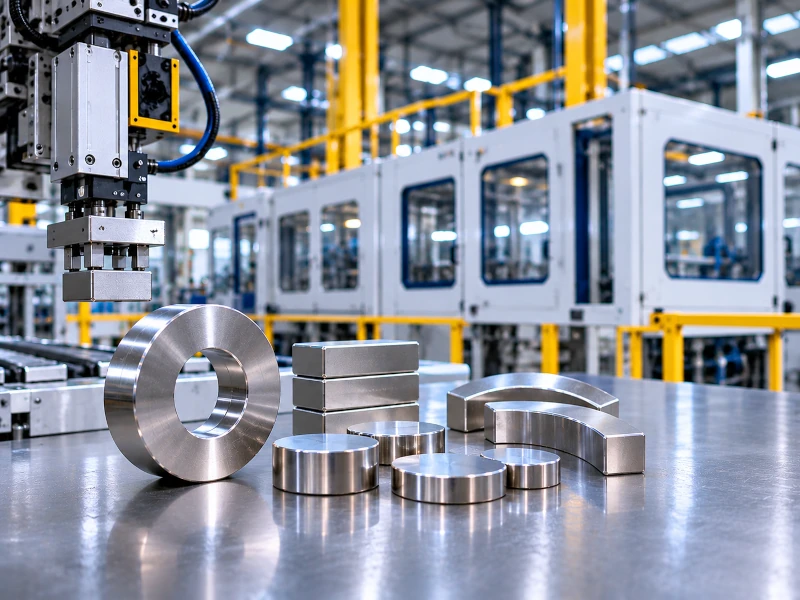
Hindustan Mag and Prozeal Green Energy are planning to establish an integrated rare-earth permanent magnet manufacturing facility in Gujarat, with a proposed annual production capacity of 600 metric tonnes. According to a PTI report published on 27 November 2026, the consortium intends to manufacture sintered neodymium-iron-boron (NdFeB) permanent magnets, which are essential components in several advanced industrial and clean energy technologies. The proposed facility represents a step towards strengthening India’s domestic rare-earth magnet manufacturing capabilities and reducing dependence on imported high-performance magnetic components.
Strengthening India’s Rare-Earth Magnet Manufacturing Capabilities
Neodymium-iron-boron magnets are among the strongest commercially available permanent magnets and are widely used in applications requiring compact, lightweight and energy-efficient systems. Their high magnetic strength makes them particularly valuable in electric vehicle motors, industrial automation systems, wind turbine generators and advanced electronic equipment. Establishing domestic manufacturing capabilities for these components is important for supporting India’s expanding advanced manufacturing ecosystem.
The proposed Gujarat facility will focus on sintered NdFeB magnets, which are manufactured through specialised powder metallurgy and thermal processing techniques. Producing these magnets requires precise control over material composition, processing conditions and magnetic properties to meet demanding industrial specifications. The initiative could contribute to the development of specialised manufacturing expertise and domestic value addition in this technologically demanding sector.
Supporting Electric Mobility and Renewable Energy Manufacturing
The proposed manufacturing facility is particularly relevant to India’s expanding electric mobility and renewable energy industries. High-performance permanent magnets are used in many electric vehicle traction motors, enabling manufacturers to achieve greater power density while reducing motor size and weight. They are also used in certain wind turbine generator designs, where their magnetic properties contribute to efficient electricity generation.
Domestic production of these components could help Indian manufacturers diversify their sourcing arrangements and improve supply-chain resilience. As demand for electric vehicles, renewable energy equipment and energy-efficient industrial machinery increases, the availability of domestically manufactured magnetic materials could become an important factor in supporting India’s industrial growth. The proposed facility could help bridge the gap between domestic demand and existing manufacturing capabilities.
Applications Across Advanced Industrial Technologies
Beyond electric mobility and renewable energy, rare-earth permanent magnets have extensive applications in robotics, industrial automation, precision instruments, consumer electronics and high-performance electric motors. Their ability to deliver strong magnetic fields within compact dimensions makes them valuable in technologies where efficiency and miniaturisation are essential. Domestic manufacturing could consequently support a broad range of emerging technology sectors.
The development of an integrated magnet manufacturing ecosystem could also create opportunities for specialised material suppliers, precision engineering companies and industrial research institutions. Establishing such capabilities requires expertise in materials science, manufacturing engineering, quality assurance and product qualification. Over time, these capabilities could contribute to the development of a more diversified domestic advanced materials industry.
Reducing Dependence on Imported Rare-Earth Magnets
Global rare-earth magnet supply chains remain geographically concentrated, making diversification an important consideration for countries seeking greater industrial resilience. Establishing domestic manufacturing facilities could help India reduce its exposure to disruptions in international supply chains, particularly for components required by rapidly expanding clean energy and advanced manufacturing industries. The proposed project represents an effort to develop domestic capacity in a strategically significant segment of the materials industry.
However, magnet manufacturing alone does not necessarily establish complete supply-chain independence. Access to rare-earth raw materials, refining capabilities, alloy production and specialised processing technologies remains important for building a comprehensive domestic ecosystem. The extent of the project’s contribution to supply-chain self-reliance will therefore depend on its eventual sourcing arrangements, technological integration and operational capabilities.
Gujarat’s Growing Advanced Manufacturing Ecosystem
The proposed facility adds another potential dimension to Gujarat’s expanding industrial manufacturing landscape, which includes automotive production, renewable energy equipment, electronics and specialised engineering industries. The state’s established industrial infrastructure and manufacturing ecosystem could provide opportunities for integration with domestic suppliers and downstream industries. A rare-earth magnet manufacturing facility could complement these existing capabilities by introducing production capacity for advanced magnetic materials.
The proposed annual capacity of 600 metric tonnes represents the consortium’s stated manufacturing target rather than an existing operational achievement. Details concerning the investment value, construction schedule, commissioning timeline and raw material sourcing arrangements have not been established in the information currently available. The project’s progress will depend on subsequent implementation and the establishment of the necessary manufacturing infrastructure.
Advancing India’s Self-Reliance in Critical Materials
The proposed collaboration between Hindustan Mag and Prozeal Green Energy highlights the growing importance of critical materials within India’s industrial development strategy. Building domestic capabilities in high-performance permanent magnets could support multiple manufacturing sectors while strengthening the country’s position in emerging clean energy and advanced technology supply chains. Successful implementation of the facility would represent a constructive step towards expanding indigenous manufacturing capabilities in specialised materials and supporting the broader objectives of Make in India and Aatmanirbharta.
Source: Press Trust of India, as reported by ET Manufacturing on 27 November 2026.
You may also like
-
Indian Traditional Artisans Record ₹2.07 Crore in Sales at India International Trade Fair
-
Omnitech Engineering Secures Development Order from BrahMos Aerospace
-
ISRO Advances Next-Generation Methane Rocket Engine with Two Successful Subsystem Tests
-
Pixxel Plans ₹350 Crore Satellite Factory, Partners Centum to Advance Indigenous Space Technologies
-
Indian Railways Achieves 6.59-Kilometre Himalayan Tunnel Breakthrough in Uttarakhand
