Bhagavad Gita — Eternal Wisdom, Minus the Sleepiness
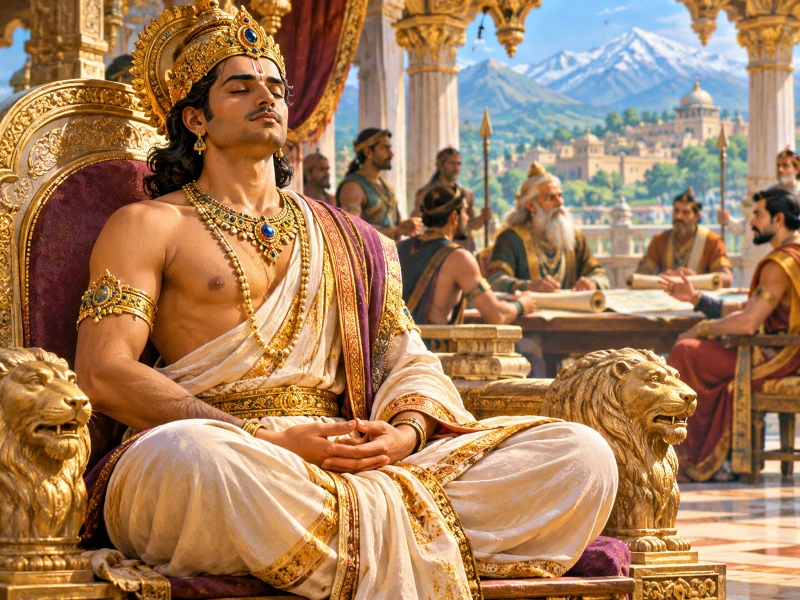
When people think of spiritual enlightenment, they often imagine a sage meditating in a Himalayan cave, far removed from worldly possessions, professional obligations and the complications of human relationships. The assumption is that spiritual liberation requires abandoning material life and withdrawing from society. However, in the Bhagavad Gita, Krishna presents a remarkably different example through King Janaka, a ruler who pursued spiritual perfection while continuing to discharge the responsibilities of kingship.
Janaka did not need to exchange his royal throne for a secluded forest to advance spiritually. He demonstrated that governance, responsibility and spiritual wisdom could coexist when actions were performed without selfish attachment. Through his example, Krishna teaches Arjuna that the path to liberation does not necessarily lie in escaping worldly responsibilities but in transforming the consciousness with which those responsibilities are fulfilled.
The Wisdom of the Bhagavad Gita
In Chapter 3 of the Bhagavad Gita, known as Karma Yoga, Krishna explains how disciplined action can become a means of spiritual advancement. He invokes Janaka and other ancient rulers to demonstrate that spiritual perfection is attainable even while actively participating in society.
कर्मणैव हि संसिद्धिमास्थिता जनकादयः ।
लोकसंग्रहमेवापि सम्पश्यन्कर्तुमर्हसि ॥
Karmaṇaiva hi saṃsiddhim āsthitā janakādayaḥ |
Lokasaṅgraham evāpi sampaśyan kartum arhasi ||
Bhagavad Gita — Chapter 3, Verse 20
Meaning: Indeed, Janaka and others attained perfection through action alone. Even considering the welfare and preservation of the world, you ought to perform your duty.
Krishna introduces Janaka at a critical moment in Arjuna’s spiritual and moral crisis. Arjuna is contemplating withdrawal from the battlefield, believing that abandoning action might offer an escape from its painful consequences. Krishna responds by explaining that spiritual maturity does not necessarily demand inactivity, and that righteous action undertaken without selfish attachment can itself become a path towards perfection.
King Janaka: The Philosopher on the Throne
In the Indian philosophical tradition, Janaka is remembered as a ruler of Videha, whose capital was Mithila, and as an embodiment of the ideal of the Rājarṣi, or royal sage. The name Janaka is associated with a lineage of rulers, including the philosopher-king celebrated in the Bṛhadāraṇyaka Upaniṣad and the royal figure traditionally remembered as the father of Sita in the Ramayana. Together, these traditions preserve the enduring ideal of a sovereign who combines political authority with spiritual wisdom.
The Bṛhadāraṇyaka Upaniṣad records profound philosophical conversations between Janaka and the sage Yājñavalkya concerning the nature of consciousness, the Self and ultimate reality. These discussions reveal a ruler whose interests extended beyond wealth, territorial expansion and political influence. Although surrounded by the privileges of royalty, Janaka recognised that genuine wisdom could not be acquired merely through material prosperity.
What makes Janaka particularly relevant to Krishna’s teaching is that kingship did not prevent his spiritual pursuit. The responsibilities of administration, justice and public welfare were compatible with his quest for self-realisation. His example challenges the assumption that worldly engagement and spiritual advancement must exist in opposition to each other.
Karma Yoga: Turning Responsibility into Spiritual Practice
Karma Yoga is frequently understood as the path of selfless action. Its central principle is that individuals should perform their appropriate duties sincerely without becoming psychologically dependent on the rewards, recognition or personal advantages that may arise from them. This does not diminish the importance of achieving good results; rather, it prevents the desire for those results from becoming the sole motivation for action.
Krishna establishes this principle in another verse of the same chapter.
तस्मादसक्तः सततं कार्यं कर्म समाचर ।
असक्तो ह्याचरन्कर्म परमाप्नोति पूरुषः ॥
Tasmād asaktaḥ satataṃ kāryaṃ karma samācara |
Asakto hy ācaran karma param āpnoti pūruṣaḥ ||
Bhagavad Gita — Chapter 3, Verse 19
Meaning: Therefore, always perform the action that ought to be done without attachment, for by performing action without attachment, a person attains the Supreme.
Janaka illustrates how this principle can operate within the demanding environment of governance. A king must make difficult decisions, allocate resources, resolve disputes and protect the welfare of his subjects. When such responsibilities are undertaken as expressions of Dharma rather than opportunities for personal glorification, they acquire a deeper ethical and spiritual significance.
The kingdom, therefore, need not become an obstacle to liberation. It can become the very environment in which patience, discipline, compassion, impartiality and self-mastery are cultivated. Karma Yoga transforms everyday obligations into opportunities for inner development.
Renunciation Without Abandoning the World
One of the most important distinctions in the Bhagavad Gita is the difference between abandoning action and abandoning attachment. A person may physically withdraw from worldly life while continuing to remain mentally occupied with ambition, possessions, recognition and personal desires. Conversely, someone may live amidst wealth, authority and responsibility while remaining inwardly free from their domination.
Janaka represents the second possibility. His spiritual significance lies not in the absence of worldly possessions but in the ability to possess material resources without allowing them to define his identity. The royal throne was a position of responsibility rather than the ultimate source of his existence or happiness.
Krishna reinforces this understanding in Chapter 6 of the Bhagavad Gita.
अनाश्रितः कर्मफलं कार्यं कर्म करोति यः ।
स संन्यासी च योगी च न निरग्निर्न चाक्रियः ॥
Anāśritaḥ karma-phalaṃ kāryaṃ karma karoti yaḥ |
Sa sannyāsī ca yogī ca na niragnir na cākriyaḥ ||
Bhagavad Gita — Chapter 6, Verse 1
Meaning: One who performs the prescribed duty without depending on its fruits is a true renunciate and a yogi, not merely one who abandons sacred fires or refrains from action.
This teaching challenges the tendency to measure spirituality through outward appearances alone. Wearing the garments of a renunciate does not automatically eliminate attachment, just as wearing a royal crown does not automatically prevent spiritual realisation. The decisive factor is the inner relationship between the individual, the action and its consequences.
Lokasaṅgraha: The Responsibility of Leadership
Krishna’s reference to Janaka carries a significance that extends beyond individual spiritual advancement. In the same verse, he introduces the concept of Lokasaṅgraha, which encompasses the welfare, cohesion and preservation of the world. Individuals occupying positions of responsibility must recognise that their actions influence the lives and conduct of others.
Krishna develops this principle in the following verse.
यद्यदाचरति श्रेष्ठस्तत्तदेवेतरो जनः ।
स यत्प्रमाणं कुरुते लोकस्तदनुवर्तते ॥
Yad yad ācarati śreṣṭhas tat tad evetaro janaḥ |
Sa yat pramāṇaṃ kurute lokas tad anuvartate ||
Bhagavad Gita — Chapter 3, Verse 21
Meaning: Whatever a distinguished person does, others follow. Whatever standard such a person establishes, the world follows that example.
A ruler who abandons legitimate responsibilities in pursuit of personal peace may leave society exposed to instability and injustice. A ruler who remains committed to public welfare while cultivating spiritual detachment demonstrates that leadership can become an expression of Dharma. Janaka’s example thus connects individual enlightenment with collective responsibility.
This principle remains relevant to political leaders, administrators, military officers, entrepreneurs, teachers and parents. Their conduct establishes standards that influence others, whether consciously or otherwise. Spiritual wisdom, therefore, is not merely a private achievement but can become a foundation for ethical leadership and social stability.
The King Who Possessed Everything Without Being Possessed by Anything
Human beings often construct their identities around what they possess, what they have achieved and how others perceive them. Professional titles, financial success, social recognition and material comforts gradually become measures of personal worth. When these external circumstances change, the individual may experience profound insecurity because happiness has become dependent upon conditions that cannot be permanently controlled.
The philosophical ideal represented by Janaka offers an alternative approach. A person may enjoy prosperity without becoming enslaved by it, exercise authority without developing arrogance and pursue excellence without making success the sole purpose of existence. Material resources can be utilised responsibly without becoming the foundation of one’s identity.
Detachment, in this context, does not mean indifference, carelessness or emotional withdrawal. It means maintaining inner stability while engaging fully with the world and accepting that external circumstances are subject to change. Janaka demonstrates that spiritual freedom is compatible with purposeful action, provided the individual does not become psychologically imprisoned by its rewards.
Janaka in the Modern World
Modern life offers countless opportunities to practise the principles embodied by Janaka. A doctor treating patients, a scientist conducting research, a soldier protecting the nation or an entrepreneur developing an enterprise can approach professional responsibilities as meaningful contributions to society. Their work becomes an opportunity to cultivate discipline, integrity and selflessness rather than merely accumulating financial rewards or social recognition.
The same principle applies to family life. Raising children, caring for elderly parents, maintaining relationships and fulfilling financial obligations need not be regarded as obstacles to spiritual development. These responsibilities provide opportunities to practise compassion, patience, sacrifice and emotional maturity, all of which contribute to inner growth.
One does not necessarily need to resign from a job, abandon a business, relocate to the Himalayas and permanently disable WhatsApp notifications to begin a spiritual journey. The workplace, household and community can become environments for practising Karma Yoga. The challenge is not simply to escape difficult circumstances but to develop the wisdom required to navigate them without losing one’s inner balance.
Success Without the Burden of Attachment
The modern world frequently encourages individuals to measure their lives through achievements. Promotions, examination results, business profits and social recognition become sources of motivation, but they can also create anxiety when personal happiness becomes entirely dependent on them. The greater the attachment to a particular outcome, the greater the possibility of emotional disturbance when circumstances fail to meet expectations.
Krishna’s teaching does not discourage ambition, planning or professional excellence. It encourages individuals to concentrate on the quality of their actions while recognising that outcomes are influenced by numerous factors beyond their immediate control. This approach allows individuals to remain committed to excellence without becoming paralysed by the fear of failure.
Janaka’s example reminds us that achievement and inner peace are not necessarily incompatible. A person can pursue meaningful objectives, accept responsibility and contribute to society while maintaining a sense of identity that extends beyond temporary success or failure. Such an understanding encourages resilience, humility and consistency of purpose.
The Larger Spiritual Lesson of King Janaka
King Janaka represents a vision of spirituality that is deeply integrated with human life. Rather than treating the material world as an unavoidable barrier to enlightenment, his example demonstrates that worldly responsibilities can provide the conditions necessary for cultivating wisdom. Authority becomes an opportunity to practise justice, wealth becomes an opportunity to practise generosity, and responsibility becomes an opportunity to practise selflessness.
Krishna’s invocation of Janaka also challenges the artificial division between spiritual individuals and those actively engaged in society. Spiritual maturity is not determined exclusively by occupation, social position or physical environment. It is reflected in the consciousness with which a person thinks, acts and responds to the changing circumstances of life.
The true battlefield of renunciation, therefore, lies within the human mind. It is the struggle against ego, greed, excessive attachment and the desire to control every outcome. Overcoming these tendencies while continuing to fulfil one’s responsibilities represents one of the most practical and transformative dimensions of Karma Yoga.
Moral: You Do Not Have to Abandon the World to Transcend It
The story of King Janaka teaches that spiritual advancement does not necessarily require abandoning one’s profession, family, possessions or responsibilities. What must be gradually relinquished is the excessive attachment that transforms these aspects of life into sources of fear, arrogance and suffering. When actions are performed with integrity, discipline and concern for the welfare of others, ordinary responsibilities can become instruments of extraordinary inner transformation.
Krishna’s message to Arjuna remains equally relevant to contemporary humanity. Spiritual wisdom is not an excuse to escape responsibility but a means of fulfilling it with greater clarity, courage and compassion. Janaka’s enduring example reminds us that liberation is not necessarily about leaving the world behind; it is about learning to live in the world without allowing the world to imprison the mind.
Scriptural References
The principal scriptural foundation of this article is the Śrīmad Bhagavad Gita, Chapter 3 (Karma Yoga), particularly verses 19–21, and Chapter 6 (Dhyāna Yoga), verse 1. The philosophical background of King Janaka is drawn from the Bṛhadāraṇyaka Upaniṣad, particularly Chapters 3 and 4, which contain discussions involving Janaka and Yājñavalkya. The English meanings of the Sanskrit verses are interpretive translations intended to communicate their philosophical significance in accessible language.
You may also like
-
The Self Cannot Be Killed: Krishna’s First Great Teaching to Arjuna
-
Aranmula Parthasarathy Temple: The Krishna Shrine Where Mahabharata, Pamba and Kerala’s Temple Culture Meet
-
Procrastination and the Bhagavad Gita: Why We Delay the Life We Are Meant to Live
-
Overcoming Depression Through the Wisdom of the Bhagavad Gita
-
Steadfast in the Storm: The Wisdom of Patience in the Bhagavad Gita
