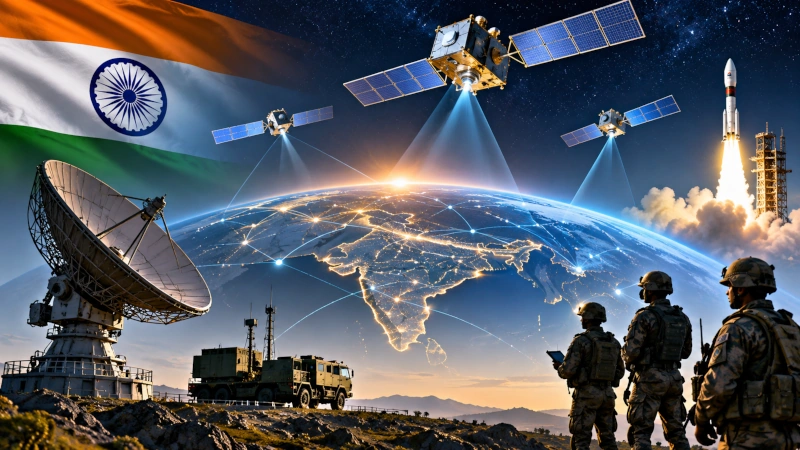
India’s Defence Space Agency (DSA) has emphasised the importance of strengthening indigenous space technologies and aligning domestic industrial capabilities with the operational requirements of the armed forces. Addressing the fifth India International Space Conclave in New Delhi on 24 November 2026, Director General of the Defence Space Agency, Air Vice Marshal Manu Midha, called for closer collaboration between military establishments, defence research institutions and India’s expanding commercial space industry.
The conclave, organised by the Indian Space Association (ISpA) on 23–24 November, brought together representatives of national space agencies, military establishments, research institutions and commercial enterprises. The discussions also featured Major General Brian A. Denaro of the United States Space Force, who addressed the importance of accelerating commercial technology integration and adapting military acquisition processes to the evolving space environment.
Space Emerges as a Critical Domain of National Security
Space-based infrastructure has become increasingly important to national security, supporting military communications, intelligence gathering, surveillance, reconnaissance, navigation and operational coordination. The growing dependence of terrestrial military operations on orbital infrastructure has also increased the importance of protecting space-based assets and ensuring the continuity of essential services during emergencies.
According to his remarks reported by BusinessLine, Air Vice Marshal Midha highlighted the transformation of space from a supporting environment for terrestrial operations into an increasingly contested domain with direct implications for military effectiveness. His address emphasised the requirement for indigenous technologies that can provide reliable access to space-based services under changing strategic conditions.
The development of domestic capabilities across satellite manufacturing, launch services, communications and ground-based infrastructure is therefore closely connected to India’s broader national security objectives. Reducing excessive dependence on external suppliers can strengthen the country’s ability to maintain essential space services during periods of international uncertainty.
Bridging the Gap Between Military Requirements and Industrial Capabilities
The Defence Space Agency chief identified the need for closer alignment between military operational requirements and the technological priorities of India’s space industry. Although the country has developed an increasingly diverse space manufacturing and research ecosystem, translating scientific and industrial achievements into operationally suitable military capabilities remains an important institutional requirement.
Greater interaction between defence establishments, scientists, manufacturers and startups can help ensure that technology development addresses clearly identified operational needs. Such collaboration can also support the development of products that meet the reliability, security and performance standards associated with military applications.
The expansion of India’s commercial space sector provides opportunities to strengthen this relationship. Domestic enterprises are increasingly participating in satellite manufacturing, launch vehicle development, geospatial services, space electronics and associated technologies, creating a broader industrial foundation upon which future defence space capabilities can be developed.
Strengthening Sovereign Space Infrastructure
The availability of dependable space-based services during periods of crisis represents an important consideration in national security planning. Indigenous satellite platforms, secure communications infrastructure, domestic supply chains and launch capabilities can contribute to greater operational autonomy.
Air Vice Marshal Midha’s reported remarks emphasised the importance of designing, developing and manufacturing critical space technologies within India. This approach is consistent with the country’s wider defence indigenisation objectives, which seek to strengthen domestic industrial capabilities while reducing vulnerabilities associated with external dependencies.
Sovereign space capabilities encompass more than the manufacture and launch of satellites. They also require reliable electronic components, specialised software, ground infrastructure, trained personnel and long-term maintenance capabilities. Developing these interconnected elements will be important for establishing a resilient national space ecosystem.
Integrating Space Capabilities Across the Armed Forces
The Defence Space Agency functions within the Headquarters Integrated Defence Staff, providing an institutional framework for cooperation across the Indian Army, Indian Navy and Indian Air Force in matters relating to military space capabilities. Its role reflects the increasing importance of space-based services to joint military operations across different domains.
The Ministry of Defence had previously demonstrated this emphasis through Antariksha Abhyas 2024, India’s maiden dedicated military space exercise, conducted from 11–13 November 2024. According to the ministry’s official assessment, the exercise strengthened coordination, mutual understanding and interoperability between the three services and the Defence Space Agency.
The continued integration of space capabilities across the armed forces represents an important component of India’s evolving joint operational framework. Common institutional standards, coordinated capability development and effective information sharing can contribute to improved cooperation while reducing unnecessary duplication of resources.
United States Emphasises Commercial Space Integration
Speaking at the same conclave, Major General Brian A. Denaro highlighted changes in the United States’ military space acquisition processes and the growing importance of cooperation with commercial technology providers. His reported remarks emphasised the need to accelerate the introduction of emerging technologies rather than depend exclusively on lengthy conventional procurement cycles.
This approach is supported by the United States Space Force’s Commercial Space Strategy, released in April 2024. The official strategy establishes a framework for incorporating commercial technologies and services into government space programmes while addressing operational requirements, technological compatibility, security and long-term capability development.
The strategy recognises the capacity of commercial enterprises to develop and introduce new technologies through comparatively rapid innovation cycles. Its implementation seeks to establish more effective institutional relationships between military organisations and private-sector technology providers.
Space Force Front Door Facilitates Industry Participation
An important institutional mechanism supporting commercial integration in the United States is the Space Force Front Door programme. Operated through the Space Systems Command’s commercial engagement framework, the initiative provides companies with a central point of access for engaging with military space organisations and identifying relevant acquisition opportunities.
The programme assists enterprises in understanding government requirements, navigating procurement processes and connecting with appropriate technology development and acquisition organisations. It also facilitates engagement between government representatives and commercial companies through dedicated industry events.
In 2026, the Space Systems Command announced the expansion of Front Door services to support the United States Space Command. The development reflects the continuing effort to improve institutional access to commercial innovations and strengthen cooperation between government organisations and the wider space industry.
Commercial Technologies and Space Domain Awareness
The expansion of commercial space activities has created new opportunities for cooperation in monitoring the orbital environment. Commercial satellite operators, observation networks and data analytics companies can provide information relevant to understanding the movement of space objects and maintaining awareness of changing orbital conditions.
The United States Space Force has established institutional mechanisms for integrating commercially generated information into its space domain awareness activities. These initiatives include engagement with private-sector data providers and international partners through programmes such as Joint Commercial Operations.
Such cooperation demonstrates the growing importance of commercial capabilities in supporting the safe and reliable use of space. It also highlights the need for appropriate information-sharing frameworks, technical standards and security arrangements as government organisations increasingly engage with private space enterprises.
India–US Cooperation in the Evolving Space Ecosystem
The participation of senior Indian and American military space officials at the India International Space Conclave reflects the growing significance of space technology within international strategic and industrial discussions. Both countries possess established national space programmes and increasingly active commercial space sectors, providing opportunities for institutional engagement and exchanges of experience.
The United States Space Force’s International Partnership Strategy, released in June 2025, formally identifies international cooperation as an important component of its broader institutional objectives. The strategy complements its commercial engagement framework by recognising the role of cooperation with allies and partners in developing resilient space capabilities.
However, the discussions at the New Delhi conclave should not be interpreted as the announcement of a new bilateral military space agreement. Their significance lies in the exchange of perspectives concerning indigenous capability development, commercial integration and the evolving institutional requirements of national space security.
Opportunities for India’s Emerging Defence Space Industry
India’s expanding space industry provides a foundation for greater domestic participation in the development of specialised defence technologies. Opportunities encompass satellite platforms, secure communications, space electronics, advanced sensors, optical systems, data processing and space situational awareness.
The growing participation of startups, research institutions and established manufacturing enterprises can contribute to a more diversified technological ecosystem. Effective coordination with defence establishments will remain important in ensuring that industrial innovation translates into reliable products suited to clearly defined national requirements.
The development of indigenous capabilities must also be supported by appropriate testing infrastructure, transparent procurement mechanisms and sustained research investment. Establishing these institutional foundations can help Indian enterprises progress from individual technological demonstrations towards dependable and commercially sustainable manufacturing capabilities.
Building a Resilient and Self-Reliant Defence Space Ecosystem
The discussions at the fifth India International Space Conclave underline the increasing importance of cooperation between military organisations and commercial space enterprises. As national security becomes more closely connected to space-based infrastructure, the ability to develop, manufacture and sustain essential technologies domestically assumes greater strategic significance.
India’s established scientific institutions, growing private-sector capabilities and expanding defence manufacturing ecosystem provide a foundation for strengthening national space security. Closer collaboration between these institutions can help bridge the gap between technological innovation and operational requirements while supporting the development of resilient infrastructure.
Through sustained indigenous research, industrial participation and responsible international cooperation, India can strengthen its technological autonomy in space while contributing to the safe and sustainable utilisation of the orbital environment. The integration of scientific expertise, industrial capacity and institutional planning represents an important step towards a more secure and self-reliant national space ecosystem.
References
- Indian Space Association — Fifth India International Space Conclave, New Delhi, 23–24 November 2026, official event programme.
- Press Information Bureau, Government of India — Official proceedings of the fifth India International Space Conclave, 24 November 2026.
- Ministry of Defence — Defence Space Agency Successfully Conducts Maiden Exercise Antariksha Abhyas 2024, November 2024.
- United States Space Force — Commercial Space Strategy, April 2024.
- United States Space Force — International Partnership Strategy, June 2025.
- United States Space Systems Command — Commercial Space Office and Space Force Front Door programme.
- United States Space Systems Command — Expansion of Space Force Front Door Services to US Space Command, 2026.
- BusinessLine — Dalip Singh, reporting on the addresses of Air Vice Marshal Manu Midha and Major General Brian A. Denaro, 24 November 2026.
You may also like
-
Garuda Aerospace Explores Joint Drone Development With Israeli Defence Companies
-
Vayuvya Defence Successfully Test-Fires Indigenous Vayu 250 Micro Jet Engine
-
DRDO and Singapore Explore Quantum and Underwater Technology Cooperation
-
DRDO Awards Laser-Based Drone Communication Contract to olee.space
-
IG Defence Successfully Test-Fires Indigenous JWALA MK-1 Counter-Drone Missile at Pokhran
