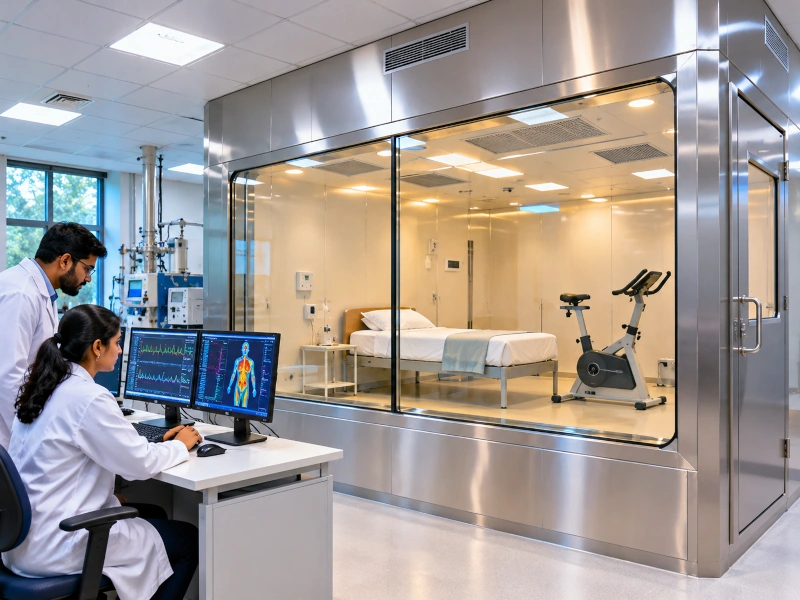
India has inaugurated its first dedicated Human Metabolic Chamber at Christian Medical College (CMC), Vellore, Tamil Nadu, marking an important development in the country’s biomedical research infrastructure. Union Health Secretary Punya Salila Srivastava inaugurated the facility on 23 November 2026. Jointly established by the Tata Institute of Fundamental Research (TIFR) and CMC Vellore, the chamber will support scientific investigations into nutrition, energy metabolism, diabetes, obesity and associated metabolic disorders.
Understanding Human Metabolism in a Controlled Environment
The Human Metabolic Chamber is a room-sized calorimeter designed to monitor human energy expenditure by measuring oxygen consumption and carbon dioxide production. Research participants can remain inside the chamber for 24 hours or longer while undertaking routine activities such as eating, sleeping and exercising. These measurements allow scientists to examine how the human body uses carbohydrates and fats to meet its energy requirements under different physiological conditions.
Unlike conventional metabolic measurements conducted over shorter periods, whole-room calorimetry allows researchers to observe changes in energy utilisation throughout an extended period. This provides opportunities to investigate the relationship between dietary intake, physical activity, sleep and metabolic function within a controlled research environment.
Strengthening India’s Metabolic Research Capabilities
The chamber complements the National Analytical Facility for Nutrition and Metabolism Research established in 2025 by the Advanced Research Unit on Metabolism, Development and Aging (ARUMDA). The integration of these facilities will allow researchers to correlate whole-body energy expenditure with biochemical and molecular observations, helping bridge the gap between laboratory investigations and human physiology.
The availability of such research infrastructure within India creates opportunities to investigate metabolic characteristics across diverse population groups. Researchers can examine how differences in dietary patterns, nutritional history, physical activity and physiological characteristics influence metabolic health, generating evidence relevant to Indian conditions.
Advancing Research Into Diabetes and Obesity
Metabolic disorders represent a complex public health challenge influenced by interactions between genetics, nutrition, lifestyle and environmental conditions. Understanding these interactions requires detailed investigations into how the body processes nutrients, regulates blood glucose and stores or expends energy. The new facility provides researchers with an additional scientific instrument for examining these mechanisms.
The collaboration builds upon CMC Vellore’s clinical experience in endocrinology and previous investigations into insulin sensitivity, energy expenditure, childhood undernutrition and low birth weight. Combining clinical knowledge with advanced metabolic measurements could help researchers better understand the relationship between early-life nutritional conditions and metabolic health during adulthood.
Institutional Collaboration and International Scientific Support
The Department of Atomic Energy provided financial support for establishing the facility, supplemented by corporate social responsibility funding from Hindustan Unilever Limited. Technical expertise was provided by NUTRIM at Maastricht University in the Netherlands, while the Netherlands Embassy in India supported the development of institutional connections.
The initiative demonstrates the value of collaboration between fundamental scientific research institutions, medical institutions, industry and international academic partners. Such partnerships enable the development of specialised research infrastructure while facilitating the exchange of scientific knowledge and technical expertise.
Supporting Evidence-Based Preventive Healthcare
During the inauguration, the Union Health Secretary emphasised the importance of generating scientific evidence that reflects India’s population diversity and specific metabolic risk profiles. Research findings derived from other populations may not fully account for differences in Indian dietary practices, nutritional backgrounds and physiological characteristics.
India-specific metabolic research could contribute to the development of more relevant nutritional recommendations, disease prevention strategies and public health interventions. The chamber also provides opportunities for investigating how changes in dietary composition and physical activity influence energy utilisation, potentially informing future approaches to managing lifestyle-associated health conditions.
The Health Secretary encouraged collaboration with national research institutions, including the Pan-AIIMS Research Consortium. Wider institutional participation could help develop comprehensive metabolic datasets and strengthen coordination between fundamental research, clinical investigations and preventive healthcare programmes.
Building a Foundation for Precision Nutrition
The establishment of the Human Metabolic Chamber creates new opportunities for research into precision nutrition, an emerging approach that seeks to understand how individual physiological characteristics influence responses to food and dietary interventions. By studying energy expenditure and nutrient utilisation under controlled conditions, researchers can investigate why individuals may respond differently to similar dietary and lifestyle patterns.
Over time, such investigations could contribute to more personalised nutritional recommendations and improved understanding of metabolic risk factors. The facility also offers opportunities for interdisciplinary research and specialised training across nutrition science, endocrinology, physiology, biochemistry and biomedical technology.
A New Milestone in India’s Biomedical Research Infrastructure
The inauguration of India’s first dedicated Human Metabolic Chamber represents a significant addition to the country’s scientific and medical research capabilities. By bringing together advanced instrumentation, fundamental science and clinical expertise, the initiative provides a platform for investigating some of the most important questions surrounding human nutrition and metabolic health.
The facility strengthens India’s capacity to generate locally relevant scientific evidence and develop research-driven approaches to preventive healthcare. Continued collaboration between medical institutions, scientific organisations and public health authorities offers a promising foundation for advancing metabolic research, improving nutritional understanding and building a healthier India.
Reference
Press Information Bureau, Ministry of Health and Family Welfare, Government of India — Union Health Secretary Smt. Punya Salila Srivastava inaugurates India’s first dedicated Human Metabolic Chamber Facility at Christian Medical College (CMC) Vellore.
Published: 23 November 2026, 4:23 PM IST.
PIB Release ID: 2340358.
https://www.pib.gov.in/PressReleasePage.aspx?PRID=2340358&lang=1®=48
You may also like
-
Indian Scientists Develop Solar-Driven Material to Remove Pollutants
-
ICMR’s SAMPADA Survey Reports Lower Anaemia Prevalence Across India
-
Ayurveda During Summer: Cooling Without Weakening Digestion
-
India Highlights Genome Research Covering 10,000 Individuals Across 84 Populations
-
India Proposes Stricter Pharmaceutical Storage and Distribution Rules to Strengthen Medicine Quality
