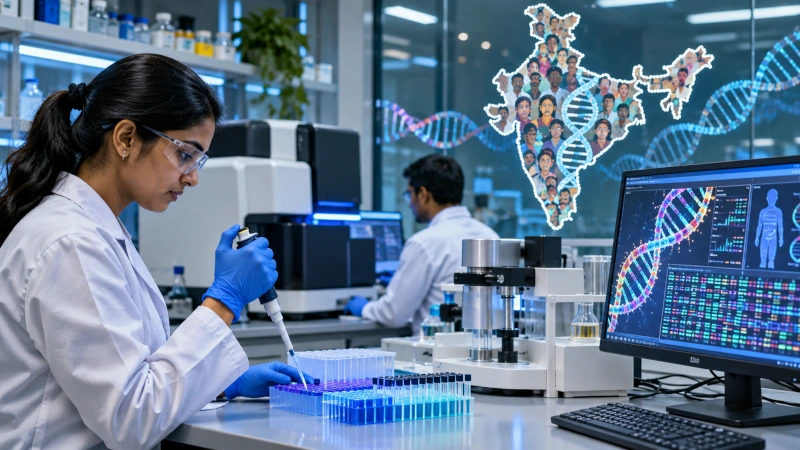
India’s genome sequencing programme is emerging as an important scientific resource for understanding genetic diversity, identifying disease susceptibility and advancing precision medicine. Union Minister of State (Independent Charge) for Science and Technology Dr. Jitendra Singh highlighted the sequencing of approximately 10,000 Indian individuals representing 84 population groups while addressing THE WEEK Health Summit 2026 in New Delhi on 22 November.
The Minister emphasised that India’s healthcare research is increasingly moving beyond conventional treatment towards preventive strategies, early disease detection and personalised medical interventions. He identified advances in molecular biology, genetic research and biotechnology as important foundations for developing more targeted approaches to managing complex diseases.
The sequencing milestone is part of the Department of Biotechnology’s established GenomeIndia programme. The government had already announced the completion of sequencing more than 10,000 Indian genomes before November 2026, with the genomic dataset formally dedicated to researchers on 9 January 2025.
Understanding India’s Genetic Diversity
India possesses one of the world’s most diverse population structures, shaped by thousands of years of migration, geographical separation, population histories and social interactions. These factors have contributed to substantial genetic variation across different communities, making India an important setting for studying human genetics and inherited disease risks.
During his address, Dr. Jitendra Singh stated that genome sequencing had been undertaken for approximately 10,000 individuals belonging to 84 population groups. He also referred to more than 400 genetic traits across different populations, highlighting the opportunities for research into disease susceptibility and personalised medical interventions.
The GenomeIndia initiative aims to develop a comprehensive understanding of genetic variations found among Indian populations. Such information can help researchers investigate how particular genetic variants are distributed across communities and whether they are associated with inherited conditions, biological characteristics or differences in disease susceptibility.
Genome sequencing involves determining the sequence of DNA contained within an individual’s genome. By comparing genomic information from thousands of individuals, scientists can identify variations that may influence biological processes, disease development or responses to particular medical treatments.
This research is especially relevant for India because international genomic databases have historically contained uneven representation of different populations. Developing an indigenous genomic reference resource can help Indian researchers investigate genetic variations that may be insufficiently represented in datasets assembled elsewhere.
GenomeIndia Builds a National Genetic Research Resource
The GenomeIndia project is a flagship initiative funded by the Department of Biotechnology under the Ministry of Science and Technology. It brings together academic and scientific institutions to create a national genomic reference resource representing India’s population diversity.
In a parliamentary reply issued on 19 March 2025, the Department of Biotechnology reported the sequencing of 10,074 healthy individuals drawn from 83 heterogeneous populations across 99 sampling locations. The department explained that the information was being used to develop a catalogue of genetic variations relevant to scientific and medical research.
A subsequent government statement issued on 30 July 2026 reported that GenomeIndia had completed 10,174 whole-genome sequences and identified nearly 180 million genetic variants, including approximately seven million novel variants.
These findings provide an extensive foundation for investigating genetic characteristics among Indian populations. Researchers can use the information to examine patterns of variation, identify potentially important genetic markers and investigate their relationships with disease risk.
However, discovering a genetic variant does not automatically establish that it causes disease. Further scientific investigation, clinical studies and validation are necessary before particular findings can be used reliably in medical diagnosis or treatment.
Indian Biological Data Centre Supports Genomic Research
An important component of GenomeIndia is the Indian Biological Data Centre (IBDC), established by the Department of Biotechnology as a national repository for biological research data.
The centre provides infrastructure for storing, managing and facilitating access to genomic information generated by Indian research programmes. GenomeIndia sequencing data has been archived at the facility to support further scientific investigation and the development of applications in biotechnology and healthcare.
The government formally dedicated the GenomeIndia dataset to researchers on 9 January 2025. The initiative was accompanied by the operationalisation of data-access infrastructure and the Framework for Exchange of Data protocols, intended to support responsible scientific use of biological information.
According to the Department of Biotechnology, the availability of this national genomic resource is expected to support the development of indigenous diagnostic technologies, genetic research tools and potential therapeutic applications.
Access to genomic information must also follow appropriate ethical and data-governance requirements. Genetic information is sensitive, and its use requires safeguards relating to privacy, consent, secure storage and responsible interpretation.
By establishing domestic infrastructure for genomic data, India is strengthening its ability to undertake large-scale biological research while building expertise in computational biology, bioinformatics and medical genetics.
Precision Medicine and Personalised Healthcare
One of the most promising applications of population-scale genomic research is precision medicine, an approach that considers differences in genetic characteristics, environmental exposures and lifestyle when designing healthcare interventions.
During the November 22 summit, Dr. Jitendra Singh explained that patients with the same disease may require different treatment approaches because of variations in their underlying biology and individual circumstances.
Genomic research can contribute to identifying inherited disease risks, understanding variations in drug metabolism and developing more precise diagnostic methods. In certain medical conditions, genetic testing already plays an important role in determining appropriate treatment strategies.
For India, a better understanding of population-specific genetic variation could eventually help improve diagnostic accuracy and support the development of medical technologies suited to the country’s diverse population.
The GenomeIndia dataset also provides opportunities to investigate rare genetic conditions that may occur more frequently within particular population groups. Identifying relevant genetic variants could assist researchers in developing targeted screening methods and improving the scientific understanding of inherited disorders.
Nevertheless, genomic information alone cannot predict every disease or determine the most effective treatment for every patient. Precision medicine requires integration with clinical evidence, environmental information, lifestyle factors and validated medical practices.
Research Into Disease Susceptibility and Early Detection
The government has increasingly emphasised preventive healthcare as metabolic disorders and other chronic diseases affect younger sections of India’s population.
Speaking at THE WEEK Health Summit, Dr. Jitendra Singh expressed concern about the growing prevalence of diabetes, obesity, hypertension and cardiovascular diseases. He identified early detection and scientific investigation into disease mechanisms as important components of India’s healthcare strategy.
The Minister also discussed ongoing research into biomarkers among women with a history of gestational diabetes. Such research seeks to identify individuals who may face an elevated risk of developing Type 2 diabetes later in life, potentially supporting earlier monitoring and preventive interventions.
GenomeIndia and related molecular research initiatives can contribute to this broader scientific approach by providing researchers with information about biological variations and their possible relationships with disease.
However, many common chronic diseases arise through complex interactions between genetic and non-genetic factors. Research findings must therefore be interpreted alongside established clinical evidence and public-health considerations.
Expanding Indigenous Genomics and Biotechnology Research
India’s genomic research initiatives are increasingly connected with developments in artificial intelligence, computational biology and advanced medical technologies.
In July 2026, the Department of Biotechnology informed Parliament that research programmes were using artificial intelligence and machine learning to analyse biological information and explore applications in precision diagnostics.
The government also reported the establishment of a national genomic variation catalogue and a biobank containing more than 20,000 biospecimens under GenomeIndia.
These resources can support research into genetic associations, biological mechanisms and diagnostic development. Advanced computational techniques can help scientists analyse large datasets, identify patterns and prioritise genetic variants for further investigation.
The integration of genomics with bioinformatics and artificial intelligence could also create opportunities for Indian universities, biotechnology companies, research institutions and medical technology developers.
Such applications remain dependent on the quality of research data, appropriate validation and effective collaboration between laboratory scientists, clinicians and computational researchers.
Strengthening Research into Rare Genetic Diseases
During the summit, Dr. Jitendra Singh also referred to government efforts, including work involving the Indian Council of Medical Research, to improve the diagnosis and treatment of rare genetic diseases.
Rare inherited conditions frequently present significant challenges because of limited diagnostic facilities, complex disease mechanisms and the high cost of specialised treatments.
Improved genomic information can help researchers identify disease-associated variants and investigate conditions that may otherwise remain difficult to diagnose.
The Minister highlighted India’s progress in genetic therapies and referred to haemophilia gene therapy research undertaken at Christian Medical College, Vellore.
Such developments illustrate the increasing capabilities of Indian biomedical researchers to investigate advanced treatment approaches. However, experimental gene therapies require extensive clinical evaluation and regulatory approval before they can become routinely available to patients.
The expansion of genomic research infrastructure could strengthen the scientific foundations for future work in rare-disease diagnosis, genetic counselling and treatment development.
India’s Growing Role in Genomic Science
The GenomeIndia programme represents a coordinated effort to build a national scientific resource that reflects the genetic diversity of Indian populations.
Its significance extends beyond the sequencing of individual genomes. The creation of genomic databases, biobanking infrastructure, computational research facilities and institutional collaborations provides a foundation for continued scientific investigation.
The Department of Biotechnology has emphasised the importance of using these resources to encourage translational research, in which scientific discoveries are investigated for potential applications in healthcare and industry.
The development of indigenous genomic research capabilities could reduce dependence on population reference datasets assembled primarily outside India while supporting the creation of diagnostic tools and technologies informed by Indian genetic diversity.
As research advances, maintaining scientific rigour, ethical oversight and responsible data governance will be essential to translating genomic findings into reliable medical applications.
Advancing India’s Future Healthcare Capabilities
India’s genome sequencing initiative demonstrates the growing importance of genomics in the country’s biomedical research ecosystem. By developing a national reference resource covering more than 10,000 individuals, the Department of Biotechnology has provided scientists with a foundation for investigating genetic diversity, inherited diseases and potential applications in precision medicine.
The renewed emphasis placed on GenomeIndia during THE WEEK Health Summit on 22 November 2026 reflects the government’s broader focus on preventive healthcare, molecular research and early disease detection.
Although the sequencing milestone was achieved earlier, the continued development and scientific use of this genomic resource could contribute to advances in diagnostics, genetic counselling, disease research and personalised medical interventions.
With sustained investment in biotechnology, responsible data management and collaboration between research institutions and healthcare professionals, India’s genomic research ecosystem has the potential to strengthen indigenous medical innovation and support more precise, accessible and evidence-based healthcare.
You may also like
-
Pollen from Wetland of Bandhavgarh Tiger Reserve Regenerative Capacity of Tropical Forest Ecosystems
-
IIT Kanpur Scientists Discover Immune-Cell Mechanism That Can Rapidly Suppress Insulin Release
-
A New Recipe to Shape Magnetisation that Could Open New Doors to Storing Quantum Information
-
ICAR Inaugurates Advanced Genome Editing Research Centre for Horticultural Crops in Bengaluru
-
Himalayan marmot droppings could reveal clues about climate change
