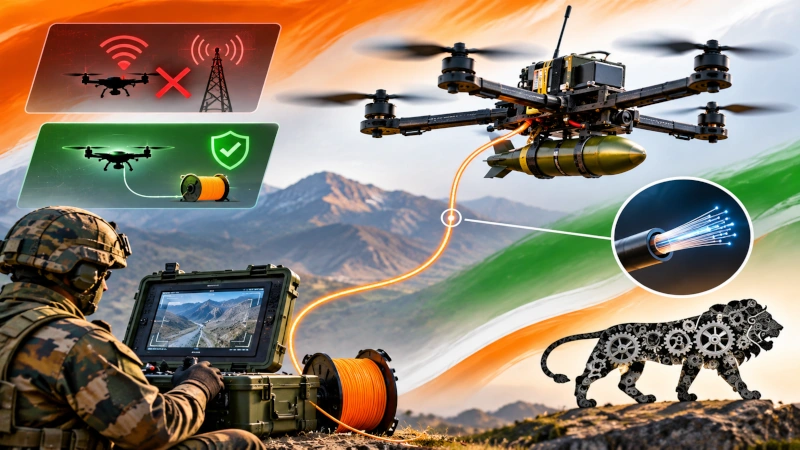
Indian defence technology company IG Defence has announced the successful qualification of its indigenously designed 2.5 kg anti-personnel warhead during Indian Army trials. The warhead was integrated with the company’s VALARI 1.5 OFC unmanned aerial platform, marking a reported milestone in the development of domestically manufactured payloads for tactical combat drones.
The company announced the development on 20 November 2026, stating that the proprietary warhead had undergone successful testing as part of the Indian Army’s evaluation process. The announcement highlights the growing involvement of India’s private defence industry in developing specialised unmanned combat systems and associated technologies.
The trial represents an important development for IG Defence’s indigenous drone technology programme. However, the company-reported qualification has not yet been independently confirmed through a separate Indian Army or Ministry of Defence announcement.
Indigenous Warhead Integrated With VALARI 1.5 OFC Drone
The 2.5 kg anti-personnel warhead was developed by IG Defence using its proprietary design and integrated with the VALARI 1.5 OFC platform.
The VALARI system is an optical-fibre-controlled unmanned aerial vehicle designed for tactical military applications. Unlike conventional drones that rely primarily on radio-frequency communication links, optical-fibre-controlled platforms use a physical fibre-optic connection to transmit control signals and video feeds between the drone and its operator.
This configuration offers advantages in electronically contested environments because the control connection does not depend on conventional radio-frequency communication. As a result, optical-fibre-controlled drones can be less vulnerable to certain forms of radio-frequency jamming and electronic interference.
Such capabilities have attracted increasing attention in modern military operations, where electronic warfare systems can disrupt communications between conventional drones and their operators.
The integration of an indigenously developed payload with an optical-fibre-controlled platform demonstrates IG Defence’s efforts to develop both unmanned aerial systems and specialised equipment intended for military applications.
Company Reports Successful Indian Army Trial Qualification
According to IG Defence’s announcement, the integrated system successfully qualified during trials conducted by the Indian Army.
The reported evaluation marks a development milestone for the company, indicating progress in testing the compatibility of its domestically designed warhead with the VALARI unmanned platform.
Military trials generally assess whether equipment meets specified technical, functional and operational requirements. Such evaluations are an important part of the process through which defence technologies are examined before potential procurement decisions.
However, successful qualification during trials does not automatically establish that a system has been approved for large-scale production, selected for procurement or inducted into operational service.
IG Defence has not publicly disclosed a corresponding Indian Army procurement contract, the number of systems that might be acquired or any production delivery schedule.
The available announcement should therefore be understood as confirmation of the company’s reported trial achievement rather than evidence of a completed military acquisition.
Optical-Fibre-Controlled Drones Gain Importance in Modern Warfare
Optical-fibre-controlled unmanned aircraft have emerged as an important area of development in military drone technology.
Conventional first-person-view drones commonly depend on radio-frequency connections for command transmission and video communication. These wireless links can be affected by electronic warfare equipment designed to interfere with navigation, control and communication signals.
Fibre-optic systems address some of these challenges by establishing a physical connection between the aircraft and its control equipment. Data can be transmitted through the cable without relying on the same radio-frequency channels used by conventional remotely piloted drones.
This approach can improve resistance to certain electronic countermeasures while maintaining a communication connection between the operator and the aircraft.
Nevertheless, optical-fibre-controlled platforms also have operational limitations. Their effective deployment depends on factors including cable length, physical handling, environmental conditions and the possibility of damage to the fibre connection.
The technology therefore represents a specialised capability within the broader unmanned aerial systems ecosystem rather than a universal replacement for conventional wireless drones.
For the Indian armed forces, research into alternative drone communication technologies is relevant to the increasing importance of operating unmanned systems in environments affected by electronic interference.
Growing Role of Indian Private Companies in Drone Development
IG Defence’s reported achievement reflects the expanding participation of Indian private companies in the development of military unmanned aerial systems.
India’s defence manufacturing ecosystem has witnessed growing activity in areas including tactical reconnaissance drones, autonomous aerial platforms, electronic warfare systems, surveillance equipment and specialised unmanned vehicle components.
Domestic companies are increasingly developing integrated systems that combine airframes, communication equipment, control technologies and mission-specific payloads.
The ability to design and test such systems within India can support the broader objective of reducing dependence on imported military technologies.
IG Defence has also been developing other indigenous unmanned aerial platforms, including its KAL long-range one-way attack drone programme.
These projects represent the company’s efforts to establish capabilities across different categories of unmanned military technology, ranging from tactical systems to longer-range platforms.
The VALARI 1.5 OFC programme is particularly relevant because it combines an alternative communication architecture with a domestically developed payload.
Supporting Make in India and Defence Self-Reliance
The development of indigenous drone platforms and associated components is closely connected with India’s efforts to strengthen domestic defence manufacturing under the Make in India and Atmanirbhar Bharat initiatives.
Unmanned aerial systems have become an increasingly important component of military modernisation because of their applications in surveillance, reconnaissance, communications and other operational tasks.
Developing these capabilities domestically involves multiple areas of engineering, including aerodynamics, electronics, software, communication systems, materials and manufacturing technologies.
Indian companies working in these fields can contribute to the creation of a broader industrial ecosystem capable of supporting military requirements through domestic research, development and production.
The availability of locally developed components may also create opportunities for specialised manufacturers, engineering startups and technology suppliers to participate in defence industry supply chains.
The development of indigenous payloads alongside domestically designed unmanned platforms is one element of this wider industrial effort.
Further Evaluation and Procurement Decisions Awaited
Although IG Defence has announced successful qualification during Indian Army trials, further information will be required to establish the next stage of the VALARI 1.5 OFC programme.
An official confirmation from the Indian Army or Ministry of Defence would provide additional clarity regarding the evaluation results and the system’s status within the military acquisition process.
Similarly, any future procurement decision would require confirmation through an appropriate government announcement or company disclosure.
There is currently no verified public announcement establishing that the Indian Army has ordered the system, approved mass production or inducted it into active service.
Nevertheless, the company’s reported successful trial represents progress in its development of indigenous tactical unmanned systems.
Strengthening India’s Indigenous Unmanned Systems Ecosystem
The development reported by IG Defence demonstrates the growing technological ambitions of India’s private defence manufacturing sector.
By combining a domestically designed 2.5 kg warhead with an optical-fibre-controlled drone platform, the company is pursuing capabilities relevant to the changing requirements of modern military operations.
The reported Indian Army trial qualification provides a potential foundation for further testing, evaluation and technological refinement.
As India continues to strengthen its indigenous defence industry, advances in unmanned platforms, electronic systems and locally developed components can contribute to a more diversified and technologically capable manufacturing ecosystem.
IG Defence’s latest announcement represents another encouraging development in India’s expanding private-sector defence innovation landscape and its pursuit of greater self-reliance in advanced military technologies.
You may also like
-
Israel’s 11 Defence Companies Engage Indian Army and Industry on Advanced Battlefield Technologies
-
Indian Army and ITBP Source Essential Supplies from Arunachal Border Villages to Strengthen Rural Economy
-
Singer India to Commence Manufacturing at New Bhiwadi Facility
-
Bihar Plans Two Nuclear Power Plants With ₹1.4 Lakh Crore Investment
-
Pinaka Aerospace Emerges L1 for DRDO’s Airborne Radar Testing System Procurement
