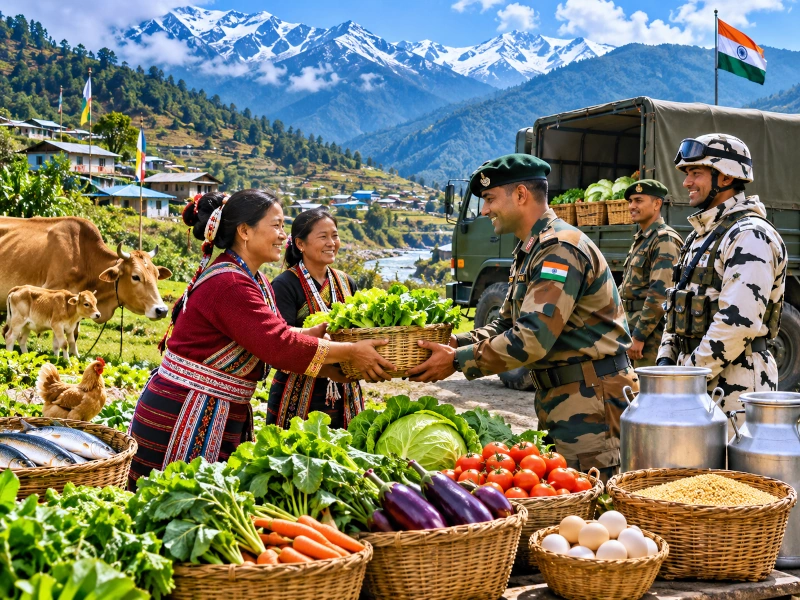
The Indian Army and Indo-Tibetan Border Police (ITBP) are procuring essential food supplies from villages and cooperative institutions in Arunachal Pradesh, strengthening local agricultural markets while supporting economic development in strategically important border regions.
Union Home and Cooperation Minister Amit Shah highlighted the initiative while addressing a cooperative development programme at the Dorjee Khandu State Convention Centre in Itanagar on Sunday. He said the Ministry of Home Affairs had taken measures to ensure that security forces stationed in border areas source essential supplies from local communities and their cooperative institutions.
The initiative brings together two important national priorities: strengthening India’s border security infrastructure and promoting economic self-reliance among communities living in remote frontier regions.
Security Forces Support Local Agricultural Communities
According to the Ministry of Cooperation, Army and ITBP personnel are procuring vegetables, eggs, milk and other essential commodities from villages in Arunachal Pradesh.
Local women and cooperative societies are supplying dairy products, vegetables, millets, flour and other agricultural commodities to meet the requirements of security personnel.
The arrangement provides local producers with access to institutional buyers while reducing the need to transport certain essential supplies over long distances from other regions.
Arunachal Pradesh’s mountainous terrain, dispersed settlements and difficult geographical conditions can make agricultural marketing and transportation challenging. Local procurement creates an opportunity for farming communities to participate more directly in the supply chains serving security establishments.
Regular institutional demand could also encourage farmers and cooperative societies to improve production planning, storage and distribution capabilities.
Strengthening the Vibrant Villages Programme
The procurement initiative is closely connected with the government’s broader efforts to strengthen infrastructure, livelihoods and essential services in India’s border villages.
Speaking at the event, Amit Shah highlighted the progress of the Vibrant Villages Programme, which seeks to improve living conditions and economic opportunities in strategically important frontier settlements.
He stated that villages along Arunachal Pradesh’s border with China, which had previously experienced outward migration, were beginning to witness the return of residents.
According to the Minister, 40 border villages that had experienced migration were now seeing people return as improvements in electricity, drinking water, education, healthcare and employment opportunities made these settlements more viable.
The procurement of locally produced agricultural commodities by security forces forms part of this broader approach.
By connecting local livelihoods with the requirements of institutions operating in border regions, the initiative seeks to make economic development a sustained feature of frontier infrastructure planning.
Cooperative Societies Become Important Supply Partners
Cooperative institutions are expected to play an important role in developing local agricultural production and connecting farmers with organised buyers.
The Ministry of Cooperation reported that more than 56,000 people in Arunachal Pradesh are associated with cooperative institutions.
The state’s cooperative network includes 185 Primary Agricultural Credit Societies, 52 dairy cooperative societies and 43 fisheries cooperative societies.
These institutions provide an organisational framework through which agricultural producers can coordinate activities, develop collective marketing arrangements and improve access to financial and technical assistance.
Women-led cooperative institutions and Self-Help Groups are particularly important to this effort because they can help organise smaller producers and connect household-level economic activities with larger markets.
The participation of security forces as institutional buyers creates an opportunity to strengthen these existing cooperative networks.
Arunachal Pradesh Targets Self-Reliance in Dairy, Fisheries and Livestock
Beyond agricultural procurement for security forces, the Union Home Minister urged Arunachal Pradesh to develop greater self-reliance in milk, eggs, meat and fish production.
He observed that increasing local production could reduce the state’s dependence on supplies transported from outside Arunachal Pradesh.
According to the Minister, achieving self-reliance in these four sectors could help at least 32,000 families become economically self-reliant.
He called for the development of dairy cooperatives and fisheries institutions, supported by appropriate infrastructure, financing and market linkages.
The National Cooperative Development Corporation and NABARD were identified as institutions that could provide financial support for cooperative development.
The Minister also indicated that the National Dairy Development Board and Amul would support the procurement of locally produced milk. Representatives of these organisations are expected to assist in preparing a district-level roadmap for dairy development.
Plans for establishing milk-processing facilities within Arunachal Pradesh were also discussed.
These measures remain development objectives requiring further implementation, but they indicate a broader effort to create organised agricultural markets within the state.
Connecting National Security with Border Village Development
Arunachal Pradesh occupies an important position in India’s northeastern frontier and shares an international boundary with China.
Security forces operating in remote border areas require dependable supplies of food and other essential commodities, often under challenging geographical and climatic conditions.
Developing reliable local supply networks offers potential benefits for both military logistics and nearby civilian communities.
For security establishments, local procurement can complement established supply arrangements by providing access to fresh agricultural produce from nearby locations.
For farmers, organised institutional demand can create marketing opportunities that may otherwise be difficult to access because of transportation costs, limited infrastructure and geographical isolation.
The initiative can also strengthen everyday interaction between security personnel and local residents, contributing to closer relationships between frontier communities and the institutions responsible for safeguarding India’s borders.
However, the scale of procurement, quantities purchased and financial benefits delivered to individual farming households have not yet been detailed in the official announcement.
A Development Model for India’s Frontier Regions
The local procurement initiative reflects a broader understanding that effective border management involves more than military infrastructure and security deployments.
Economic opportunities, dependable public services, agricultural development and the continued presence of thriving local communities are also important to the long-term development of frontier regions.
By connecting agricultural producers and cooperative institutions with the requirements of the Indian Army and ITBP, the government is seeking to establish stronger economic links between border settlements and the institutions operating nearby.
The approach offers opportunities for rural entrepreneurs, dairy producers, farmers and women-led cooperative organisations to participate in local supply chains.
As cooperative infrastructure and agricultural production expand, such arrangements could help create more resilient rural economies while complementing the logistical requirements of India’s security forces.
The development represents a constructive example of how agricultural self-reliance, community participation and national security can reinforce one another, strengthening both the livelihoods of border residents and the long-term development of India’s northeastern frontier.
You may also like
-
Mizo Chilli: Mizoram’s Fiery Bird’s Eye Chilli and Its Geographical Indication Heritage
-
Singer India to Commence Manufacturing at New Bhiwadi Facility
-
Bihar Plans Two Nuclear Power Plants With ₹1.4 Lakh Crore Investment
-
Pinaka Aerospace Emerges L1 for DRDO’s Airborne Radar Testing System Procurement
-
NSE Becomes World’s Fifth-Largest Listed Exchange Operator by Market Capitalisation
