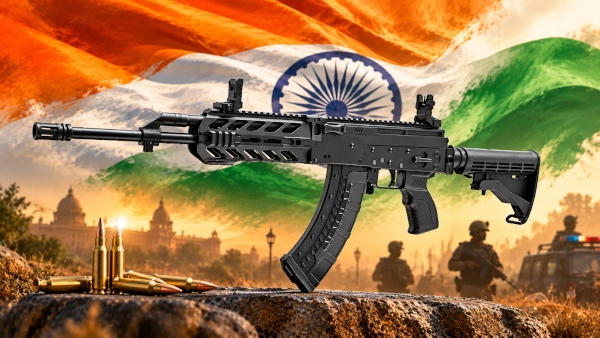
Bengaluru-based defence manufacturer SSS Defence Technologies has reportedly emerged as the lowest (L1) bidder in an Indian Army procurement process for indigenous 12-gauge semi-automatic counter-drone shotguns. The development, reported on November 19–20, reflects the Army’s growing emphasis on locally manufactured weapons designed to counter low-flying unmanned aerial vehicles, particularly first-person-view (FPV) drones that have become an increasingly prominent threat in modern warfare.
Recent defence reports have linked the procurement to a requirement for 84 T-12 semi-automatic shotguns, along with associated ammunition and accessories. However, an earlier Government e-Marketplace (GeM) tender, identified as GEM/2026/B/7776827, specifies 81 counter-drone shotguns and associated counter-unmanned aerial system ammunition. Available tender-result records identify SSS Defence as the lowest bidder for that procurement, although it remains unclear whether the recently reported 84-unit requirement represents a separate tender or a revision of the earlier quantity.
The reported L1 selection represents a procurement development rather than a confirmed new supply contract. A formal contract award, its value and the delivery schedule for the latest requirement have not been independently established.
Indigenous T-12 Shotgun Designed for Counter-Drone Operations
SSS Defence has developed the T-12 as an indigenous 12-gauge semi-automatic shotgun intended for military applications, including close-range engagements against small unmanned aerial vehicles. The weapon is designed to provide soldiers with a portable means of engaging drones operating at low altitudes and within relatively short distances.
The T-12 uses a gas-operated semi-automatic mechanism that allows successive rounds to be fired without manually cycling the action after each shot. This capability is relevant to counter-drone operations, where personnel may have limited opportunities to respond to fast-moving aerial targets.
Unlike conventional small arms that fire individual projectiles, shotguns can employ ammunition containing multiple pellets. The resulting spread offers a different engagement mechanism against small aerial targets, although effectiveness depends on factors such as target distance, ammunition characteristics, movement and environmental conditions.
Reports concerning the T-12 describe the use of specialised ammunition, including hardened steel pellets, for counter-drone applications. Such ammunition is intended to increase the probability of striking small unmanned aircraft within the weapon’s effective engagement envelope.
The shotgun is therefore positioned as a close-range defensive weapon rather than a replacement for dedicated electronic warfare systems, air-defence missiles or other specialised counter-unmanned aircraft technologies.
Indian Army Expands Close-Range Counter-Drone Capabilities
The growing use of small drones in military operations has increased the importance of developing effective countermeasures at multiple engagement ranges. FPV drones, in particular, present challenges because they can be relatively inexpensive, manoeuvrable and capable of approaching military positions at low altitudes.
Conventional air-defence systems are generally designed to counter a broader range of aerial threats, including aircraft, helicopters and missiles. Employing sophisticated missile systems against every small drone may be operationally or economically impractical, creating a requirement for complementary counter-drone technologies.
Portable firearms designed for close-range drone engagements can form one component of a layered defensive arrangement. Such arrangements may combine surveillance equipment, electronic countermeasures, specialised firearms and other kinetic interception systems according to the operational environment.
For infantry formations, particularly those operating in forward positions, the availability of portable counter-drone weapons provides an additional defensive option against aerial threats that penetrate outer layers of protection.
However, shotgun-based counter-drone systems have inherent limitations in range, target acquisition and engagement effectiveness. Their role is best understood as part of a broader defensive architecture rather than as a comprehensive solution to unmanned aerial threats.
SSS Defence’s Earlier Indian Army Contracts
The latest procurement development follows earlier Indian Army contracts involving the T-12 shotgun. In June 2026, reports confirmed that SSS Defence had secured multiple contracts for the weapon, marking an important entry for the Bengaluru-based company into the Army’s small-arms supply ecosystem.
Those earlier contracts demonstrated military interest in the indigenous shotgun platform before the latest L1 development was reported. They also reflected the increasing attention being given to specialised weapons capable of addressing emerging operational requirements.
SSS Defence operates within India’s expanding private-sector defence manufacturing industry, which has seen growing participation in small arms, ammunition, precision engineering and specialised military equipment.
The company’s work on the T-12 highlights an effort to develop domestic alternatives in a segment where military forces have traditionally relied on established international firearms manufacturers.
The ability of Indian manufacturers to develop, test and supply specialised small arms is relevant to the broader objective of reducing dependence on imported defence equipment while building domestic manufacturing expertise.
Understanding the Latest Procurement Development
The reported selection of SSS Defence as the L1 bidder is significant because it indicates the company’s competitive position in the procurement process. Under government tender procedures, the L1 designation generally identifies the lowest-priced bidder meeting the applicable evaluation requirements.
However, L1 status does not automatically constitute a final contract award. Procurement authorities may still need to complete the necessary administrative, technical and contractual procedures before placing an order.
The available procurement records also require careful interpretation. The earlier GeM tender for 81 counter-drone shotguns closed on August 3, 2026, and identifies SSS Defence as the lowest bidder among five participating firms.
Reports published on November 19–20 refer to 84 T-12 shotguns. Without a corresponding official procurement document establishing that quantity, the two figures cannot conclusively be treated as referring to the same requirement.
Consequently, the latest development is best described as a reported L1 selection in an Indian Army counter-drone shotgun procurement, while the precise relationship between the earlier tender and the newly reported requirement remains to be established.
Strengthening India’s Indigenous Small-Arms Manufacturing
The development comes amid wider efforts to expand India’s domestic defence manufacturing capabilities and encourage private-sector participation in military equipment production.
The increasing prominence of unmanned systems in modern conflicts has generated demand for specialised countermeasures, creating opportunities for Indian companies working across firearms, surveillance technologies, electronic warfare, sensors and autonomous systems.
Domestic development of weapons such as the T-12 contributes to the diversification of India’s defence industrial base. It also provides opportunities for local expertise in firearm design, precision manufacturing, ammunition development, testing and equipment maintenance.
For the Indian Army, the availability of indigenous counter-drone systems can support procurement flexibility and help develop a domestic supply chain for equipment intended to meet emerging operational needs.
The reported L1 development involving SSS Defence is therefore relevant not only to the company’s small-arms business but also to India’s broader efforts to strengthen indigenous capabilities in specialised military technologies.
Advancing Make in India in Counter-Drone Defence
SSS Defence’s reported emergence as the lowest bidder for an Indian Army counter-drone shotgun requirement represents another development in India’s evolving defence manufacturing ecosystem. The company’s T-12 platform illustrates how Indian private-sector manufacturers are responding to operational requirements created by the growing use of small unmanned aerial systems.
Although the latest procurement has not been independently confirmed as a final contract award, the development builds upon the company’s earlier Indian Army orders and highlights continued military interest in domestically manufactured counter-drone firearms.
As India’s armed forces strengthen their layered counter-drone capabilities, indigenous manufacturers of specialised weapons, ammunition and associated technologies have an important role to play in meeting operational requirements.
The continued development of such capabilities supports the objectives of Make in India and Atmanirbhar Bharat, while contributing to a more diversified and technologically capable domestic defence manufacturing industry.
You may also like
-
India’s Core Industries Grow 10.9% in October, Led by Iron Ore, Coal and Power
-
US Naval Supply Ship Arrives at L&T Kattupalli Shipyard for Repairs
-
Indian Navy Receives Indigenous Diving Support Craft DSC A21 Built by Titagarh Rail Systems
-
Sarus Aerospace Demonstrates Indigenous Shaurya VTOL Drone’s High-Altitude Capabilities at Tawang
-
Coal India Receives Government Letter of Intent for 1,200-Tonne Rare Earth Magnet Manufacturing Facility
