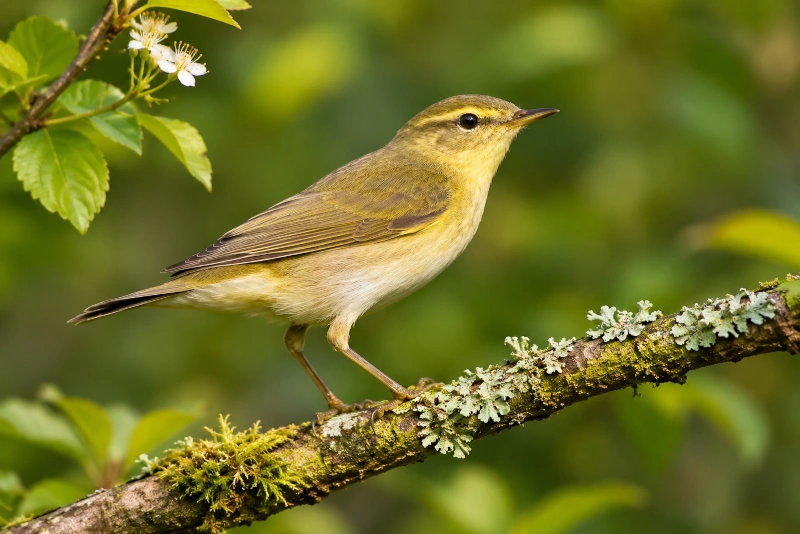
A rare migratory willow warbler (Phylloscopus trochilus) has been recorded at the Kenjar grasslands near Mangaluru in Karnataka, marking what birdwatchers have identified as the first confirmed sighting of the species in the state. The observation is also being reported as only the fifth confirmed record of the bird in India, making it a noteworthy addition to the country’s documented migratory bird occurrences.
The bird was spotted and photographed on November 11, 2026, by Mangaluru-based birdwatcher Arnold M. Goveas near the proposed Coast Guard Academy at Kenjar. Fellow birdwatcher K. Vivek R. Nayak also witnessed the sighting, while naturalist and eBird representative Ashwin Viswanathan subsequently helped confirm the identification through the Ask ID For Indian Birds group.
The sighting attracted attention among birdwatchers because the willow warbler is not a regular winter visitor to India. Its normal migration takes it from breeding grounds across Europe and northern Asia to wintering habitats in sub-Saharan Africa.
Karnataka Records Its First Willow Warbler Sighting
The Kenjar observation represents an important addition to Karnataka’s bird records. According to birdwatcher Vivek R. Nayak, previous confirmed Indian sightings had been reported from Kerala, Tamil Nadu and other parts of the country, but no definitive record had been established for Karnataka.
The bird was initially observed at approximately 8.45 AM on November 11 and was photographed to document its distinguishing physical characteristics.
Its identification was subsequently examined by experienced birdwatchers, providing additional support for the record.
The willow warbler was reportedly observed again during the following two days, allowing other birdwatchers to visit the grasslands and look for the unusual visitor.
The observation was reported by The Hindu and The Times of India on November 13, bringing attention to the ornithological significance of the Kenjar grasslands.
Understanding the Willow Warbler
The willow warbler belongs to the leaf warbler family, Phylloscopidae, and is a small insectivorous songbird widely distributed across northern Europe and Asia during the breeding season.
An adult willow warbler generally measures approximately 11 centimetres in length, with a wingspan of around 17–22 centimetres. It has greenish-brown upperparts, pale underparts with varying yellowish tones and a slender bill adapted for catching insects.
The species is similar in appearance to several other leaf warblers, making identification challenging when observed outside its usual geographical range.
Its relatively long primary feathers, pale legs, facial markings and overall proportions help distinguish it from closely related species. Careful examination of photographs and, where available, vocalisations is often important in establishing reliable identification.
Willow warblers feed primarily on insects and other small invertebrates, searching among leaves, branches and low vegetation. Their feeding behaviour contributes to insect population regulation within the habitats they occupy.
A Migratory Bird That Normally Winters in Africa
The willow warbler is among the long-distance migratory songbirds of the Palearctic region.
Its breeding distribution extends across much of Europe and northern Asia, from Ireland and Scandinavia to eastern Siberia. During the northern autumn, the birds leave their breeding territories and migrate towards sub-Saharan Africa, where they spend the winter months.
Some populations undertake journeys covering several thousand kilometres between their breeding and wintering grounds.
An interesting characteristic of the species is that even populations breeding in far eastern Siberia generally migrate westwards before turning south towards Africa.
This indirect route can involve extensive travel across Eurasia and West Asia before the birds reach their wintering destinations.
India does not lie within the species’ principal migration and wintering range. Consequently, observations from the Indian subcontinent are uncommon and attract considerable interest among ornithologists.
Earlier Records of Willow Warblers in India
Although the Kenjar observation is being described as Karnataka’s first confirmed sighting, willow warblers have previously been documented in other parts of India.
One significant record came from the Punchakkari wetlands adjoining Vellayani Lake in southern Kerala in November 2020.
The observation was subsequently documented in the ornithological journal Indian BIRDS in a paper titled The Willow Warbler Phylloscopus trochilus in Punchakkari, Southern Kerala: A Definitive Record for the Indian Subcontinent, published in March 2021.
That study provided detailed photographic and identification evidence supporting the presence of willow warblers in southern India.
Additional records have subsequently been reported from other locations, including Tamil Nadu.
The Mangaluru birdwatchers have described the Kenjar sighting as India’s fifth confirmed record. The precise national total depends on the treatment of earlier observations and their acceptance in ornithological records, but the occurrence is clearly unusual for Karnataka.
Significance of the Kenjar Grasslands
The location of the sighting is another important aspect of the development.
Kenjar, situated on the outskirts of Mangaluru in Dakshina Kannada district, contains grassland and associated vegetation that provide habitats for several bird species.
Grasslands support a variety of insects and other invertebrates, offering feeding opportunities for insectivorous birds. They can also provide temporary resting and foraging habitats for migratory species moving through unfamiliar regions.
The presence of an unusual migratory bird at Kenjar draws attention to the ecological value of such open habitats.
Grasslands are sometimes overlooked in discussions of wildlife conservation, which frequently concentrate on forests, wetlands and protected areas. However, they support specialised plant and animal communities and form an important component of India’s wider biodiversity.
The Kenjar sighting demonstrates the value of documenting birds in habitats outside conventional wildlife reserves and sanctuaries.
Unusual Bird Movements and Migration Patterns
The appearance of a willow warbler in coastal Karnataka raises questions about the circumstances that brought the bird so far from its usual migration route.
Migratory birds can occasionally appear outside their normal geographical ranges. Such occurrences, known as vagrancy, may result from navigational errors, unusual weather conditions or other factors affecting migration.
Birdwatchers associated with the Kenjar sighting suggested that changing weather patterns might have influenced the movement of some migratory species.
However, no scientific study has established the specific reason for the willow warbler’s presence in Mangaluru.
The observation therefore provides a useful record for understanding the geographical occurrence of the species without establishing a change in its regular migration route.
Birdwatchers Contribute to India’s Biodiversity Records
The discovery also highlights the contribution of amateur birdwatchers and citizen-science initiatives to wildlife documentation.
Birdwatchers regularly record species occurrences through photographs, field observations and digital databases such as eBird. These records contribute information on bird distribution, seasonal occurrence and unusual movements.
When observations involve species rarely encountered in a particular region, photographic documentation and expert examination become especially important.
In the Kenjar case, the initial photograph, observations by local birdwatchers and subsequent identification review helped establish the significance of the record.
Such documentation adds to the information available to researchers studying bird distribution and migration across the Indian subcontinent.
The willow warbler is currently classified as a species of Least Concern on the International Union for Conservation of Nature Red List. Although it is widely distributed globally, its occurrence in India remains uncommon.
The November 11 observation at Kenjar has added an unusual migratory species to Karnataka’s documented bird records, while drawing attention to the importance of grasslands and local birdwatching networks in recording India’s biodiversity.
You may also like
-
Scientists Discover New Flowering Plant Disporopsis crispata in Arunachal Pradesh, First Record of Genus in India
-
Critically Endangered Spoon-Billed Sandpiper Returns to Bengal Coast After 8,000-Km Migration from Russia
-
Assam Releases 240 Critically Endangered Black Softshell Turtle Hatchlings into Roumari Beel
-
Golden Rattlepod Flowers Transform Munnar’s Yellapetty Hills into a Sea of Yellow
-
Scientists Discover New Scorpion Species in Odisha’s Similipal Tiger Reserve
