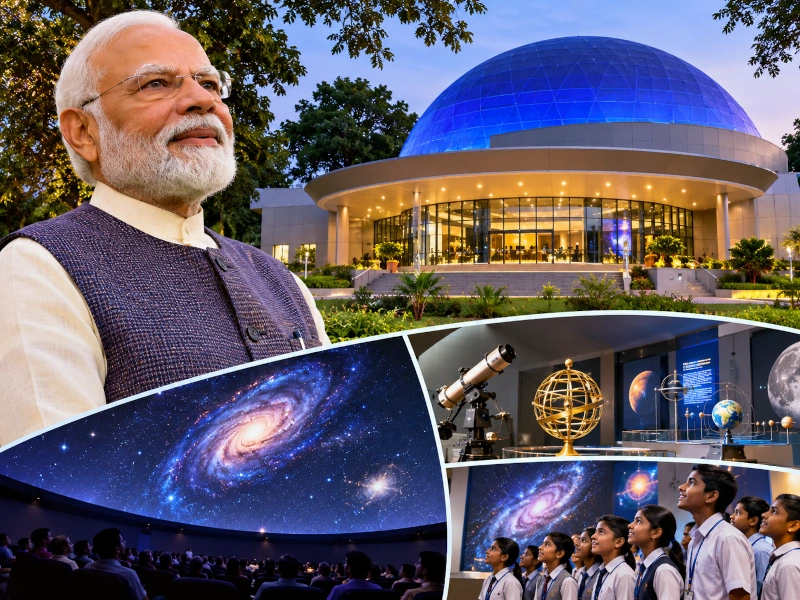
Prime Minister Narendra Modi inaugurated the COSMOS-Mysuru Planetarium, India’s first LED dome planetarium, in Mysuru, Karnataka, on November 13, 2026, marking a significant development in the country’s astronomical education and scientific outreach infrastructure. Developed by the Indian Institute of Astrophysics (IIA), the advanced facility combines immersive digital technology with astronomy education, offering students, researchers and the public an opportunity to explore the universe through high-resolution visual experiences.
Located on the University of Mysore campus at the foothills of Chamundi Hills, the planetarium has been conceived as a centre for astronomy education and training. The facility represents an addition to India’s growing network of scientific institutions dedicated to promoting astronomy, astrophysics and space sciences among younger generations.
India’s First LED Dome Planetarium
The COSMOS-Mysuru Planetarium introduces advanced LED dome technology to India’s planetarium infrastructure. Unlike conventional planetariums that rely on projectors to display astronomical images on a passive dome, the new facility employs individually controlled LED panels to create an immersive viewing environment.
The planetarium features a 15-metre tilted dome comprising approximately 6,150 LED panels and 4.2 crore individual LEDs. The system allows images to be controlled in real time, providing high-quality visual representations of celestial objects, planetary movements, astronomical phenomena and the structure of the universe.
The facility includes a Sky Theatre designed to screen professionally produced astronomy programmes, including a specially developed film examining the historical relationship between Mysuru and astronomy. The programmes will be available in Kannada, English and Hindi, enabling visitors from different linguistic backgrounds to engage with scientific concepts.
Beyond the dome theatre, the centre includes exhibition halls, a museum displaying astronomical models and artefacts, a lecture hall, a training centre and interactive outdoor exhibits. These facilities are intended to support astronomy education through visual demonstrations, scientific exhibits and structured learning activities.
Celebrating India’s Astronomical Heritage
Addressing the gathering, Prime Minister Modi highlighted India’s long tradition of astronomical observation and mathematical inquiry, recalling the achievements of Aryabhata, Varahamihira, Bhaskaracharya and Nilakantha Somayaji.
The Prime Minister observed that ancient Indian astronomers studied planetary and stellar movements, developed calendars and calculated solar and lunar eclipses despite lacking the sophisticated instruments available to modern researchers. Their work demonstrated the depth of mathematical and astronomical knowledge developed in India over successive centuries.
He also referred to Mysuru’s historical contribution to scientific and educational development, particularly the establishment of the University of Mysore under Maharaja Nalwadi Krishnaraja Wadiyar and the Wadiyar royal family’s contribution to the establishment of the Indian Institute of Science in Bengaluru.
The Prime Minister described the new planetarium as another chapter in this tradition of supporting scientific knowledge. Referring to the Viveka Smaraka inaugurated earlier in Mysuru, he observed that the two institutions reflected India’s longstanding engagement with both spiritual inquiry and scientific exploration.
Strengthening India’s Space Science Ecosystem
The inauguration also provided an opportunity to review India’s achievements in space exploration and the growing participation of young Indians in scientific research.
Prime Minister Modi referred to the Chandrayaan-3 mission, which made India the first country to achieve a soft landing in the Moon’s southern polar region, and Aditya-L1, India’s first dedicated space-based solar observatory. He also highlighted India’s demonstration of space docking and undocking capabilities and the scientific experience gained through an Indian astronaut’s mission to the International Space Station.
The Prime Minister stated that the experience acquired through the International Space Station mission was contributing to India’s preparations for the Gaganyaan human spaceflight programme.
He also emphasised the government’s decision to open the space sector to greater private participation, creating opportunities for Indian startups and technology companies to develop launch vehicles, satellites and other space-related systems.
These developments have expanded the scope of India’s space activities beyond government-led missions, encouraging participation from emerging enterprises, research institutions and young scientists.
Encouraging Young Scientists and Researchers
Highlighting the importance of scientific education, the Prime Minister referred to the performance of Indian students in international competitions involving astronomy, mathematics, physics, chemistry and biology.
He particularly noted India’s performance at the International Olympiad on Astronomy and Astrophysics in Vietnam, where five Indian participants secured four gold medals and one silver medal.
The Prime Minister emphasised that access to appropriate learning resources, advanced technologies and institutional support allows young Indians to develop their scientific abilities and compete internationally.
He also discussed initiatives intended to strengthen scientific learning and research across the country. According to the Prime Minister, more than one crore students have benefited from over 10,000 Atal Tinkering Labs, which provide opportunities for experimentation, innovation and practical problem-solving.
The government’s One Nation One Subscription initiative was highlighted as an effort to expand access to international scientific journals and research publications. The Anusandhan National Research Foundation and the ₹1 lakh crore Research, Development and Innovation Scheme were also cited as mechanisms for strengthening research capabilities and supporting the development of new technologies.
Connecting Space Technology with Everyday Life
Prime Minister Modi emphasised that India’s space programme is directed not only towards scientific exploration but also towards addressing practical challenges affecting citizens.
He cited satellite-based communication systems developed by ISRO to support fishermen operating at sea. These systems enable authorities to transmit weather warnings and other important information to equipped fishing vessels, contributing to maritime safety.
The Prime Minister also referred to the Real-Time Train Information System developed through cooperation between Indian Railways and ISRO, which uses satellite-based technology to monitor train movements and improve operational information.
In agriculture, satellite observations are used alongside field-based information under the Pradhan Mantri Fasal Bima Yojana to support crop-yield assessment and agricultural insurance administration.
These applications demonstrate how satellite infrastructure developed for space-related activities can support transportation, agriculture, disaster preparedness and public safety.
Expanding Astronomy Education and Scientific Outreach
The COSMOS-Mysuru Planetarium has been designed to complement the research and educational activities of the Indian Institute of Astrophysics, one of India’s principal institutions specialising in astronomy and astrophysics.
The institute’s activities encompass astronomical research, the operation of telescope facilities across different wavelengths, the development of scientific instrumentation and public outreach programmes.
The new planetarium will provide an additional platform for communicating astronomical discoveries and scientific principles to students and the wider public. Its combination of immersive visual technology, exhibition spaces and educational facilities creates opportunities for structured astronomy learning beyond conventional classrooms.
Concluding his address, the Prime Minister encouraged those associated with the planetarium to invite school and college students from across the region to experience its facilities and develop an interest in scientific exploration.
With the inauguration of COSMOS-Mysuru, India has introduced LED dome technology into its planetarium infrastructure, creating a new educational facility that connects the country’s astronomical heritage with modern scientific learning and space exploration.
You may also like
-
Kārttikeya and the War Against Tārakāsura: The Rise of the Divine Commander
-
Two Envoys, Two Missions: Comparing Hanumān’s and Aṅgada’s Diplomatic Strategies
-
Aṅgada and Rāvaṇa: The Art of Diplomatic Communication and the Weight of Words
-
Shiva versus Jalandhara: Siege Warfare, Strategic Deception and the Destruction of an Invincible Asura
-
Ashoka Buildcon Secures $58.9 Million Contract to Develop 120 MW Solar Power Plant in Bhutan
