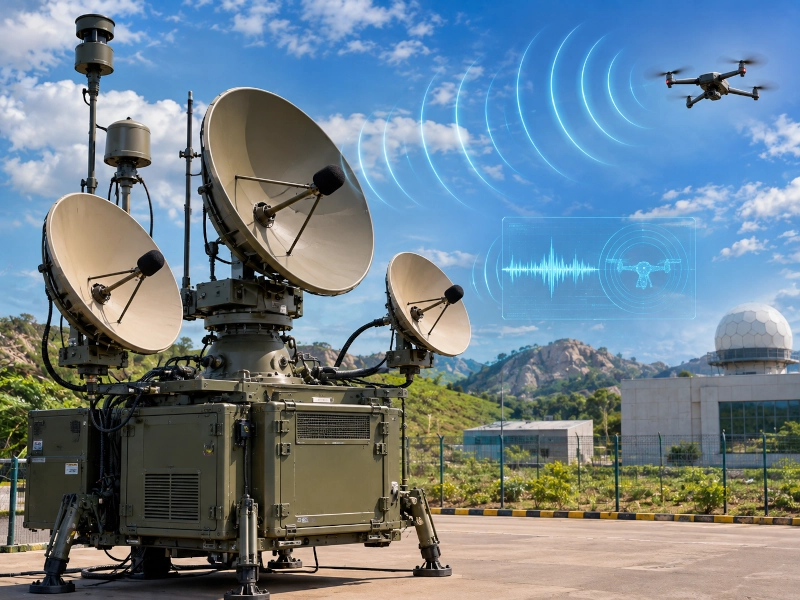
India’s Defence Research and Development Organisation (DRDO) has initiated an indigenous technology development programme to strengthen the country’s counter-drone surveillance capabilities through an advanced acoustic-based detection system. The initiative seeks to involve Indian industry in developing equipment capable of identifying unmanned aerial vehicles by analysing the distinctive sounds generated during their operation.
The Solid State Physics Laboratory (SSPL), a DRDO establishment in Delhi, issued an Expression of Interest (EoI) on November 9, 2026, inviting Indian developers and manufacturers to participate in the development of an Acoustic-Based Drone Detection (ADD) System. The proposed technology is intended to complement existing counter-drone surveillance systems by introducing an additional method of detecting aerial threats through sound.
The programme reflects DRDO’s continuing efforts to expand indigenous defence technologies and involve domestic industry in developing advanced surveillance equipment for India’s security requirements.
Acoustic Technology to Detect Drone Threats
The proposed detection system will use acoustic sensing technology to identify drones through the sound signatures produced by their motors, propellers and other mechanical components.
Unlike radar systems that detect objects through reflected electromagnetic signals, or radio-frequency monitoring equipment that identifies communications between drones and their operators, acoustic detection relies on capturing and analysing sound waves.
The technology is particularly relevant to smaller unmanned aerial vehicles that may present detection challenges for conventional surveillance systems. It could also provide an additional means of identifying drones operating autonomously without continuous radio communication with their operators.
The proposed architecture reportedly incorporates high-sensitivity microphones and specially designed parabolic reflectors to collect acoustic signals from the surrounding environment. These components would capture sound patterns that can subsequently be analysed to distinguish drones from other sources of environmental noise.
Acoustic detection is inherently passive, meaning the equipment does not need to emit signals to locate potential threats. This characteristic could make it useful in surveillance environments where limiting electronic emissions is operationally desirable.
Artificial Intelligence to Identify Drone Signatures
Artificial Intelligence and Machine Learning are expected to play an important role in the proposed system by distinguishing drone-generated sounds from background acoustic activity.
The microphones would capture surrounding sound, while associated data-acquisition electronics would convert the signals into digital information suitable for analysis. AI-based processing would then examine the acoustic patterns to identify characteristics associated with unmanned aerial vehicles.
The system is intended to differentiate drone signatures from environmental sounds such as road traffic, industrial machinery, wind and other sources of interference.
Such classification is important because acoustic surveillance equipment operating in real-world environments must distinguish relevant sounds from a wide variety of unrelated noise sources. Machine-learning techniques can potentially improve recognition by analysing patterns associated with different types of drones.
The proposed detection architecture is also expected to generate alerts when acoustic patterns consistent with drone activity are identified, providing surveillance operators with additional information about possible aerial threats.
The effectiveness of these capabilities will depend on the development and testing process, including the system’s ability to operate under varying noise, weather and terrain conditions.
DRDO Invites Indian Industry to Participate in Development
The development initiative is being pursued through an Expression of Interest issued by DRDO’s Solid State Physics Laboratory under tender reference SSPL/MMG/DPP/EOI/26-27/006.
The tender, identified as 2026_DRDO_798000_1, was published on the Defence eProcurement portal on November 9, 2026, at 5 PM.
The procurement process provides an opportunity for eligible Indian industrial organisations to participate in developing the proposed surveillance technology.
According to the tender schedule, a pre-bid meeting is planned for November 16, while bid submissions will open on November 17. The deadline for submitting responses is November 30, 2026, with bid opening scheduled for December 1.
The tender specifies a work period of 120 days. This represents the duration identified in the procurement documentation and should not be interpreted as a confirmed date for operational deployment.
Reports describing the development proposal indicate that the selected industrial partner would participate in designing, manufacturing and testing five prototype systems.
The initiative remains at the industry-selection and development stage, with no completed or operational system announced under this procurement.
Strengthening India’s Multi-Layered Counter-Drone Defences
The increasing use of small unmanned aerial vehicles has created new surveillance challenges for military installations, sensitive infrastructure and border-security operations.
Smaller drones can operate at relatively low altitudes and may have radar signatures that are difficult to distinguish from environmental clutter. Some autonomous platforms can also operate without maintaining continuous radio-frequency communications, reducing the effectiveness of surveillance methods that depend exclusively on detecting control signals.
Acoustic surveillance offers a complementary approach because the mechanical operation of many propeller-driven drones generates recognisable sound patterns.
However, the detection capability of acoustic systems can be influenced by distance, terrain, wind, background noise and the acoustic characteristics of individual aircraft. For this reason, sound-based detection is generally most valuable as one component of a broader surveillance architecture.
The proposed DRDO technology could eventually be integrated with radar, electro-optical cameras, thermal imaging equipment and electronic warfare systems to provide additional situational awareness.
Such integration would allow different detection technologies to compensate for one another’s limitations, improving the overall ability of surveillance networks to identify potential aerial threats.
The ADD System is intended for detecting and identifying drones rather than physically intercepting or neutralising them. Any future integration with counter-drone response systems would require additional development and operational validation.
Expanding Indigenous Defence Research and Manufacturing
The decision to involve Indian industry in the proposed acoustic detection programme is consistent with the broader effort to strengthen domestic participation in defence research, development and manufacturing.
Indigenous development of acoustic sensors, signal-processing electronics and AI-based classification technologies could support capabilities extending beyond military drone detection.
Several underlying technologies have potential applications in industrial monitoring, perimeter surveillance, infrastructure security and other areas requiring the identification of distinctive acoustic patterns.
Collaboration between DRDO laboratories and domestic manufacturers also creates opportunities to translate research concepts into prototype equipment that can undergo practical evaluation and subsequent refinement.
The development process will be particularly important in determining whether the proposed technology can achieve reliable performance in demanding operational environments.
Building Additional Capabilities for Future Drone Threats
The proposed Acoustic-Based Drone Detection System represents an effort to diversify India’s methods of identifying small unmanned aerial vehicles.
As drone technologies become increasingly accessible and autonomous systems become more sophisticated, relying on a single method of detection may leave surveillance networks vulnerable to different operating conditions and technical limitations.
A combination of acoustic sensing, radar, optical surveillance and electronic monitoring could provide more comprehensive coverage by exploiting different characteristics of airborne platforms.
DRDO’s initiative provides an opportunity for Indian developers to contribute to this emerging field while strengthening the country’s indigenous expertise in sensor technologies and artificial intelligence.
With the Expression of Interest process now underway, the next milestones will involve industry participation, prototype development and technical evaluation. Successful development and testing could eventually provide India’s security agencies with an additional indigenous capability for detecting unmanned aerial threats.
You may also like
-
Data Patterns Completes Indigenous Su-30MKI Self-Protection Jammer Design, Prepares for Flight Trials
-
Y Combinator-Backed Archgen Labs Develops AI Agent to Automate Advanced Semiconductor Design
-
Indian Spacetech Startup PierSight’s Varuna 2.0 Satellite Clears Key Structural Qualification Test
-
Morepen Laboratories Enters US Prescription Generics Market with Desloratadine Launch
-
Paras Semiconductors Partners with US Firm BroadPak to Develop Advanced Chip Packaging Capabilities in India
