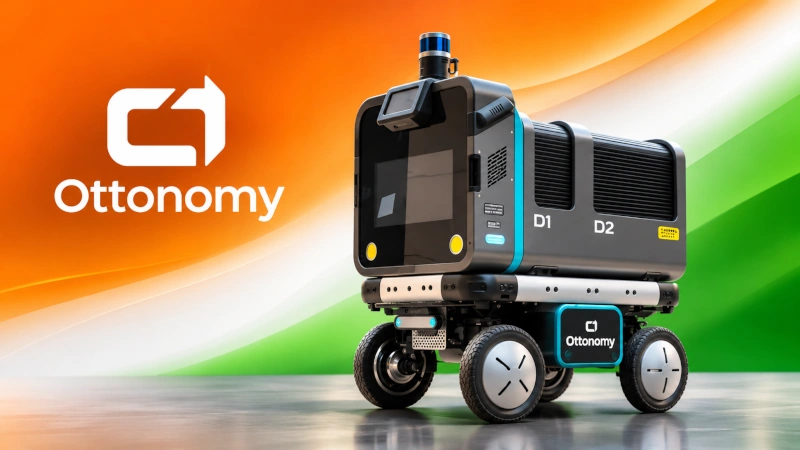
Indian-founded robotics venture Ottonomy has raised approximately $4.2 million (₹40.6 crore) in a post-seed funding round to expand its autonomous delivery robot operations across international healthcare and industrial automation markets. Announced on 4 November 2026, the investment includes participation from Japan-based venture capital firm Enrission India Capital and will support the company’s efforts to commercialise intelligent robotic systems capable of transporting materials through complex indoor and outdoor environments.
Founded in 2020 by Ritukar Vijay, Hardik Sharma, Pradyot Korupolu and Ashish Gupta, Ottonomy is headquartered in California, United States, with significant research, development and manufacturing activities in India. The company operates a production facility in Noida and has developed autonomous delivery technologies for hospitals, pharmaceutical facilities, industrial campuses, airports and commercial establishments. Its flagship Ottobot platform combines artificial intelligence, robotic navigation and intelligent sensing to automate routine material transportation without continuous human supervision.
Ottobot: Autonomous Robots Designed for Real-World Logistics
Ottonomy’s principal innovation is Ottobot, an autonomous delivery robot engineered to transport medicines, laboratory samples, equipment, industrial components and other essential materials between different locations within a facility. Unlike conventional automated guided vehicles that generally operate along predefined routes in controlled environments, Ottobot is designed to navigate changing surroundings, including corridors, elevators, access-controlled doors and outdoor pathways.
The system uses proprietary Contextual AI technology to interpret its operating environment and determine appropriate navigation behaviour. Its navigation architecture incorporates detailed environmental maps, sensors and onboard computing capabilities, allowing the robot to operate in areas where satellite-based positioning systems may be unavailable or unreliable. The technology enables the robot to travel through indoor and outdoor spaces as part of a continuous delivery operation.
A distinguishing feature of Ottonomy’s technology is its ability to interact with building infrastructure. The robots can communicate with elevators and electronically controlled access systems, enabling them to transport materials between floors and buildings. Modular cargo compartments allow the same robotic platform to support different applications, from medical sample transportation to industrial material movement.
Transforming Hospital Logistics and Medical Supply Transportation
Healthcare represents one of Ottonomy’s principal commercial markets. Large hospitals require the continuous movement of blood samples, diagnostic specimens, medicines, medical equipment and other essential supplies between wards, laboratories, pharmacies and specialised treatment facilities. These activities consume considerable staff time, particularly in hospitals spread across multiple buildings.
Ottonomy’s autonomous delivery robots are designed to undertake such transportation tasks while allowing healthcare professionals to concentrate on clinical responsibilities. Its systems can collect laboratory samples from designated locations, travel between buildings and deliver materials to authorised recipients without requiring personnel to accompany each shipment.
The company has deployed its robots at Wellstar Kennestone Hospital in the United States, where they support the transportation of blood samples, vaccines and other clinical materials. The system incorporates secure cargo compartments and controlled access mechanisms intended to maintain accountability during medical transportation.
Ottonomy’s healthcare solutions also support pharmacy deliveries, food distribution and the movement of medical equipment. By automating repetitive logistical activities, the technology offers hospitals an opportunity to improve internal transportation efficiency while reducing the time clinical personnel spend moving supplies.
Expanding Robotic Automation into Industrial Facilities
Beyond healthcare, Ottonomy is developing autonomous logistics applications for manufacturing plants, pharmaceutical production facilities, aerospace establishments and large industrial campuses. These environments frequently require the movement of components, maintenance equipment, documents and production materials between buildings and operational areas.
Traditional industrial automation systems are often designed for structured factory environments, where machines follow predetermined routes. Ottonomy’s approach seeks to extend autonomous material transportation into less predictable environments involving pedestrian movement, changing obstacles and transitions between indoor and outdoor spaces.
The company’s robots can transport materials between warehouses, production facilities and administrative buildings while integrating with existing access-control infrastructure. Such capabilities are relevant to industrial campuses where internal transportation remains dependent on human-operated vehicles or manual delivery processes.
Ottonomy has also explored applications in airports and remote industrial locations. Its wider commercial activities demonstrate how autonomous robotics can be adapted to different logistical requirements through software integration and modular hardware.
Ottumn.AI: Coordinating Robots, Drones and Intelligent Infrastructure
Alongside its autonomous delivery robots, Ottonomy has developed Ottumn.AI, a cloud-based orchestration platform designed to coordinate multiple robotic systems and connected infrastructure.
The platform brings together autonomous ground robots, drones, building access systems, elevators and intelligent delivery stations within a common operational environment. It is intended to manage transportation workflows involving different robotic platforms rather than treating individual machines as isolated automation systems.
For example, an autonomous robot could collect materials from an indoor facility, transport them to a designated transfer location and coordinate their onward movement through another robotic system. Similar arrangements could support the movement of medical supplies, industrial components and commercial deliveries across larger operational networks.
Ottonomy has developed the platform using NVIDIA’s artificial intelligence infrastructure and has participated in the NVIDIA Inception programme. The company has also collaborated with Indian drone logistics company Skye Air Mobility to explore coordinated operations between aerial delivery systems and autonomous ground robots.
This integration of robotics, artificial intelligence and infrastructure represents an emerging area of physical AI, in which intelligent software controls machines capable of performing practical tasks in the physical world.
Indian Engineering and Manufacturing Support Global Robotics Development
Ottonomy’s development reflects the growing participation of Indian engineers and manufacturing facilities in advanced robotic technologies. Although headquartered in the United States, the company’s engineering origins and production operations have important links to India’s deep-technology ecosystem.
The company maintains a manufacturing facility in Noida and has developed proprietary technologies covering autonomous navigation, robotic control and integrated delivery systems. According to its management, Ottonomy has received 24 patents from 29 patent applications, reflecting its continued investment in intellectual property development.
Its robotic systems have been deployed across North America, Europe, the Middle East and India. The company is also expanding manufacturing capabilities in the United States to support its international operations.
The combination of Indian engineering capabilities, international investment and overseas commercial deployments demonstrates how Indian-founded technology ventures are participating in the global market for advanced autonomous systems.
New Investment to Support International Expansion
The latest $4.2 million funding round will support Ottonomy’s expansion across healthcare and industrial automation markets. Japan-based Enrission India Capital participated in the financing through its investment platform, reflecting international investor interest in robotics technologies addressing practical logistical requirements.
The investment comes as healthcare institutions and industrial companies increasingly examine automation to manage workforce constraints, improve operational efficiency and reduce dependence on manual transportation processes.
Ottonomy plans to expand deployments of its Ottobot systems while strengthening the Ottumn.AI platform and its ability to coordinate different categories of autonomous machines. The company is also pursuing additional international commercial opportunities and manufacturing expansion.
Physical AI Opens New Opportunities for Indian Deep Technology
Ottonomy’s development illustrates the emergence of physical AI as an important area of advanced technology. Unlike artificial intelligence applications confined to software environments, physical AI combines computational intelligence with robotic systems capable of sensing, navigating and interacting with their surroundings.
Applications in healthcare, manufacturing, logistics and industrial automation demonstrate how autonomous machines can undertake repetitive transportation activities while human personnel focus on specialised responsibilities.
For India’s deep-technology ecosystem, Ottonomy provides an example of Indian-origin engineering expertise contributing to internationally deployed robotic products. Its manufacturing activities in Noida, proprietary navigation technologies and growing international customer base highlight the opportunities available to Indian technology developers in advanced automation.
The latest investment strengthens Ottonomy’s ability to expand its commercial operations and develop more sophisticated autonomous logistics systems. As robotics becomes increasingly integrated into healthcare and industrial infrastructure, companies combining physical engineering, artificial intelligence and practical deployment experience are establishing new capabilities in the global automation industry.
You may also like
-
India’s Railgun Programme: DRDO Advances Next-Generation Artillery Technology in Pune
-
Bharat Forge Receives Bulk Production Clearance for Indigenous ATAGS, Manufacturing to Begin in FY2026–27
-
Government Connects Indian Startups with 31,540 Scientific Equipment Listings Through I-STEM
-
Sigma Advanced Systems Reports ₹2,315 Crore Defence Orders in Artillery and Anti-Drone Technologies
-
BEL Begins Production Preparations for ₹30,000 Crore Indigenous QRSAM Programme
