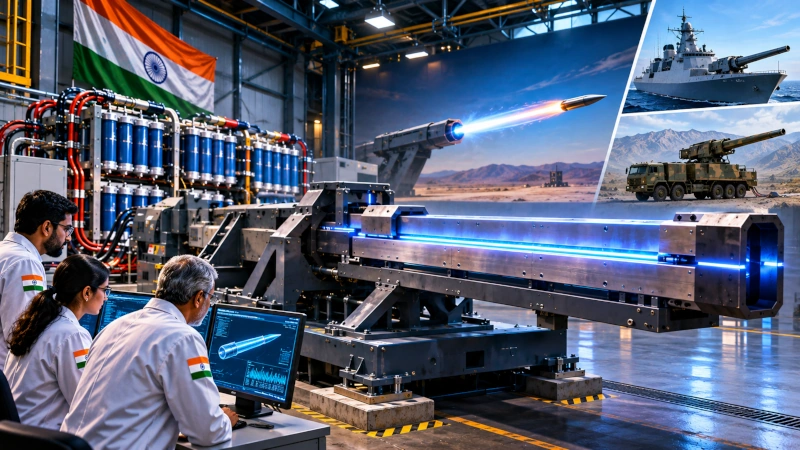
India’s Defence Research and Development Organisation (DRDO) is advancing research into electromagnetic railgun technology through specialised facilities at the Armament Research and Development Establishment (ARDE) in Pune. The programme represents an important effort to develop a new generation of artillery systems capable of launching projectiles at extremely high velocities using electromagnetic energy instead of conventional chemical propellants.
At the centre of this initiative is the Centre for Electromagnetic Launch Technology (CEMaLT), a dedicated research and testing facility established to support the development of advanced electromagnetic launch systems and their associated technologies. The centre was formally inaugurated in 2025, marking an important milestone in a research programme that has evolved through several decades of indigenous experimentation and technological development.
India’s progress in this field includes the successful experimental firing of a 10-megajoule electromagnetic railgun and ongoing research into the high-energy power systems, specialised materials and precision engineering required for larger weapons. Together, these developments demonstrate DRDO’s efforts to establish domestic expertise in a technology that could eventually influence the future of land-based artillery and naval warfare.
Pune Emerges as a Centre for Electromagnetic Railgun Research
The Armament Research and Development Establishment in Pune has been involved in the development of advanced armament technologies for the Indian Armed Forces for several decades. Its research encompasses artillery systems, ammunition, weapon mechanisms and emerging technologies intended to improve the range, accuracy and effectiveness of military weapons.
The establishment of CEMaLT has expanded this work into a specialised infrastructure programme dedicated to electromagnetic launch technology. According to the Ministry of Defence’s Annual Report 2024–25, the facility was developed to support the research and testing requirements associated with large-calibre electromagnetic railguns.
The centre includes provisions for high-energy capacitor banks, large-calibre railgun systems, a dedicated design centre, instrumentation facilities and a testing range. These facilities are intended to provide researchers with the infrastructure needed to investigate the complex electrical, mechanical and material challenges associated with electromagnetic projectile acceleration.
DRDO’s June 2025 newsletter confirmed that the centre had been inaugurated by the Secretary, Department of Defence Research and Development, and Chairman of DRDO, in the presence of senior officials associated with the organisation’s armament and combat engineering activities.
The establishment of this facility represents a step towards consolidating India’s research capabilities in electromagnetic weapons technology. By bringing together specialised infrastructure, scientific expertise and experimental testing capabilities, CEMaLT provides a dedicated environment for advancing research into increasingly powerful electromagnetic launch systems.
How Electromagnetic Railguns Work
Conventional artillery systems use chemical propellants to generate rapidly expanding gases that accelerate a projectile through a gun barrel. Electromagnetic railguns employ a fundamentally different method, using electrical energy to generate the force required to launch a projectile.
A typical railgun consists of two parallel conductive rails connected to a high-energy electrical power source. A conductive armature or another suitable electrical contact arrangement completes the circuit between the rails. When a large electrical current passes through the system, it generates a magnetic field that interacts with the current to produce a powerful electromagnetic force.
This force, known as the Lorentz force, accelerates the armature and the associated projectile along the rails. The projectile leaves the launcher at high velocity, with its kinetic energy providing much of the destructive effect upon impact.
The principal attraction of this technology is its potential to achieve projectile velocities substantially beyond those typically associated with conventional artillery. Such velocities could permit engagements at extended ranges while reducing reliance on chemical propellants within the launching system.
However, producing these velocities requires enormous electrical power delivered within a very short period. The associated electrical currents also generate substantial heat, mechanical stress and wear within the launcher. Consequently, successful railgun development involves far more than designing a gun barrel; it requires an integrated system of energy storage, power electronics, advanced materials, cooling arrangements and precision control technologies.
India’s Research Began More Than Four Decades Ago
India’s involvement in electromagnetic railgun research is not a recent development. DRDO’s October 2022 issue of Technology Focus, dedicated to electromagnetic railgun technology, documented the early development of the programme at ARDE.
According to the publication, initial research was undertaken between 1983 and 1991, during which scientists developed capacitor-bank technology to power experimental 12mm electromagnetic railguns. These early investigations included a 5-kilovolt, 240-kilojoule capacitor bank and contributed to the establishment of foundational expertise in electromagnetic projectile acceleration.
The programme subsequently progressed towards more powerful experimental systems. DRDO reported that ARDE successfully completed a science and technology project involving a 10-megajoule electromagnetic railgun powered by a capacitor bank.
The system was successfully test-fired using different bore sizes and projectile masses, demonstrating the laboratory’s ability to integrate high-energy electrical storage with electromagnetic launch technology.
This achievement provided an important foundation for further research into larger and more capable railguns. In its 2022 publication, DRDO identified the development of a 100-megajoule railgun as a future objective associated with efforts to translate experimental electromagnetic launch technology into a weapon-grade capability.
The progression from early experimental launchers to high-energy systems illustrates the cumulative nature of India’s railgun research. Each stage contributes to understanding electrical power delivery, projectile acceleration, rail durability and the engineering requirements necessary for practical military applications.
The Challenge of Developing Weapon-Grade Railguns
Although electromagnetic railguns offer considerable theoretical advantages, converting experimental systems into reliable operational weapons presents significant technological challenges. A military railgun must function repeatedly under demanding conditions while maintaining accuracy, safety and acceptable equipment life.
One of the greatest challenges is the development of a compact and reliable energy-storage system capable of delivering extremely high electrical currents. Capacitor banks can store substantial quantities of electrical energy and release it rapidly, but the equipment required for high-energy firing can be bulky and complex.
The launcher must also withstand the intense thermal and mechanical forces generated during each firing cycle. Extremely high currents can cause erosion of the conductive rails and damage to the contact surfaces through heating, electrical arcing and friction. These effects can reduce component life and complicate repeated firing.
Researchers must therefore develop specialised rail materials, protective coatings and cooling technologies that can maintain performance under repeated electrical and mechanical loading. The reliability of electrical switching systems and the ability to manage energy efficiently are equally important.
DRDO’s published technology requirements demonstrate the breadth of these challenges. The organisation has identified research areas including high-energy capacitors, semiconductor switching systems, specialised rail coatings, advanced battery technologies, power augmentation and improved launcher configurations.
Addressing these challenges is essential for progressing from experimental demonstrations towards larger electromagnetic launchers capable of meeting military operational requirements.
DRDO Developing Advanced Materials and High-Energy Power Systems
India’s electromagnetic railgun programme encompasses a range of technologies intended to improve launch performance, efficiency and system durability. DRDO’s publicly available technology-foresight information identifies several development areas associated with ARDE and other research laboratories.
These include friction-reducing graphene coatings for launcher rails, wear-resistant nickel-molybdenum cladding, specialised electrical insulation and advanced rail configurations. Such materials are intended to address the mechanical and electrical stresses experienced during high-energy projectile acceleration.
The organisation has also identified high-power compulsator-based electrical systems, semiconductor switches, high-energy-density capacitors and specialised current-injection technologies as important areas for research.
A compulsator is a specialised rotating electrical generator designed to deliver high-power electrical pulses. Such systems are relevant to electromagnetic launch technology because they offer an alternative approach to generating the intense electrical power required during firing.
Additional work includes battery-bank technologies, supercapacitor development and improved mechanical configurations for electromagnetic launchers. DRDO has also identified research involving high-mobility vehicle mounting and extreme long-range targeting as areas associated with the future development of electromagnetic railguns.
These efforts demonstrate that India’s programme extends beyond a single experimental weapon. It involves the development of a broader technological ecosystem covering electrical engineering, advanced materials, energy storage, precision manufacturing and weapon-system integration.
Potential Applications for the Indian Navy
Naval warfare is one of the areas in which electromagnetic railgun technology could eventually offer important operational advantages. Modern warships already depend on sophisticated electrical systems to power propulsion, sensors, communications and combat equipment, making the integration of advanced electromagnetic weapons an area of international defence research.
A naval railgun could potentially launch high-velocity projectiles against selected surface or land targets at extended distances. The use of kinetic-energy projectiles could also reduce dependence on conventional chemical propellants in the launching mechanism.
For naval applications, the ability to store and manage sufficient electrical energy would be a major consideration. Warships equipped with suitable power-generation and energy-storage infrastructure could provide a platform for future electromagnetic launch systems, although integration would require substantial engineering development.
Other challenges include controlling the effects of repeated firing on launcher components, maintaining accuracy at long distances and ensuring that ammunition and associated equipment can be stored and handled safely aboard naval vessels.
DRDO’s research into high-power electrical systems, advanced materials and launcher configurations is relevant to addressing these requirements. The organisation’s technical publications have also identified naval strike operations as a possible future application of electromagnetic railgun technology.
For the Indian Navy, the eventual availability of such systems could introduce additional options for long-range engagement. However, naval integration remains a prospective application of India’s research rather than an officially confirmed operational deployment.
Implications for the Indian Army’s Future Artillery Capabilities
Electromagnetic railguns also hold potential relevance for future land-based artillery systems. Conventional artillery continues to rely on chemical propellants to achieve the velocities required for long-range engagement, while electromagnetic launch technology offers an alternative means of accelerating projectiles.
One possible application involves the development of high-velocity artillery systems capable of engaging targets at extended distances. The use of electromagnetic acceleration could also create opportunities for new projectile configurations designed around kinetic-energy effects.
For land-based operations, however, the electrical energy requirements of large railguns present substantial challenges. Mobile artillery systems must balance weapon performance with transportability, deployment time, power supply, maintenance requirements and operational reliability.
A high-energy electromagnetic launcher may require specialised electrical generators, capacitor banks or other energy-storage equipment, potentially increasing the size and complexity of the overall platform.
DRDO’s identification of high-mobility vehicle mounting as a technology-development area reflects the importance of addressing these practical requirements. Research into power-system efficiency, compact energy storage and durable launcher materials will be essential for exploring the feasibility of future mobile electromagnetic artillery platforms.
The development of such capabilities would complement India’s existing work on advanced conventional artillery rather than immediately replace established gun systems.
Strengthening Indigenous Defence Research and Industrial Capabilities
The railgun programme reflects India’s broader objective of developing expertise in strategically important defence technologies through domestic research and engineering.
Electromagnetic launch systems require specialised capabilities across multiple scientific and industrial disciplines. High-energy capacitors, power electronics, precision-machined components, advanced conductive materials and sophisticated instrumentation are all important to the successful development of such systems.
The establishment of dedicated research facilities in Pune creates opportunities for the integration of these disciplines within a coordinated defence technology programme. It also provides a foundation for cooperation between DRDO laboratories, academic institutions and Indian industries possessing relevant engineering and manufacturing expertise.
Technologies developed for electromagnetic launch systems may also contribute knowledge applicable to other high-power electrical and pulsed-energy systems. Advances in capacitor technology, electrical switching, specialised materials and thermal management can support wider research and industrial development.
The programme therefore contributes to the establishment of domestic scientific capabilities extending beyond the immediate objective of developing an electromagnetic artillery weapon.
From Experimental Technology to Future Military Systems
India’s electromagnetic railgun research has progressed through successive stages of technological development, beginning with experimental work in the 1980s and advancing towards increasingly powerful electromagnetic launch systems.
DRDO’s successful experimental firing of a 10-megajoule railgun demonstrated important scientific and engineering capabilities, while its stated ambition to develop substantially higher-energy systems reflects the long-term direction of the programme.
The inauguration of the Centre for Electromagnetic Launch Technology in 2025 strengthened the infrastructure available for pursuing these objectives. Its provisions for high-energy capacitor banks, large-calibre launchers, instrumentation and testing facilities support the continued development of the technologies required for weapon-grade electromagnetic systems.
The programme remains a research and technology-development effort, with no publicly confirmed induction of an operational Indian electromagnetic railgun into Army or Navy service. Its significance lies in the establishment of specialised expertise and infrastructure for a class of weapons that could influence future military capabilities.
Pune’s Growing Role in India’s Next-Generation Defence Technology
The development of electromagnetic railgun technology at ARDE highlights Pune’s importance as a centre of indigenous defence research and advanced armament engineering. Through decades of experimentation, DRDO has developed expertise in electromagnetic launch systems and established dedicated facilities to support the next stages of the programme.
The combination of experimental railgun development, high-energy electrical research and specialised infrastructure at CEMaLT provides a foundation for pursuing increasingly advanced electromagnetic weapons technology.
As India’s defence research ecosystem continues to expand, the Pune programme illustrates the importance of investing in technologies whose potential military applications may emerge over longer development periods. Electromagnetic railguns represent one such field, combining advanced electrical engineering with new approaches to projectile acceleration and long-range firepower.
By strengthening domestic capabilities in this technologically demanding area, DRDO is contributing to India’s long-term preparedness for future developments in artillery and naval weapon systems while advancing the country’s objective of greater technological self-reliance in defence.
You may also like
-
Indian-Founded Robotics Startup Ottonomy Raises $4.2 Million to Expand Autonomous Healthcare and Industrial Logistics
-
Bharat Forge Receives Bulk Production Clearance for Indigenous ATAGS, Manufacturing to Begin in FY2026–27
-
Indian Armed Forces Successfully Validate Integrated Electronic Warfare Capabilities at Sea During Tri-Service Exercise
-
Government Connects Indian Startups with 31,540 Scientific Equipment Listings Through I-STEM
-
Sigma Advanced Systems Reports ₹2,315 Crore Defence Orders in Artillery and Anti-Drone Technologies
