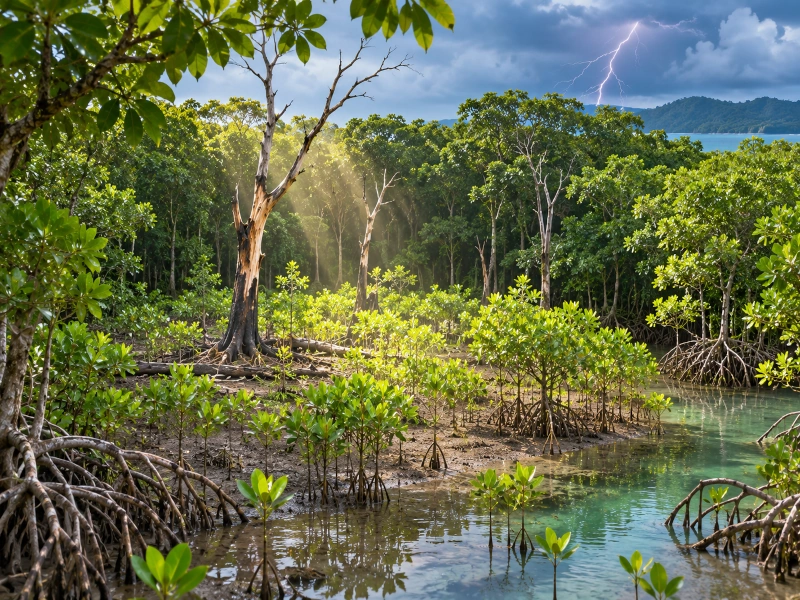
Researchers associated with the Wildlife Institute of India (WII) have discovered that lightning-induced disturbances play an important role in the natural regeneration of mangrove forests in the Andaman Islands. Their study reveals that lightning strikes, which can kill groups of mature trees and create openings in dense forest canopies, also establish favourable conditions for young mangrove plants to grow. These naturally occurring gaps support increased plant diversity during the early stages of forest recovery and contribute to the ecological processes that sustain mangrove ecosystems.
The findings were published in the scientific journal Aquatic Botany in a study titled Vegetation Dynamics in the Mangrove Canopy Gaps of the Andaman Islands, India. Conducted by Perarivalan Sengannan, Anoop Raj Singh and Nehru Prabakaran, the research examined how natural disturbances influence vegetation composition, seedling recruitment and forest regeneration across different stages of canopy recovery. The study provides valuable scientific evidence that occasional disturbances can contribute to maintaining ecological diversity within otherwise continuous mangrove forests.
Lightning Creates Natural Openings in Dense Mangrove Forests
Mangrove forests are among the most distinctive coastal ecosystems, developing in intertidal environments where vegetation must tolerate saline water, fluctuating tides and waterlogged soils. Mature mangrove forests often form dense canopies that limit the amount of sunlight reaching the ground, creating conditions in which only certain plant species can establish and survive.
Lightning strikes can disrupt this structure by causing the death of individual trees or groups of trees, sometimes producing approximately circular openings in the forest canopy. These openings, known as canopy gaps, expose previously shaded areas to greater sunlight and alter local environmental conditions.
The sudden availability of sunlight can provide an opportunity for mangrove seedlings and saplings to establish themselves in areas where dense overhead vegetation previously restricted their growth. Seeds and propagules transported by tidal water may also settle in these openings, allowing different species to colonise newly available spaces.
The researchers examined how these processes influence forest recovery in the Andaman Islands, where mangroves occupy extensive coastal and intertidal habitats. Their investigation demonstrates that lightning-related canopy openings can function as natural regeneration zones, supporting vegetation recruitment and creating greater structural variation within mangrove ecosystems.
Researchers Examine 40 Canopy Gaps Across Six Locations
The Wildlife Institute of India study investigated 40 canopy gaps distributed across six sites in the Andaman Islands. Researchers divided the openings into two categories based on their estimated age and stage of vegetation recovery.
The first category consisted of 20 newly formed canopy gaps, ranging from one to six years old. The second included 20 recovering canopy gaps that were approximately seven to fifteen years old. Each opening was compared with a corresponding control plot located in an intact section of mangrove forest.
The canopy gaps varied considerably in size, covering areas between 270 and 2,463 square metres. Their average area was approximately 941 square metres, demonstrating that natural disturbances can create substantial openings within dense mangrove vegetation.
By comparing recently formed gaps, older recovering gaps and intact forest areas, the researchers were able to examine how vegetation changes over time. They assessed plant species richness, seedling and sapling densities, canopy characteristics and environmental conditions associated with different stages of recovery.
This comparative approach allowed the team to identify the ecological processes that influence which plant species establish themselves after a disturbance and how the composition of vegetation changes as the canopy gradually regenerates.
Young Mangrove Plants Twice as Abundant in New Canopy Gaps
One of the study’s most important findings was that newly formed canopy gaps contained approximately twice the density of seedlings and saplings recorded in intact mangrove forests.
The higher concentration of young plants indicates that newly opened areas provide favourable conditions for vegetation recruitment. Increased sunlight and reduced competition from mature trees allow a greater number of seedlings to establish during the early stages of forest recovery.
The researchers also found that plant species richness was highest in newly formed canopy gaps. This suggests that the initial stages of regeneration create opportunities for several species to colonise areas that were previously dominated by mature vegetation.
As the canopy gaps aged, however, the number of plant species gradually declined. During later stages of recovery, species better adapted to the prevailing mangrove conditions became increasingly dominant, reducing the diversity initially observed in the younger openings.
These findings demonstrate that mangrove regeneration is a dynamic ecological process. Newly formed openings support a broader range of plant species, while competition and changing environmental conditions gradually determine which species persist as the forest matures.
Rhizophora apiculata Emerges as Dominant Mangrove Species
The study identified Rhizophora apiculata, a tall mangrove species characterised by distinctive stilt roots, as the dominant species across the different sampling categories.
This species is well adapted to intertidal environments and plays an important role in the structure of mangrove forests. Its specialised root system provides stability in soft coastal sediments while helping the trees withstand tidal movement and changing water conditions.
Although newly formed canopy gaps initially supported a wider variety of plants, the researchers observed that species adapted to the specific environmental conditions of the mangrove habitat gradually outcompeted others as regeneration progressed.
This process, known as ecological succession, helps explain why plant diversity changes over time following a natural disturbance. The species that establish themselves immediately after a canopy opening forms are not necessarily the same species that eventually dominate the mature forest.
Understanding these changes is important for conservation because successful mangrove restoration requires attention to local environmental conditions and the ecological characteristics of individual plant species.
Canopy Openings Influence Water Temperature and Forest Conditions
The researchers also examined how canopy openings affect environmental conditions within mangrove habitats. Their findings indicated that water temperature increased with greater canopy openness, reflecting the influence of increased solar radiation reaching previously shaded areas.
However, the study did not identify significant changes in water pH or salinity associated with the presence of canopy gaps. These findings suggest that the influence of canopy disturbances varies across different environmental factors.
Light availability emerged as an important factor shaping vegetation composition and seedling recruitment. In dense mangrove forests, mature trees intercept a substantial proportion of incoming sunlight, limiting the light available to plants growing beneath the canopy.
When lightning-induced tree mortality creates openings, additional sunlight reaches the forest floor and surrounding water surfaces. These changes can alter growing conditions and create opportunities for plants that might otherwise struggle to establish beneath dense vegetation.
As the canopy gradually closes during forest recovery, the amount of sunlight reaching the ground decreases again. This changing light environment contributes to the transition from diverse early-stage vegetation towards a more established mangrove community dominated by species suited to local conditions.
Natural Disturbances Support Mangrove Biodiversity
The findings contribute to a broader understanding of how natural disturbances influence biodiversity in forest ecosystems. While events such as lightning strikes can cause localised tree mortality, the resulting changes in habitat structure may support regeneration and increase ecological diversity at the landscape level.
In mangrove forests, canopy gaps introduce variation into otherwise continuous vegetation cover. Areas containing mature trees, recently opened gaps and recovering vegetation provide different environmental conditions, allowing ecological processes to operate across multiple stages of forest development.
This structural diversity is important because different organisms may depend on different stages of vegetation growth and canopy cover. Earlier research conducted at the Wildlife Institute of India also examined the relationship between mangrove canopy gaps and crab communities, identifying these disturbed areas as important habitats for certain crab species.
The combined findings demonstrate that mangrove conservation involves more than protecting mature tree cover alone. Understanding the natural processes that influence regeneration, vegetation composition and habitat diversity is equally important for maintaining the ecological functioning of these coastal forests.
Important Findings for Mangrove Restoration
The research offers useful insights for planning mangrove restoration and habitat management programmes, particularly in coastal areas where environmental conditions vary considerably over relatively short distances.
Restoration programmes frequently involve planting mangrove seedlings in degraded coastal habitats. However, the success of such efforts depends on selecting species suited to local conditions, including tidal exposure, salinity, sediment characteristics and available sunlight.
The Andaman study demonstrates that different species may establish successfully during the early stages of vegetation recovery but may not necessarily survive as the forest matures. This distinction is important because initial seedling establishment alone does not guarantee the development of a stable mangrove community.
By identifying how plant composition changes between newly formed and older canopy gaps, researchers can improve their understanding of the conditions that support long-term mangrove regeneration.
The study also provides baseline information for monitoring natural forest recovery. Comparing vegetation development across different stages of canopy succession can help conservation authorities evaluate restoration methods and select species that are more likely to persist under particular ecological conditions.
Andaman Mangroves Hold Important Ecological Value
The mangrove forests of the Andaman and Nicobar Islands form an important component of India’s coastal biodiversity. These ecosystems provide habitats for numerous species of fish, crabs, molluscs, birds and other wildlife while supporting ecological processes essential to coastal environments.
Mangrove root systems stabilise sediments, reduce shoreline erosion and provide sheltered habitats for juvenile aquatic organisms. Their dense vegetation also contributes to carbon storage, making mangrove conservation relevant to climate change mitigation and coastal ecosystem resilience.
The ecological importance of these forests extends beyond their tree cover. Mangrove habitats support complex interactions between vegetation, tidal movements, sediments, microorganisms and animal communities.
Research examining natural regeneration processes therefore contributes to a more comprehensive understanding of how these ecosystems maintain their structure and recover from environmental disturbances.
The Andaman study adds valuable information about the role of canopy openings in this process, demonstrating that natural forest recovery involves changes in species composition, plant density and environmental conditions over extended periods.
Long-Term Monitoring to Improve Understanding of Forest Recovery
The researchers have recommended continued monitoring of canopy gaps across different size categories and stages of recovery. Repeated observations at fixed intervals would provide additional information about how vegetation develops after natural disturbances and how long different stages of regeneration persist.
Long-term monitoring would also help scientists understand whether the patterns observed across the study sites remain consistent under different environmental conditions. Mangrove ecosystems are influenced by tidal dynamics, sediment movement, rainfall, temperature and other factors that may affect vegetation recovery.
Such research can support conservation planning by improving knowledge of natural regeneration processes and identifying ecological characteristics relevant to restoring degraded mangrove habitats.
The study’s findings provide a foundation for further investigations into mangrove succession, forest structure and the relationship between natural disturbances and biodiversity.
Understanding Nature’s Role in Mangrove Regeneration
The Wildlife Institute of India’s research demonstrates that lightning-induced canopy openings, despite causing localised tree mortality, can perform an important ecological function by creating opportunities for new vegetation to establish.
The discovery that newly formed gaps support approximately twice as many seedlings and saplings as intact mangrove forests provides measurable evidence of their contribution to natural regeneration. The subsequent decline in plant species richness as the forest matures also illustrates how competition and habitat conditions shape the composition of recovering vegetation.
For India’s coastal conservation programmes, the findings strengthen scientific understanding of the ecological processes that sustain mangrove forests. They highlight the importance of studying natural disturbances, vegetation succession and habitat diversity when developing strategies for long-term ecosystem protection.
By revealing how lightning-related disturbances can help create natural regeneration zones, the research contributes to a deeper understanding of the resilience and ecological complexity of the Andaman Islands’ mangrove forests.
References
1. Primary Scientific Research — Aquatic Botany
Perarivalan Sengannan, Anoop Raj Singh and Nehru Prabakaran.
Vegetation Dynamics in the Mangrove Canopy Gaps of the Andaman Islands, India.
DOI: 10.1016/j.aquabot.2026.104085
https://doi.org/10.1016/j.aquabot.2026.104085
2. Wildlife Institute of India — Institutional Research Repository
Influence of Canopy Gaps on Mangrove Vegetation and Crab Communities in the Andaman Islands.
Perarivalan Sengannan, 2025.
https://digitalrepository.wii.gov.in/handle/123456789/1372
3. The Wave Andaman — 6 November 2026
Lightning-Caused Forest Gaps Create Nursery Habitats in Andaman Mangroves, WII Finds.
Lightning-Caused Forest Gaps Create Nursery Habitats in Andaman Mangroves, WII Finds
You may also like
-
India and EU Conclude Horizon Europe Negotiations, Opening New Opportunities for Scientific Research
-
IIT Guwahati Uses Drone Data from 36,000 Vehicles to Develop Indian Traffic Models
-
Satellite-Tagged Vulture Travels 600 Kilometres from Nepal to Nest in Himachal Pradesh
-
Indian and Russian Scientists Develop Solar-Powered Ammonia Production Method for Greener Fertilisers
-
Rare Migratory White Stork Recorded at Okhla Bird Sanctuary After Seven Years
