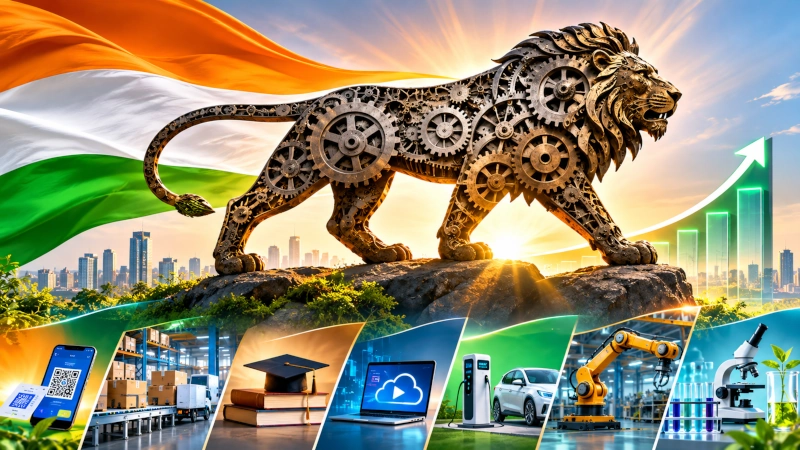
India’s startup ecosystem is entering an important phase of economic maturity, with a growing number of technology-driven enterprises demonstrating that innovation, rapid business expansion and sustained profitability can coexist. From financial technology and logistics to education, cloud computing and advanced manufacturing, Indian companies that began as entrepreneurial ventures are increasingly generating substantial revenues, strengthening their financial positions and establishing commercially sustainable operations.
The transformation is reflected in the latest financial results announced by several prominent Indian technology companies. On November 5, logistics platform Shiprocket reported its first quarterly profit, while cloud broadcasting company Amagi, digital lending platform Moneyview and education technology company PhysicsWallah disclosed significant earnings growth. Their performance follows a broader improvement in the financial position of Indian startups during FY2025–26, when an increasing number of enterprises moved into profitability or substantially reduced operating losses.
According to an analysis published by startup industry research platform Inc42, 66 of the 106 new-age technology companies covered in its FY2025–26 financial tracker reported profits, representing approximately 62.3% of the companies examined. Together, the profitable enterprises generated approximately ₹14,547 crore in net earnings, while the entire group recorded operating revenues of ₹4.89 lakh crore, growing 33.17% from ₹3.67 lakh crore in the previous financial year. The findings highlight the increasing commercial scale of India’s entrepreneurial ecosystem, although the companies tracked represent a selected group rather than the country’s entire startup population.
Indian Startups Move Beyond the Era of Growth at Any Cost
For much of the past decade, India’s startup industry was characterised by rapid customer acquisition, aggressive expansion and substantial dependence on venture capital funding. Many technology enterprises prioritised building market share, expanding geographical coverage and developing consumer awareness before establishing consistent profitability.
That approach helped create businesses operating at national scale in areas such as digital payments, e-commerce, logistics, financial services and education. However, it also produced substantial financial losses in companies where operational expenditure and customer acquisition costs grew faster than revenues.
The changing investment environment has encouraged entrepreneurs to place greater emphasis on business efficiency, revenue quality, customer retention and sustainable operating margins. Companies are increasingly working towards generating sufficient income from their core activities to support operations and future expansion.
The latest financial results demonstrate how this transition is beginning to produce measurable outcomes. Several established startups are expanding revenues while improving operating margins, controlling expenditure and generating profits, indicating that their business models have progressed beyond the initial stages of market development.
Shiprocket Achieves First Quarterly Profit as Logistics Business Expands
One of the most significant developments announced on November 5 came from Shiprocket, the Indian logistics and e-commerce technology company that provides shipping, fulfilment and digital commerce infrastructure to merchants.
Shiprocket reported its first quarterly net profit of approximately ₹60 lakh for the three months ending September 2026, compared with a net loss of ₹20.3 crore in the corresponding quarter of the previous year. Revenue from operations increased by approximately 35% to ₹674 crore, demonstrating substantial business growth alongside the company’s transition into quarterly profitability.
The company’s core shipping business, which includes domestic logistics services and associated software solutions, recorded revenue growth of approximately 25% to ₹462 crore. The expansion was supported by increasing demand from online merchants and businesses supplying products through quick-commerce distribution networks.
Shiprocket’s performance is particularly relevant because logistics technology is a capital-intensive and operationally complex business. Companies must coordinate transportation, delivery networks, fulfilment infrastructure and technology services while maintaining competitive pricing and reliable service standards.
The achievement of quarterly profitability represents an important financial milestone for Shiprocket, although the company will need to maintain positive earnings across subsequent periods to establish a sustained profitability record. Its results nevertheless demonstrate how an Indian startup can develop an integrated business serving thousands of commercial customers and progress towards financial self-sufficiency.
Amagi Demonstrates Global Success of Indian Cloud Technology
Bengaluru-based Amagi Media Labs provides another example of the increasing commercial maturity of Indian technology enterprises.
The company reported profit after tax of approximately ₹75 crore during the September 2026 quarter, compared with around ₹2.5 crore during the corresponding period of the previous year. Revenue from operations increased by 27% to ₹476 crore, supported by growth across its cloud modernisation, streaming technology and advertising businesses.
Amagi develops cloud-based software infrastructure that enables broadcasters, television networks and streaming platforms to manage content distribution, advertising and media operations. Its technology serves international customers, demonstrating the ability of Indian-developed enterprise software to compete in specialised global markets.
The company’s adjusted EBITDA increased to approximately ₹89 crore, with its adjusted operating margin rising to 18.7% from 11.1% a year earlier. The improvement indicates that its business expansion has been accompanied by greater operational efficiency.
Amagi’s success is especially significant because it reflects the development of an Indian enterprise that creates proprietary technology rather than relying exclusively on conventional outsourced software services. Its financial performance demonstrates the commercial possibilities available to Indian startups developing specialised products for international customers.
Moneyview Reports ₹201 Crore Quarterly Profit
India’s financial technology industry has also produced several examples of profitable enterprises operating at substantial commercial scale.
Digital lending and financial services company Moneyview reported net profit of approximately ₹201 crore for the September 2026 quarter, supported by strong growth in lending activity and customer demand.
Revenue from operations increased by approximately 41% to ₹1,120 crore, while the value of loans disbursed during the quarter reached ₹7,701 crore, representing year-on-year growth of approximately 41%.
Moneyview has developed a technology-enabled financial services platform offering credit and related financial products to Indian consumers. Its business combines digital customer acquisition, technology-based credit assessment and financial service delivery through regulated lending arrangements.
The company’s results demonstrate the scale achieved by India’s fintech ecosystem, which has benefited from widespread smartphone adoption, digital payments infrastructure and increasing consumer familiarity with technology-enabled financial services.
Its profitability also illustrates the growing importance of revenue generation and financial discipline in an industry where credit quality, regulatory compliance and risk management are essential to long-term business sustainability.
PhysicsWallah Demonstrates Commercial Strength of Indian Edtech
The education technology sector, which experienced considerable expansion and subsequent financial challenges during the early 2020s, is also witnessing examples of improved profitability.
PhysicsWallah reported consolidated net profit of approximately ₹143.63 crore for the September 2026 quarter, compared with around ₹70 crore in the corresponding period of the previous year. The company also recorded revenue growth of approximately 18%, supported by its online education business and expanding network of physical learning centres.
Founded as an education-focused digital initiative, PhysicsWallah developed into a large educational enterprise combining technology-based learning platforms with classroom teaching and examination preparation services.
Its growth demonstrates the continuing demand for organised educational services in India, particularly among students preparing for competitive examinations and seeking access to structured learning resources.
The company’s recent financial performance is relevant to the broader edtech sector because it demonstrates that education technology businesses can move beyond rapid user acquisition towards revenue-generating operations supported by established customer demand.
The integration of digital learning with physical education centres also illustrates how Indian startups are adapting their business models to serve consumers through multiple channels while developing more diversified revenue streams.
Pine Labs Achieves First Full Year of Profitability
Among the strongest examples of the transition towards sustainable business operations is financial technology company Pine Labs.
In May 2026, the company announced its first full financial year of profitability, reporting profit after tax of approximately ₹113 crore for FY2025–26, compared with a loss of ₹145 crore in the previous year.
Operating revenue increased by 19% to approximately ₹2,711 crore, while adjusted EBITDA rose by 57% to ₹559 crore. The company also reported operating cash flow of ₹395 crore, an important indicator of its ability to generate cash through business activities.
Pine Labs operates payment and merchant technology platforms serving businesses across different markets. Its services include payment processing infrastructure, merchant solutions and technology supporting commercial transactions.
The company’s transition from losses to annual profitability represents an important milestone because it demonstrates improved financial performance over an entire financial year rather than a single quarter.
Its results also highlight the commercial opportunities created by India’s digital payments ecosystem, where companies have developed business models around the infrastructure supporting merchants, financial institutions and consumers.
Porter Demonstrates Profitable Growth in Logistics Technology
Bengaluru-based logistics platform Porter has emerged as another example of an Indian startup combining rapid business expansion with improving profitability.
For FY2025–26, Porter reported operating revenue of approximately ₹6,649 crore, representing year-on-year growth of 54%. Net profit increased substantially to approximately ₹229 crore from ₹55.3 crore in the preceding financial year.
The company provides technology-enabled transportation and logistics services, connecting businesses and customers with vehicles for goods movement and delivery requirements.
Porter’s growth has been supported by the increasing demand for organised transportation services among small businesses, commercial enterprises and urban consumers.
The company has demonstrated that technology-based logistics platforms can generate substantial revenues while improving profitability through business scale and operational efficiency.
Its performance is particularly relevant to India’s broader economy because reliable logistics services support manufacturing, retail, trade and the movement of goods between commercial establishments and consumers.
Indian Deep-Tech Companies Show That Advanced Engineering Can Be Profitable
The success of India’s startup ecosystem is not confined to digital platforms and consumer-facing technology businesses. Companies operating in advanced engineering and industrial technology are also demonstrating commercially viable business models.
Pune-based SEDEMAC Mechatronics reported revenue from operations of approximately ₹1,058 crore during FY2025–26, representing growth of nearly 61% over the previous year. Profit after tax more than doubled to approximately ₹103.6 crore, while EBITDA increased to ₹222 crore.
The company develops electronic control systems and advanced engineering technologies used in automotive and industrial applications. Its products incorporate specialised software and electronics designed to improve the performance and control of engines and industrial equipment.
SEDEMAC’s reported return on capital employed exceeded 40% during FY2025–26, reflecting strong capital efficiency alongside substantial business growth.
The company’s performance demonstrates the potential for Indian deep-technology enterprises to develop proprietary engineering capabilities, establish commercial relationships with industrial customers and generate profits from technologically sophisticated products.
Such examples are particularly important for India’s manufacturing ambitions because they illustrate how domestic research, engineering talent and intellectual property can support the creation of high-value industrial businesses.
India’s Startup Profitability Extends Across Multiple Industries
The improvement in startup profitability is visible across several additional sectors, demonstrating that successful entrepreneurial business models are emerging beyond a small group of prominent technology companies.
In FY2025–26, used-vehicle marketplace CarTrade reported net profit of approximately ₹243.5 crore, representing growth of nearly 68%. Its operating revenue increased to ₹779.3 crore, reflecting the continued development of organised digital marketplaces for automobile transactions.
Financial technology company Fibe reported net profit of approximately ₹257.4 crore during the same financial year, more than doubling its earnings from the preceding year. Its operating revenue increased by approximately 31% to ₹1,584.5 crore, demonstrating continued expansion in technology-enabled financial services.
Furniture and appliance rental company RentoMojo reported profit after tax of approximately ₹104.2 crore, compared with ₹43.1 crore in FY2024–25. Its revenue increased by approximately 46% to ₹387 crore, illustrating the commercial development of subscription and rental-based consumer services.
Logistics company Shadowfax also recorded substantial improvement, with annual net profit increasing to approximately ₹115.2 crore from ₹6.2 crore in the previous financial year. Its operating revenue rose by approximately 65% to ₹4,080 crore, supported by the expansion of its delivery and logistics operations.
These examples demonstrate that profitability is emerging across business models involving digital marketplaces, consumer finance, rental services, logistics and industrial technology. Their combined performance reflects a broader evolution in India’s entrepreneurial economy, where established enterprises are increasingly demonstrating the ability to grow while generating financial returns.
Startup India Creates a Nationwide Entrepreneurship Ecosystem
The expansion of profitable enterprises has taken place alongside the substantial growth of India’s recognised startup ecosystem.
According to the Department for Promotion of Industry and Internal Trade, the number of recognised startups in India exceeded 2.23 lakh as of March 31, 2026, with more than 55,200 startups receiving recognition during FY2025–26 alone. This represented the highest number of recognitions recorded in a single financial year since the launch of the Startup India initiative.
The government also reported that recognised startups had generated more than 23.36 lakh direct employment opportunities, demonstrating the growing contribution of entrepreneurial enterprises to job creation.
Launched in January 2016, the Startup India initiative established a framework for encouraging entrepreneurship through regulatory reforms, institutional support, funding mechanisms and measures intended to improve the business environment for emerging enterprises.
The programme has contributed to the development of a startup ecosystem extending beyond established technology centres into smaller cities and regional industrial hubs.
The expansion of recognised startups and employment opportunities illustrates the growing scale of entrepreneurship within the Indian economy. The emergence of profitable enterprises among more mature companies represents another important dimension of this development, demonstrating how some ventures are progressing from early-stage innovation into established commercial businesses.
Public Market Listings Encourage Financial Discipline
The increasing number of startup-origin companies entering India’s stock markets has introduced greater financial transparency and accountability into the entrepreneurial ecosystem.
Publicly listed companies are required to disclose financial results, material business developments and other information under applicable regulatory requirements. These disclosures allow investors, analysts and the public to evaluate business performance using measurable financial indicators.
The growing presence of technology companies in public markets has also encouraged greater attention to revenue quality, profitability, operating cash flows and capital efficiency.
For startups preparing to enter public markets, financial performance and corporate governance are becoming important considerations alongside customer growth and market opportunities.
The evolution reflects the increasing maturity of India’s startup financing ecosystem, where venture capital continues to support early-stage innovation while established companies gain access to public equity markets for further expansion.
The growing pool of profitable startup-origin enterprises also provides examples for younger entrepreneurs seeking to develop commercially sustainable business models.
A Profitable Startup Ecosystem Strengthens India’s Economic Development
The economic contribution of profitable startups extends beyond returns to investors and company founders.
Successful enterprises generate employment, purchase goods and services from suppliers, invest in technology and infrastructure, contribute tax revenues and create business opportunities for other companies operating within their supply chains.
Technology-driven logistics firms support retailers and manufacturers, fintech platforms expand the range of digital financial services, education businesses provide learning infrastructure, and industrial technology companies develop advanced engineering capabilities.
As these enterprises become financially stronger, they gain greater flexibility to invest in research, expand production, enter international markets and develop additional products.
Profitability can also reduce dependence on repeated external funding rounds, allowing established companies to finance a larger share of their operations through internally generated resources.
The development of financially sustainable startups is therefore relevant to India’s broader objectives of economic diversification, technological innovation, employment generation and industrial competitiveness.
Profitability Marks a New Stage in India’s Entrepreneurial Development
India’s startup ecosystem has undergone a substantial transformation over the past decade, evolving from a relatively concentrated technology industry into a broad network of enterprises operating across digital services, manufacturing, biotechnology, education, logistics, financial technology and advanced engineering.
The latest financial results demonstrate that a growing group of these businesses has reached a stage where commercial expansion is accompanied by measurable profitability.
The achievements of Pine Labs, Porter, SEDEMAC Mechatronics and other companies reporting full-year profits provide evidence of business models that have progressed beyond their early development stages. Meanwhile, the November 5 results from Shiprocket, Amagi, Moneyview and PhysicsWallah demonstrate the improving financial performance of established startup-origin enterprises during the current financial year.
The broader industry figures reinforce this development. With 66 of the 106 companies examined in Inc42’s FY2025–26 tracker reporting profits and the group collectively generating operating revenue of ₹4.89 lakh crore, India’s new-age technology sector is demonstrating increasing commercial scale.
At the same time, the remaining companies in the tracker recorded substantial combined losses, highlighting the diversity of financial performance across the ecosystem. The transition towards profitability is therefore an important trend among established enterprises rather than a transformation completed by every startup.
For India, the significance lies in the emergence of an entrepreneurial economy capable of supporting innovation through commercially viable businesses. Startups that develop proprietary technologies, serve substantial customer markets and generate sustainable earnings can contribute to long-term economic growth while supporting domestic technological capabilities.
The increasing profitability of Indian startups marks an important stage in the country’s entrepreneurial development, demonstrating that businesses founded around innovation and technological ambition are progressively becoming established contributors to India’s economy, employment and industrial competitiveness.
You may also like
-
India Crosses 65 Lakh Rooftop Solar Installations Under PM Surya Ghar Yojana
-
Indian Startup Aina Unveils AI Smart Ring with Context-Aware Controls
-
Russian BRICS Researchers Highlight India’s Responsible Business Roadmap and Employment Development Model
-
Airbus Confirms Extended Flight Testing of India’s First Made-in-India C-295 Aircraft
-
BITS Hyderabad Startup Beijan Develops Indigenous GPS-Independent Drone Navigation Technology for Indian Army
