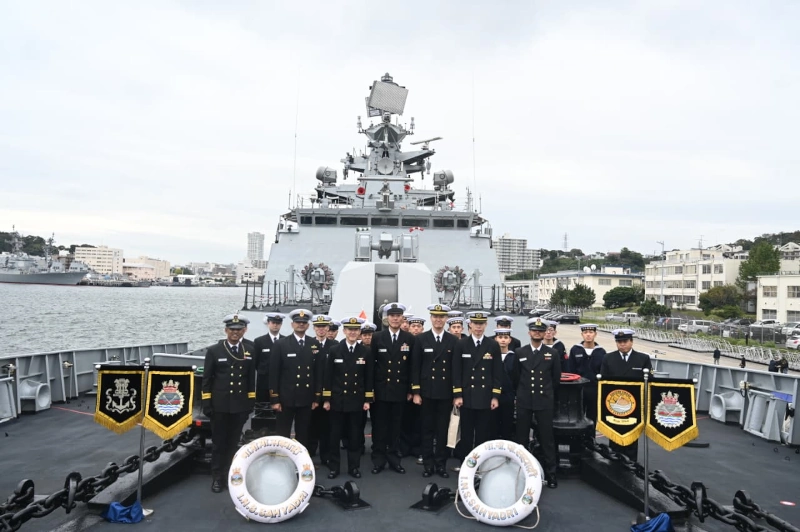
The Indian Navy’s indigenously built guided-missile stealth frigate INS Sahyadri arrived at Yokosuka Naval Base in Japan on November 4 to participate in Exercise MALABAR 2026, a major multilateral maritime engagement involving the navies of India, Japan, the United States and Australia. The exercise brings together four important maritime partners to strengthen operational coordination, enhance interoperability and deepen naval cooperation in the strategically significant Indo-Pacific region.
INS Sahyadri, which belongs to the Indian Navy’s Eastern Fleet, received a ceremonial welcome from the Japan Maritime Self-Defense Force (JMSDF) upon its arrival at Yokosuka. The reception was attended by Vice Admiral Yagi Koji, Commandant of the Yokosuka District, and R. Madhu Sudan, Deputy Chief of the Indian Mission in Japan, reflecting the close defence relationship and expanding maritime cooperation between the two countries.
The Ministry of Defence confirmed on November 5 that the exercise will include coordinated activities in harbour and at sea, allowing participating naval forces to exchange operational experience, improve coordination and strengthen their ability to undertake maritime operations together. The deployment also forms part of the Indian Navy’s continuing efforts to promote maritime security and regional partnerships under India’s MAHASAGAR vision.
MALABAR 2026 Brings Together Four Major Indo-Pacific Navies
Exercise MALABAR 2026 brings together the naval forces of India, Japan, Australia and the United States, providing an important platform for strengthening professional cooperation among four countries with extensive maritime interests in the Indo-Pacific.
Originally established in 1992 as a bilateral exercise between the Indian Navy and the United States Navy, MALABAR has progressively evolved into a multilateral engagement incorporating Japan and Australia. The exercise has developed into an important mechanism for improving naval interoperability, exchanging operational expertise and enhancing familiarity with the procedures and capabilities of participating maritime forces.
The four participating countries also constitute the Quadrilateral Security Dialogue, commonly known as the Quad. Although MALABAR is a naval exercise rather than a formal Quad military operation, participation by all four countries reflects the importance attached to practical maritime cooperation and a stable regional security environment.
The 2026 edition provides an opportunity for participating forces to strengthen their understanding of one another’s operating procedures, command structures and maritime capabilities. Such engagements are valuable for navies that may operate together during multinational maritime missions, humanitarian assistance operations, disaster relief efforts and other coordinated activities.
Harbour and Sea Phases to Strengthen Operational Interoperability
According to the Ministry of Defence, MALABAR 2026 will be conducted through harbour and sea phases designed to strengthen operational cooperation among the participating naval forces.
The harbour phase will involve professional interactions, coordinated operational planning and exchanges of expertise among naval personnel. These engagements allow participating crews and commanders to develop a common understanding of operating procedures, communications arrangements and the objectives of the exercise before proceeding to sea.
Professional exchanges also provide opportunities for personnel to discuss operational experience, technical procedures and developments in maritime warfare. Such interactions contribute to mutual understanding and help participating navies become more familiar with the equipment, capabilities and operational practices of their international counterparts.
The subsequent sea phase will bring INS Sahyadri together with participating naval units from Japan, the United States and Australia for coordinated maritime activities. While the Ministry of Defence has not yet released a detailed schedule of individual sea-phase drills, MALABAR exercises traditionally provide opportunities to practise complex naval manoeuvres and interoperability across multiple areas of maritime operations.
These activities are intended to improve communication, operational coordination and the ability of participating naval forces to function effectively in a multinational maritime environment.
INS Sahyadri Demonstrates India’s Indigenous Naval Shipbuilding Capabilities
INS Sahyadri is a Shivalik-class guided-missile stealth frigate developed and constructed in India under Project 17, representing an important achievement in the country’s indigenous warship design and shipbuilding capabilities.
Built by Mazagon Dock Shipbuilders Limited in Mumbai and commissioned into the Indian Navy in July 2012, the frigate was designed to undertake a broad range of maritime missions, including surface warfare, anti-submarine operations, air defence, surveillance and long-range deployments.
The Shivalik-class frigates incorporate stealth-oriented design features intended to reduce their detectability by hostile surveillance systems. Their integrated combat systems, sensors, missile armament and helicopter-operating capabilities enable them to undertake complex missions across different operational environments.
INS Sahyadri is equipped to support maritime operations over extended distances, making it suitable for international deployments, multinational naval exercises and sustained operations across the Indian Ocean and wider Indo-Pacific region.
The ship’s participation in MALABAR 2026 highlights the operational role of indigenously constructed warships in India’s international defence engagements. It also demonstrates how domestic shipbuilding capabilities contribute to the Indian Navy’s ability to maintain a sustained presence in strategically important maritime regions.
INS Sahyadri Continues Extensive Indo-Pacific Deployment
INS Sahyadri’s arrival in Japan follows a series of international maritime engagements undertaken during its ongoing operational deployment.
In October 2026, the frigate participated in Exercise INDRA with the Russian Navy after arriving at Vladivostok on October 10. The bilateral exercise, scheduled from October 13 to 18, provided opportunities for professional exchanges and coordinated maritime activities aimed at strengthening operational cooperation between the two navies.
Following its engagements in Russia, INS Sahyadri continued its regional deployment and arrived at Busan in the Republic of Korea on October 26 for bilateral naval interactions.
During the subsequent exercise with the Republic of Korea Navy, INS Sahyadri operated alongside the South Korean destroyer ROKS Munmu the Great. The engagements included coordinated navigation, helicopter operations and maritime manoeuvres, strengthening professional understanding and operational coordination between the two naval forces.
The frigate’s progression from Russia to South Korea and subsequently Japan demonstrates the Indian Navy’s ability to undertake successive international maritime engagements during extended deployments. Such missions support defence diplomacy, strengthen relationships with regional partners and provide valuable operational experience for naval personnel.
India and Japan Deepen Maritime Defence Cooperation
INS Sahyadri’s arrival at Yokosuka further reinforces the growing maritime relationship between India and Japan, two countries with significant economic and strategic interests in the Indo-Pacific.
India and Japan maintain regular defence engagements, including bilateral naval exercises, professional exchanges and operational interactions between their maritime forces. Their cooperation is supported by the India-Japan Special Strategic and Global Partnership, which encompasses security, economic development, connectivity and regional stability.
The Japan Maritime Self-Defense Force and the Indian Navy have developed sustained professional cooperation through bilateral and multilateral exercises. These engagements contribute to improved familiarity between the two services while supporting coordination on maritime security challenges affecting the wider region.
INS Sahyadri has previously participated in naval activities involving Japan, including the Japan-India Maritime Exercise, known as JAIMEX. During JAIMEX 2025, the frigate conducted exercises with Japanese naval units involving anti-submarine warfare, missile defence, helicopter operations and underway replenishment.
The continuation of such engagements through MALABAR 2026 reflects the established operational relationship between the Indian Navy and the Japan Maritime Self-Defense Force.
MALABAR Exercise Supports Maritime Security in the Indo-Pacific
The Indo-Pacific encompasses some of the world’s busiest maritime transportation routes, connecting major manufacturing centres, energy producers and international markets. The security and stability of these waterways are essential for global trade, energy supplies and economic activity.
India’s maritime interests extend across the Indian Ocean and into the wider Indo-Pacific, where freedom of navigation, secure sea lines of communication and the protection of maritime infrastructure remain important priorities.
Multilateral naval exercises such as MALABAR contribute to regional maritime cooperation by improving the ability of participating forces to communicate, coordinate operations and respond effectively to complex situations at sea.
The participation of India, Japan, the United States and Australia also provides a framework for exchanging operational knowledge and strengthening professional relationships among naval forces operating across a geographically extensive maritime region.
These interactions support the development of practical cooperation on issues ranging from maritime domain awareness and naval operational coordination to disaster response and humanitarian assistance.
INS Sahyadri’s Deployment Advances India’s MAHASAGAR Vision
The Ministry of Defence has linked INS Sahyadri’s participation in MALABAR 2026 with India’s MAHASAGAR vision, representing Mutual and Holistic Advancement for Security and Growth Across Regions.
The MAHASAGAR framework emphasises cooperation, shared security, regional partnerships and inclusive economic development. It reflects India’s approach to maritime engagement through sustained diplomatic interaction, defence cooperation and practical collaboration with partner countries.
The Indian Navy contributes to this vision through operational deployments, joint exercises, port visits, training programmes and maritime security initiatives involving countries across the Indian Ocean and wider Indo-Pacific.
INS Sahyadri’s participation in successive international exercises illustrates the operational dimension of this approach. By engaging with different naval forces, the Indian Navy strengthens professional relationships while enhancing its ability to participate in coordinated maritime activities across the region.
Such deployments also reinforce India’s commitment to maintaining an active naval presence beyond its immediate maritime neighbourhood, supporting the country’s wider diplomatic and security partnerships.
Indigenous Warships Strengthen India’s International Naval Presence
The deployment of INS Sahyadri highlights the growing importance of indigenous naval platforms in supporting India’s international maritime commitments.
India’s shipbuilding industry has progressively developed capabilities in the design and construction of sophisticated surface combatants, including destroyers, frigates, corvettes and other specialised vessels. Programmes such as Project 17 and Project 17A have contributed to the development of domestic expertise in warship construction, systems integration and advanced naval engineering.
Indigenously designed and constructed warships provide the Indian Navy with platforms tailored to its operational requirements while supporting domestic industrial development and technological self-reliance.
Participation in demanding international exercises provides valuable opportunities to evaluate shipboard systems, operational procedures and crew performance in multinational environments. It also enables the Navy to demonstrate the capabilities of Indian-built vessels during engagements with advanced maritime forces.
INS Sahyadri’s participation in MALABAR 2026 therefore carries significance beyond the exercise itself, reflecting the role of India’s indigenous defence manufacturing capabilities in supporting sustained international naval operations.
Strengthening Maritime Partnerships Through MALABAR 2026
The arrival of INS Sahyadri at Yokosuka Naval Base on November 4 marks another important stage in the Indian Navy’s continuing engagement with partner maritime forces across the Indo-Pacific.
Through professional exchanges in harbour and coordinated activities at sea, MALABAR 2026 will provide opportunities for the navies of India, Japan, Australia and the United States to deepen operational understanding, strengthen interoperability and reinforce established defence relationships.
For India, the exercise combines several important priorities: maintaining an active maritime presence, strengthening international naval partnerships, demonstrating indigenous warship capabilities and contributing to regional maritime security.
INS Sahyadri’s participation also reflects the broader purpose of India’s MAHASAGAR vision, which places cooperation and shared security at the centre of the country’s maritime engagement. As the Indian Navy continues its extended deployments across the Indo-Pacific, indigenous platforms such as INS Sahyadri remain important instruments of maritime diplomacy, operational cooperation and India’s commitment to a secure and stable regional maritime environment.
You may also like
-
Russia Proposes Local Production of PD-8 Aircraft Engines in India as HAL–UAC Cooperation Advances
-
Zen Technologies Plans Annual Production Capacity of 1.8 Lakh HyperStrike Interceptor Drones
-
India and Poland Explore Strategic Cooperation in Semiconductors, AI and Critical Minerals
-
Philippines Hails BrahMos Missile Technology, Signals Growing Interest in Advanced Indian Defence Equipment
-
Cabinet Opens Pathway for All Agniveers to Join Regular Armed Forces Through Two-Year Service Extension
