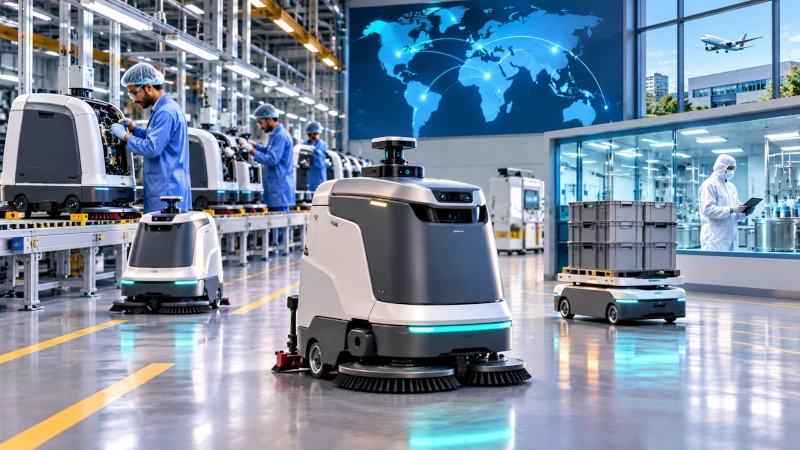
Indian deep-tech company Peppermint Robotics has raised ₹100 crore in a Pre-Series B funding round to expand its manufacturing capabilities, accelerate the development of autonomous industrial robots and strengthen its international operations. The Pune- and Austin-based company, which develops robotic systems for commercial cleaning and industrial material transportation, plans to increase its annual manufacturing capacity from approximately 1,500 to 3,000 robots by the end of FY2027–28, while establishing an additional assembly facility in North America.
The investment round was led by pi Ventures and Crane Venture Partners, with participation from Asiana Fund. According to the company’s official announcement on November 4, the transaction comprises a combination of primary investment and secondary share sales. The fresh capital will support manufacturing infrastructure, engineering research, next-generation robotics development, international market expansion and recruitment of specialised technical personnel. The funding represents an important development for India’s emerging industrial robotics ecosystem, where domestic companies are increasingly designing and manufacturing sophisticated autonomous systems for global customers.
Manufacturing Capacity to Double to 3,000 Robots Annually
Peppermint Robotics is preparing to undertake a substantial expansion of its manufacturing operations in Pune, where the company assembles autonomous robots developed through its in-house engineering and technology platforms. Founder and Chief Executive Officer Runal Dahiwade confirmed that the existing facility has the capacity to manufacture approximately 1,500 robots annually, with plans to increase production capacity to at least 3,000 units by the end of FY2027–28.
The proposed investment will be directed towards manufacturing equipment, production tooling and improvements in assembly processes, allowing the company to increase production while supporting a wider portfolio of robotic systems. Peppermint also intends to strengthen its research and development centre in Pune, expanding the engineering capabilities required for mechanical design, electronics, autonomous navigation and specialised industrial applications.
A significant proportion of the new investment will be deployed in India, supporting manufacturing expansion, product development and engineering recruitment. The company expects these investments to strengthen its ability to serve customers across international markets while retaining important design, research and production activities within its Indian operations.
Indigenous Autonomous Robots Designed for Industrial Applications
Founded in 2019 and incubated at the Society for Innovation and Entrepreneurship (SINE) at IIT Bombay, Peppermint Robotics develops autonomous machines capable of performing repetitive cleaning and material-handling tasks across commercial and industrial environments. Its systems are deployed in factories, warehouses, hospitals, airports, shopping centres, hotels and universities, where automated equipment can improve operational consistency and reduce the physical demands associated with routine maintenance activities.
The company’s robotic platforms combine mechanical engineering, computer vision, LiDAR-based environmental sensing and autonomous navigation technologies. These capabilities enable robots to map their surroundings, identify obstacles, plan routes and move through complex environments with limited human intervention. The systems operate using Peppermint OS, the company’s proprietary robotics software platform, which integrates navigation, operational control and fleet-management capabilities.
Peppermint also provides cloud-based monitoring tools that allow customers to track robotic operations and manage deployed equipment. For organisations operating in security-sensitive environments, the company offers robots capable of functioning entirely offline, reducing dependence on external network connectivity while supporting institutional information-security requirements.
By developing its robotics hardware, software and perception technologies internally, Peppermint has established an integrated approach to industrial automation. This enables the company to adapt its products to specialised operating conditions while retaining control over essential technologies involved in robotic navigation and autonomous operation.
Advanced Cleanroom Robots Target Pharmaceutical Manufacturing
One of Peppermint Robotics’ important areas of technological development is autonomous cleaning equipment designed for pharmaceutical cleanrooms and other contamination-controlled industrial environments. Such facilities require carefully regulated cleaning procedures to maintain manufacturing conditions and comply with applicable quality standards.
The company has reported that its cleanroom robotic systems successfully completed qualification testing within an EU Good Manufacturing Practice (GMP) Grade cleanroom operated by a global pharmaceutical company. The achievement demonstrates the company’s progress in adapting autonomous cleaning technology to environments where contamination control, operational reliability and adherence to prescribed procedures are particularly important.
Peppermint intends to use part of its new investment to accelerate development of its next-generation CR cleanroom robotics line. The programme will focus on strengthening specialised cleaning capabilities and expanding the range of industrial environments in which autonomous robotic systems can operate.
The development is particularly relevant to India’s pharmaceutical and biotechnology manufacturing sectors, which increasingly require advanced automation for production facilities, laboratories and controlled manufacturing environments. Autonomous cleaning equipment can support routine maintenance operations while allowing trained personnel to concentrate on specialised production and quality-control activities.
North American Assembly Facility to Support Global Expansion
Alongside its Indian manufacturing expansion, Peppermint Robotics plans to establish an assembly line in North America over the coming months. The proposed facility will complement the company’s existing Pune operations and enable more localised production, customer support and maintenance services in one of its largest international markets.
Peppermint currently operates across nine countries, with the United States emerging as its largest market. Its growing international presence spans industrial facilities, commercial properties and specialised manufacturing environments, reflecting demand for automated cleaning and internal material transportation systems.
The company also intends to expand its business development activities across the United States and Asia while strengthening its presence in European markets. Additional investment in senior management, engineering recruitment and customer-support infrastructure will accompany this expansion, enabling the company to support a larger installed base of robotic systems.
The North American assembly initiative represents an important step in Peppermint’s international manufacturing strategy. By combining Indian engineering and production capabilities with regional assembly and service infrastructure, the company aims to establish a more responsive global operating network while continuing to develop its core technologies domestically.
Revenue Expands Nearly Sixfold Between FY2023–24 and FY2025–26
Peppermint Robotics has reported substantial business growth over the past two financial years, with revenue increasing nearly sixfold between FY2023–24 and FY2025–26. The company also stated that its revenue doubled during the most recent financial year, reflecting expanding adoption of its autonomous robotic systems across domestic and international markets.
The latest investment follows a ₹34 crore Series A funding round completed in April 2025. The successive funding rounds have provided the company with additional resources to expand its engineering capabilities, strengthen manufacturing operations and build its international customer network.
The ₹100 crore Pre-Series B round includes both primary capital and secondary transactions involving existing shareholders. Consequently, the entire announced amount should not be interpreted as fresh funding available for company expenditure. The primary investment component will finance Peppermint’s manufacturing, technology-development and international expansion initiatives.
Indian Deep-Tech Manufacturing Attracts International Investment
The participation of pi Ventures, Crane Venture Partners and Asiana Fund reflects investor interest in Indian companies developing advanced industrial technologies with established commercial applications. Unlike software-only platforms, industrial robotics companies must integrate sophisticated engineering with manufacturing, supply-chain management, field deployment and long-term equipment maintenance.
Peppermint’s technological capabilities and international customer base have contributed to its ability to attract investment for the next phase of development. The company’s expansion beyond autonomous floor-cleaning machines into material-handling and cleanroom automation also provides opportunities to serve industries with increasingly specialised operational requirements.
Shubham Sandeep, Partner at pi Ventures, highlighted the company’s integrated robotics technology and international expansion as important indicators of its progress. Crane Venture Partners similarly recognised Peppermint’s development of production-grade cleanroom robots for demanding industrial environments, while Asiana Fund emphasised the potential for technology-led manufacturing businesses originating in India to compete internationally.
The investment demonstrates how Indian deep-tech enterprises can combine domestic research and engineering with international commercial opportunities. It also highlights the growing availability of specialised venture capital for companies developing advanced hardware, automation technologies and industrial equipment.
Peppermint Robotics Strengthens India’s Advanced Manufacturing Ecosystem
Peppermint Robotics’ ₹100 crore investment and proposed manufacturing expansion represent an important development in India’s indigenous industrial automation sector. The company’s plans to double annual production capacity, expand its autonomous robotics portfolio and establish overseas assembly operations demonstrate the growing commercial opportunities available to Indian manufacturers developing sophisticated robotic systems.
The programme brings together several technologies relevant to India’s advanced manufacturing ambitions, including artificial intelligence, computer vision, autonomous navigation, precision engineering and integrated hardware-software development. These capabilities are increasingly important for industries seeking greater operational efficiency, improved manufacturing processes and specialised automation solutions.
The planned increase in production to 3,000 robots annually by FY2027–28 will strengthen Peppermint’s ability to manufacture autonomous systems for international markets, while continued investment in its Pune engineering operations will support domestic technological capabilities.
As Indian deep-tech companies expand beyond research and prototyping into industrial-scale manufacturing, Peppermint Robotics provides an example of how indigenous engineering, specialised technology and global market development can combine to create internationally competitive manufacturing enterprises. Its latest investment establishes a foundation for expanding India’s participation in the growing global market for autonomous industrial robots.
You may also like
-
Indian Startup insideFPV Reports Successful Anti-Jamming Trials of Indigenous Advik Drone at 18,000 Feet in Ladakh
-
PM Modi Highlights India’s Metro Revolution as Network Expands Nearly Fivefold After 2014 to 1,200 km Across 26 Cities
-
Indian Fintech Startup Decentro Launches Advanced UPI Soundboxes with Dynamic QR and Contactless Payment Capabilities
-
OneStack Enables Indian Cooperative Banks to Access UPI Network Directly Through Indigenous Banking Technology
-
Tata Power Commissions 300 MW Solar Project in Karnataka, Expands Renewable Energy Portfolio to 12 GW
