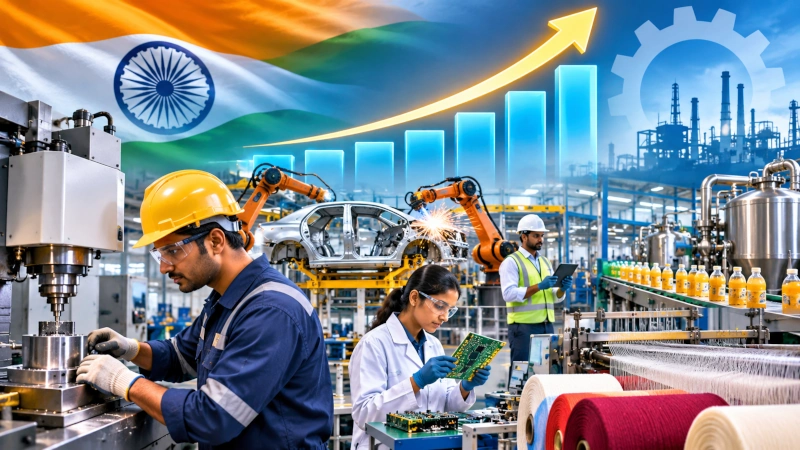
India’s manufacturing corporate sector recorded a 9.28% increase in Gross Value Added (GVA) during the financial year 2024–25, reflecting growth in industrial production and economic activity across the country’s registered manufacturing sector. The latest findings, released by the Ministry of Statistics and Programme Implementation (MoSPI) on 4 November 2026, also reveal increases in factory operations, employment, industrial machinery and value addition.
According to the detailed publications of the Annual Survey of Industries (ASI) 2024–25, the gross value of plant and machinery in registered manufacturing increased by 7.25% compared with the previous financial year. The manufacturing corporate sector, which accounted for more than 89% of total manufacturing GVA covered by the survey, registered a 3.45% increase in operating factories and a 7.57% rise in the number of persons engaged.
The findings provide a comprehensive picture of India’s registered manufacturing sector during FY2024–25, highlighting expansion across industrial establishments, capital investment, employment and production. The survey also identifies significant contributions from major manufacturing industries and states that continue to serve as important centres of industrial activity.
Manufacturing Growth Accompanied by Higher Productivity and Investment
One of the important findings of the survey is the increase in value addition generated by manufacturing establishments. Net Value Added (NVA) per operating factory increased by 6.59% during FY2024–25, while Gross Value Added per person engaged grew by 2.25%. These indicators demonstrate improvements in the economic output generated by factories and the productivity of workers within the registered manufacturing sector.
Gross Value Added measures the value created by an industry after deducting the cost of goods and services used in production. It provides an important indication of the manufacturing sector’s contribution to economic activity. The 9.28% increase reported for the manufacturing corporate sector therefore reflects growth in the value generated by corporate manufacturing establishments rather than simply an increase in gross sales or production volumes.
The increase in the gross value of plant and machinery also indicates an expansion in the industrial asset base. Manufacturing investment in machinery and production equipment is important for developing additional capacity, adopting modern technologies and improving operational efficiency. The survey’s findings show that registered manufacturing enterprises expanded their industrial assets while generating higher value addition during the reference year.
The broader Annual Survey of Industries results released in September 2026 had also recorded growth of 7.81% in industrial output, 7.19% in total employment and 12.08% in wages across registered manufacturing. Together, these indicators illustrate the expansion of factory activity and manufacturing employment during FY2024–25.
Large Manufacturing Establishments Account for Major Share of Industrial Output
The survey provides detailed insights into the structure of India’s manufacturing sector by examining factories according to the value of their investment in plant and machinery. Establishments with machinery investments of up to ₹5 crore represented 78.69% of operating factories during FY2024–25. These establishments accounted for 34.32% of persons engaged and contributed 19.24% of total industrial output.
Their contribution to Net Value Added stood at 17.61%, illustrating the substantial role played by smaller manufacturing establishments in employment generation and industrial activity. Although individually smaller in scale, these factories collectively form an extensive production network supporting industries across the country.
At the other end of the industrial structure, factories with investments of ₹10 crore or more in plant and machinery represented 15.84% of operating establishments but accounted for 87.42% of total fixed capital. These factories employed 59.66% of persons engaged in registered manufacturing and generated 76.82% of total output.
Their contribution to Net Value Added reached 78.07%, highlighting the concentration of industrial production and value creation among larger manufacturing establishments. Such enterprises frequently operate capital-intensive production systems and contribute significantly to industrial supply chains, large-scale manufacturing and the development of specialised production capabilities.
The findings underline the complementary roles of smaller and larger factories within India’s industrial economy. Smaller establishments provide employment, specialised manufacturing services and supply-chain support, while larger factories account for a substantial share of capital investment, production capacity and industrial value addition.
Food Processing, Textiles, Metals and Automobile Manufacturing Drive Employment
The Annual Survey of Industries identifies five major industrial categories that together accounted for more than 41% of India’s registered manufacturing employment during FY2024–25. These industries were food products, textiles, basic metals, motor vehicles and wearing apparel.
The prominence of these sectors reflects the diverse structure of India’s manufacturing economy. Food processing connects industrial production with agricultural supply chains, while textiles and apparel manufacturing provide employment across numerous production centres. Basic metals serve as an essential foundation for construction, engineering, machinery and industrial equipment manufacturing.
The motor vehicle industry contributes to manufacturing activity through automobile assembly, component production and an extensive network of suppliers. Its industrial ecosystem includes engineering enterprises, component manufacturers, electronics producers and specialised materials suppliers.
Together, these industries demonstrate the importance of both labour-intensive and capital-intensive manufacturing activities in supporting industrial employment. Their combined contribution also highlights the interconnected nature of India’s manufacturing supply chains, where agricultural products, raw materials, intermediate goods and finished products move through multiple stages of industrial processing.
Maharashtra, Gujarat, Tamil Nadu, Karnataka and Uttar Pradesh Lead Manufacturing GVA
The survey identifies Maharashtra, Gujarat, Tamil Nadu, Karnataka and Uttar Pradesh as the five leading states in manufacturing Gross Value Added during FY2024–25. Together, these states accounted for more than 54% of India’s total registered manufacturing GVA, demonstrating their significant contribution to the country’s industrial economy.
Maharashtra and Gujarat have established industrial ecosystems encompassing engineering, chemicals, pharmaceuticals, automobile manufacturing and numerous intermediate industries. Their extensive industrial infrastructure and connectivity support both domestic production and export-oriented manufacturing.
Tamil Nadu has developed major manufacturing capabilities in automobiles, automotive components, textiles, electronics and engineering. Karnataka’s industrial economy includes machinery, electronics, aerospace-related manufacturing and other technology-intensive activities, while Uttar Pradesh has a broad industrial base covering food processing, leather, textiles, engineering and emerging manufacturing investments.
The concentration of manufacturing GVA in these states highlights the importance of established industrial infrastructure, production clusters and supporting supply chains. At the same time, the geographical distribution of manufacturing activity provides valuable information for planning industrial corridors, logistics networks, skill development programmes and investments in new production facilities.
Detailed Industrial Survey Data Released for Research and Policy Planning
The Ministry of Statistics and Programme Implementation has made available Volume I and the Summary Results of the Factory Sector for ASI 2024–25, along with unit-level data and accompanying metadata. The release follows the publication of the initial survey factsheet on 30 September 2026.
The Annual Survey of Industries is one of India’s principal statistical instruments for examining the structure and performance of registered manufacturing. It provides detailed information on factories, fixed and working capital, employment, wages, industrial inputs, production output, depreciation, fuel consumption and Gross Value Added.
The survey covers registered factories and specified industrial establishments, with data compiled across states and industry classifications. Its findings provide inputs for national and state economic accounts while supporting industrial research, economic planning and assessments of manufacturing development.
The newly released publications enable researchers, policymakers and industry organisations to examine manufacturing activity at a more detailed level. By presenting information across industrial categories, investment sizes and geographical regions, the data supports assessments of production capacity, industrial employment, capital formation and changes in the structure of registered manufacturing.
The availability of detailed unit-level information also contributes to evidence-based industrial policymaking. It enables more precise analysis of manufacturing establishments and provides a statistical foundation for understanding the relationship between investment, employment, productivity and value addition.
Manufacturing Expansion Supports India’s Industrial Development
The findings of ASI 2024–25 demonstrate the growing contribution of registered manufacturing enterprises to India’s industrial economy. The increase in corporate manufacturing GVA, machinery investment, operating factories and employment reflects expansion across several important dimensions of industrial activity.
The survey also illustrates the scale and diversity of India’s manufacturing ecosystem. Smaller factories constitute the majority of establishments and support substantial employment, while larger enterprises contribute most of the sector’s fixed capital, output and value addition. Major industries such as food processing, textiles, metals and automobiles continue to provide an important foundation for industrial employment.
The expansion in manufacturing activity is relevant to India’s broader objectives of strengthening domestic production, developing industrial supply chains and increasing the contribution of manufacturing to national economic development. Initiatives supporting industrial infrastructure, technology adoption, investment and workforce skills complement these objectives by creating opportunities for enterprises across different manufacturing segments.
With the release of detailed ASI 2024–25 results, India now has an expanded statistical foundation for assessing industrial progress and identifying opportunities for further development. The findings highlight the role of manufacturing enterprises in generating economic value, supporting employment and strengthening the country’s industrial capabilities.
You may also like
-
OneStack Enables Indian Cooperative Banks to Access UPI Network Directly Through Indigenous Banking Technology
-
IIT Bombay-Incubated Peppermint Robotics Raises ₹100 Crore to Expand Indigenous Robot Manufacturing and Global Operations
-
Tata Power Commissions 300 MW Solar Project in Karnataka, Expands Renewable Energy Portfolio to 12 GW
-
Indian Railways Records Highest-Ever October Freight Loading at 145.07 Million Tonnes
-
NALCO Advances ₹30,000 Crore Aluminium Smelter Expansion in Odisha, Targets One Million Tonnes of Annual Capacity
