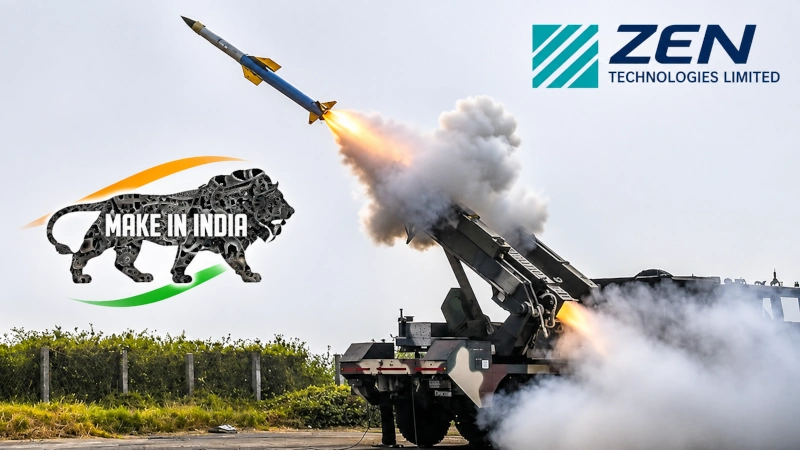
Indian defence technology company Zen Technologies Limited is developing manufacturing capacity to produce up to 1.8 lakh HyperStrike interceptor drones annually, marking a significant expansion of its ambitions in indigenous counter-drone technology. The proposed manufacturing infrastructure, capable of supporting production of approximately 15,000 interceptor drones per month at full capacity, is intended to address the growing requirement for affordable, high-speed aerial interception systems capable of neutralising hostile unmanned aerial vehicles.
The company’s manufacturing plans were disclosed during its Q2 FY2026–27 earnings conference call held on November 2, 2026. Zen Technologies’ management confirmed that production capacity was being developed for HyperStrike, an advanced interceptor drone designed to counter emerging aerial threats, including low-cost attack drones and loitering munitions. The project represents an important step in expanding India’s domestic manufacturing capabilities for expendable counter-drone systems, an increasingly important category of military equipment in contemporary warfare.
Manufacturing Capacity to Reach 15,000 Interceptor Drones Monthly
Zen Technologies Chief Financial Officer Hariharan Chalath confirmed that the company was building manufacturing infrastructure capable of supporting production of approximately 15,000 HyperStrike interceptor drones per month. Once fully established and operational, this would translate into an annual manufacturing capacity of approximately 1,80,000 units, making the programme a potentially significant contributor to India’s domestic counter-unmanned aerial systems industry.
The company intends to introduce production in phases rather than immediately operating at its maximum planned capacity. Management indicated that initial production could begin at approximately 600 units per month before increasing progressively in response to commercial orders and manufacturing requirements. The full monthly capacity of 15,000 units is based on operations across three production shifts, reflecting the company’s intention to develop a scalable industrial manufacturing system.
During the earnings conference call, management clarified that HyperStrike had not yet contributed orders to the company’s order book. Initial commercial revenue is expected during FY2027–28, with a larger proportion of anticipated orders and production expansion projected for FY2028–29. The planned manufacturing capacity therefore represents Zen Technologies’ preparations for future demand rather than an indication that full-scale production or confirmed procurement of 1.8 lakh drones has already commenced.
HyperStrike Designed for High-Speed Interception of Hostile Drones
HyperStrike has been developed to address one of the most pressing challenges facing modern armed forces: the proliferation of inexpensive attack drones capable of threatening military installations, critical infrastructure and deployed formations. These aerial systems can be employed individually or in large numbers, creating operational challenges for conventional air-defence systems that depend on comparatively expensive interception technologies.
According to technical details disclosed by Zen Technologies during its May 4, 2026, earnings conference call, HyperStrike is designed to achieve speeds of up to 400 kilometres per hour and engage aerial threats at distances exceeding 20 kilometres. The system incorporates artificial intelligence-enabled target tracking and guidance capabilities, alongside a manual override function that allows an operator to intervene during an interception.
The interceptor has been described as having a lightweight airframe weighing approximately four kilograms and a loitering capability of around five minutes. Zen Technologies has also outlined a proximity-based payload configuration of approximately 200 grams, intended to support effective interception of hostile aerial targets.
These characteristics position HyperStrike as a high-speed aerial interception platform designed to engage threats that may be difficult to defeat using conventional electronic countermeasures alone. Its combination of speed, autonomous guidance, operator control and a comparatively lightweight structure is intended to support the development of an economically viable response to increasingly sophisticated unmanned aerial threats.
Affordable Interception Emerges as a Defence Priority
The development of HyperStrike reflects the increasing importance of cost-effective interception technologies in modern military operations. The widespread employment of low-cost attack drones has created situations in which defending forces may need to expend expensive missiles or other sophisticated weapons to neutralise considerably cheaper aerial threats. This imbalance has encouraged defence manufacturers to develop affordable interceptor drones capable of physically engaging hostile unmanned systems.
Zen Technologies has indicated an assumed unit price of approximately US$10,000 for HyperStrike, presenting the system as a potential lower-cost alternative for countering certain categories of attack drones. The figure represents a commercial planning assumption rather than a confirmed procurement price, with actual pricing dependent on configuration, production scale and contractual requirements.
The company has specifically identified the challenge posed by Shahed-type attack drones, which combine relatively low manufacturing costs with the ability to threaten targets over considerable distances. HyperStrike is being developed to provide a high-speed interception capability against such threats while reducing reliance on more expensive defensive weapons.
The programme also reflects a broader transition in counter-drone technologies towards layered defence systems combining electronic warfare, surveillance, conventional air-defence weapons and dedicated kinetic interceptors. Within such an architecture, lightweight interceptor drones can provide an additional engagement option against selected aerial threats, particularly where operational conditions require the physical destruction of an incoming unmanned aircraft.
Indigenous Technology and Industrial Collaboration Support Development
Zen Technologies’ HyperStrike programme draws upon India’s expanding ecosystem of private-sector defence technology companies specialising in unmanned systems, artificial intelligence, propulsion and advanced manufacturing. The company’s development approach integrates specialised technologies from domestic partners, supporting the creation of a broader industrial network capable of designing and producing sophisticated counter-drone platforms.
During its May 2026 earnings conference call, Zen Technologies Chairman and Managing Director Ashok Atluri identified Vector Technics as a contributor to the high-speed propulsion system used in HyperStrike. The collaboration illustrates the growing role of specialised Indian technology companies in developing critical subsystems for advanced military equipment.
The integration of propulsion technology, artificial intelligence-enabled guidance, lightweight airframe engineering and scalable production processes is central to the HyperStrike programme. These capabilities are relevant not only to the development of individual interceptor platforms but also to India’s wider efforts to strengthen domestic competence in unmanned aerial systems and associated defence technologies.
Expanding manufacturing capacity for such systems can also support opportunities for component suppliers, precision engineering companies, electronics manufacturers and other participants in India’s defence industrial ecosystem. The programme demonstrates how indigenous technological development and industrial collaboration can contribute to the emergence of new manufacturing capabilities in strategically important defence sectors.
Zen Technologies Reports Strong Financial Performance
The HyperStrike manufacturing announcement follows a period of substantial business growth for Zen Technologies. In its financial results for the second quarter of FY2026–27, the Hyderabad-based company reported consolidated revenue from operations of ₹345.13 crore, representing year-on-year growth of approximately 98.8 per cent. The company also reported operational EBITDA of ₹131.99 crore, reflecting an operating margin of approximately 38.2 per cent.
Zen Technologies recorded order inflows of ₹481.81 crore during the quarter, taking its consolidated order book to ₹1,375.70 crore as of September 30, 2026. The figures reflect the company’s expanding business across defence training systems, simulation technologies and counter-unmanned aerial systems.
The company has been strengthening its presence in advanced defence technologies alongside its established military training and simulation business. Its growing focus on counter-drone solutions reflects the increasing importance of technologies capable of detecting, tracking, disrupting and intercepting hostile unmanned aircraft.
The planned HyperStrike manufacturing expansion represents a separate opportunity within this broader business strategy. While the existing order book provides visibility for the company’s established product categories, management expects HyperStrike to begin contributing revenue during FY2027–28, followed by a more substantial commercial expansion in subsequent periods.
HyperStrike Programme Strengthens India’s Counter-Drone Manufacturing Ambitions
The proposed annual manufacturing capacity of 1.8 lakh HyperStrike interceptor drones represents an ambitious development in India’s private-sector defence manufacturing landscape. By preparing to produce high-speed interceptor platforms at industrial scale, Zen Technologies is positioning itself to participate in a growing market for affordable and technologically advanced counter-drone systems.
The programme brings together several capabilities increasingly important to India’s defence industry, including indigenous propulsion, artificial intelligence-enabled guidance, precision manufacturing and the ability to scale production according to operational requirements. These technologies can contribute to the development of domestic solutions for countering hostile aerial systems while reducing dependence on imported equipment.
For the Indian Armed Forces, the availability of domestically manufactured interceptor drones could broaden the range of technologies available for protecting military installations, deployed formations and critical infrastructure. The development is also relevant to India’s defence export ambitions, as countries facing similar unmanned aerial threats increasingly examine specialised and cost-effective interception systems.
Zen Technologies’ decision to invest in large-scale HyperStrike manufacturing capacity reflects the expanding role of Indian private industry in advanced military technology development. As the programme moves towards commercial production, it adds another dimension to India’s efforts to strengthen indigenous defence manufacturing and establish competitive capabilities in the rapidly evolving field of counter-unmanned aerial warfare.
You may also like
-
Philippines Hails BrahMos Missile Technology, Signals Growing Interest in Advanced Indian Defence Equipment
-
Cabinet Opens Pathway for All Agniveers to Join Regular Armed Forces Through Two-Year Service Extension
-
India Reportedly Evaluates 52 Russian Pantsir Air-Defence Systems with Domestic Manufacturing
-
Pune Fintech Fibe Enters UPI Payments Market After NPCI Approval
-
Indian AI Startup Sarvam Launches Prism, an Indigenous Decision Model for Enterprise Automation
