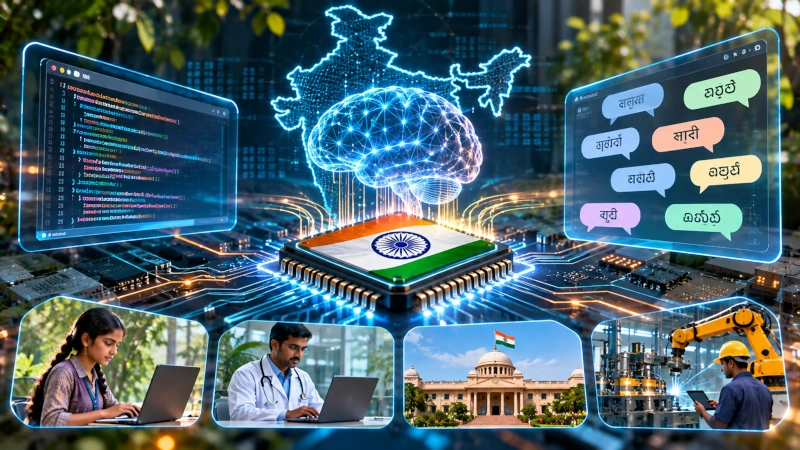
India has taken another significant step towards developing indigenous artificial intelligence capabilities with the release of three foundation models under the IndiaAI Mission. The Ministry of Electronics and Information Technology (MeitY) unveiled EKA-1, a 26.3-billion-parameter language model developed by Soket Labs Technology and Research Private Limited, alongside Dhīr 2B and Dhīr 5B, two multilingual models developed by ZenteiQ AiTech Innovations. The releases strengthen India’s efforts to establish domestic AI technologies capable of addressing the country’s linguistic diversity, industrial requirements and growing demand for secure artificial intelligence applications.
The models were formally released at an event in New Delhi on November 3, 2026, in the presence of MeitY Secretary S. Krishnan, senior officials of the IndiaAI Mission and representatives of the two companies. Developed under the IndiaAI Innovation Centre’s Foundation Models initiative, the systems demonstrate different approaches to domestic AI development, combining a large-scale language model designed for complex reasoning and enterprise applications with compact models capable of operating in environments where cloud connectivity is limited or unavailable.
EKA-1: Indigenous AI Model Supporting All 22 Scheduled Indian Languages
Soket Labs has developed EKA-1 as an open, sparse hybrid language model containing 26.3 billion parameters and trained on approximately 7.5 trillion tokens. The model supports all 22 languages listed in the Eighth Schedule of the Indian Constitution, alongside English, and is designed to perform tasks involving mathematics, software development, reasoning and agentic artificial intelligence.
The development is particularly relevant to India’s multilingual digital environment, where artificial intelligence applications must operate across languages with different scripts, grammatical structures and linguistic resources. By incorporating all 22 scheduled Indian languages, EKA-1 aims to provide a foundation for developing applications that can serve users beyond predominantly English-language digital systems.
Its sparse hybrid architecture is intended to support complex computational tasks through a model design that can selectively activate parts of its processing structure. Such architectures can offer efficiency advantages compared with systems that activate all model parameters for every operation, although actual performance depends on implementation, hardware configuration and the tasks being performed.
EKA-1 has been designed for applications requiring mathematical reasoning, programming capabilities and multi-step problem-solving. These functions are relevant to software engineering, scientific research, business process automation and enterprise decision-support systems. The model’s agentic capabilities are intended to support AI applications that undertake structured tasks involving multiple stages of reasoning and execution.
Soket Labs has also identified banking, financial services and cybersecurity as important application areas. Abhishek Upperwal, Chief Executive Officer of Soket Labs, explained that the company developed the model to address sector-specific requirements within India’s financial and digital technology ecosystem. The objective is to provide domestic organisations with AI capabilities that can be adapted to their operational requirements while supporting applications involving sensitive information and specialised workflows.
Dhīr 2B and Dhīr 5B Bring Multilingual AI to Local Devices
While EKA-1 focuses on large-scale language processing and complex applications, ZenteiQ AiTech Innovations has developed Dhīr 2B and Dhīr 5B as compact, open-source multilingual models designed for flexible deployment. The two models support English and ten Indian languages, with an emphasis on secure operation in environments where continuous internet connectivity or access to external cloud infrastructure may not be practical.
The models are designed to support document-based automation, knowledge retrieval and digital assistance across government, industrial, educational and other institutional applications. Their architecture allows organisations to deploy AI capabilities within their own computing environments, potentially reducing the need to transfer sensitive information to external servers.
An important feature of the Dhīr model family is its support for on-premises and offline-capable deployment. In conventional cloud-based AI systems, information may be transmitted to remote computing infrastructure for processing. Locally deployed models can instead perform inference within an organisation’s own systems or on compatible devices, allowing greater control over where information is processed and stored.
ZenteiQ has indicated that the models can operate across different computing platforms, including graphics processing units and tensor processing units. Their compact design also creates opportunities for deployment on compatible mobile devices, allowing certain AI functions to operate without a continuous connection to cloud services.
Professor Sashikumar, Chief Executive Officer of ZenteiQ AiTech Innovations, highlighted the importance of enabling AI capabilities directly on user devices. According to the company, the ability to process information locally can improve accessibility in areas with limited connectivity while allowing users and organisations to maintain greater control over sensitive data.
Offline AI Could Support Government, Education and Industrial Applications
The development of compact multilingual models has particular relevance for India because digital services must operate across a wide range of technological environments. While major cities and large enterprises increasingly have access to advanced computing infrastructure, many institutions and communities continue to face limitations involving connectivity, hardware availability and the cost of operating cloud-based services.
Offline-capable AI systems could provide additional options for educational institutions, government offices, industrial facilities and other organisations that require language-processing or document-retrieval capabilities without continuous dependence on remote servers. Potential applications include multilingual information assistance, retrieval of institutional knowledge, document analysis and support for structured administrative processes.
For educational institutions, locally deployable models could support multilingual learning resources and document-based academic assistance. Government organisations could explore applications involving public information and administrative workflows, while industrial users may investigate systems for accessing technical documentation and operational knowledge.
The ability to run AI models within controlled computing environments is also relevant to organisations handling confidential or commercially sensitive information. However, local deployment does not automatically guarantee data security, accuracy or regulatory compliance. These requirements depend on system design, access controls, software maintenance and the safeguards implemented by the organisation using the technology.
The November 3 announcement establishes that the Dhīr models have been released with these intended capabilities. It does not establish that they have already been deployed across government departments, educational institutions or industrial enterprises on a large commercial scale.
IndiaAI Mission Provides Computing and Research Support
The development of EKA-1 and Dhīr was supported through the IndiaAI Innovation Centre, one of the principal components of the government’s IndiaAI Mission. Both Soket Labs and ZenteiQ were selected under the mission’s Foundation Models initiative, which seeks to strengthen India’s capacity to develop advanced AI systems suited to domestic requirements.
According to MeitY, access to subsidised national AI computing infrastructure and support for associated research expenditure played an important role in enabling the companies to develop their models. This support is particularly relevant because training advanced language models requires substantial computing resources, specialised engineering expertise and access to appropriately prepared datasets.
The IndiaAI Mission was approved by the Union Cabinet on March 7, 2024, with the objective of developing a comprehensive domestic artificial intelligence ecosystem. Its seven principal components cover computing capacity, indigenous model development, datasets, application development, skills, startup financing and safe and trusted AI.
The mission’s infrastructure initiatives are intended to make advanced computing resources more accessible to Indian researchers, startups and technology companies. By reducing some of the financial and infrastructure barriers associated with AI development, the programme seeks to encourage domestic participation in areas that have traditionally required substantial private investment.
The release of models from two Indian technology companies demonstrates how publicly supported computing resources and private-sector research capabilities can contribute to the development of indigenous AI systems. The longer-term significance of this approach will depend on the performance of the models, their accessibility to developers and the extent to which they are adopted for practical applications.
AIKosh Could Expand Access to Indigenous AI Technologies
The government has also identified AIKosh, the IndiaAI Datasets Platform, as an important mechanism for making domestic AI resources accessible to researchers, students, innovators and other users. The platform forms part of the mission’s effort to support collaborative AI development through access to datasets and related technological resources.
During the release event, MeitY Secretary S. Krishnan emphasised that indigenous foundation models could strengthen India’s technological capabilities while creating opportunities to improve productivity across government, industry, research and education. He also highlighted the potential for platforms such as AIKosh to make these resources available to a wider community of developers and institutions.
Broader access to indigenous models could encourage experimentation and the development of applications addressing specific Indian requirements. Researchers may be able to evaluate model performance across Indian languages, while technology companies could explore domain-specific adaptations involving finance, education, industrial operations and public services.
Open-source and openly accessible AI models can also help reduce barriers for smaller developers by allowing them to build upon existing technologies instead of undertaking expensive model training from the beginning. Nevertheless, access conditions, licensing provisions and computing requirements remain important considerations when evaluating how individual models can be adapted or deployed.
The release of the EKA-1 and Dhīr model families provides additional domestic resources for India’s AI development ecosystem. Their practical impact will depend on continued technical evaluation, accessible deployment frameworks, developer participation and the availability of suitable applications.
Indigenous AI Development and India’s Technological Autonomy
The development of domestic foundation models forms part of India’s wider effort to strengthen its capabilities in strategically important digital technologies. Foundation models serve as the underlying systems for a broad range of AI applications, making their development relevant to software engineering, enterprise automation, scientific research and digital public services.
Countries and technology companies investing in indigenous AI development are seeking greater control over model architecture, training processes, deployment arrangements and the availability of specialised capabilities. For India, these considerations are particularly important because of its linguistic diversity, expanding digital economy and growing requirement for AI systems capable of operating in domestic institutional environments.
The EKA-1 and Dhīr releases represent complementary approaches to these requirements. EKA-1 is designed to provide substantial language-processing and reasoning capabilities across all scheduled Indian languages, while Dhīr focuses on compact multilingual systems suitable for deployment on local infrastructure and compatible devices.
This distinction is important because different AI applications require different balances of computing capacity, performance, cost and deployment flexibility. Large models can support complex tasks but may require significant computational resources, while smaller models can provide more practical options for applications operating under hardware, connectivity or security constraints.
The availability of both types of models could support the development of a more diverse domestic AI ecosystem. However, the number of model parameters or training tokens alone does not establish superiority over international alternatives. Independent benchmark results, reliability assessments, language-specific evaluations and real-world deployment experience will be important in determining their capabilities and limitations.
Indian AI Startups Strengthen Domestic Foundation Model Ecosystem
The participation of Soket Labs and ZenteiQ also demonstrates the expanding role of Indian technology startups in developing foundational artificial intelligence technologies. While much of India’s software industry has historically concentrated on IT services, enterprise applications and digital infrastructure, domestic companies are increasingly participating in the development of underlying AI models.
Building foundation models requires expertise in machine learning, data engineering, distributed computing, model evaluation and software infrastructure. Developing these capabilities within Indian companies can contribute to a stronger domestic research and engineering base while creating opportunities for collaboration with universities, research laboratories and industrial organisations.
The IndiaAI Mission’s support framework is intended to accelerate this transition by providing access to computing resources and encouraging companies to develop models addressing Indian requirements. The release of EKA-1 and Dhīr demonstrates progress in this direction, particularly through the development of multilingual models designed for different operational environments.
For Indian enterprises, the availability of domestic AI technologies could create additional options when evaluating model deployment, data management and specialised applications. However, adoption will depend on technical performance, reliability, support infrastructure and the ability of developers to demonstrate clear advantages for specific use cases.
The November 3 announcement therefore represents an important technological milestone rather than evidence that India’s indigenous AI systems have already achieved widespread commercial adoption.
Building an AI Ecosystem for India’s Linguistic and Industrial Needs
The release of EKA-1, Dhīr 2B and Dhīr 5B strengthens India’s portfolio of domestically developed artificial intelligence foundation models and demonstrates the complementary capabilities emerging within its technology ecosystem. By combining a 26.3-billion-parameter multilingual model with compact systems designed for secure local deployment, the initiative addresses different requirements associated with advanced computing, language accessibility and institutional data control.
The development also illustrates the importance of cooperation between public digital infrastructure and private-sector innovation. Subsidised computing resources and research support under the IndiaAI Mission have enabled Indian companies to participate in an area of technology development that demands substantial technical and financial resources.
The next stage will involve evaluating the models against established performance benchmarks, expanding access for developers and identifying practical applications in government, industry, education and research. Their long-term contribution will depend not only on their technical specifications but also on their accuracy, reliability, affordability and usefulness in real operating environments.
With the release of EKA-1 and Dhīr, India has added new indigenous capabilities to its growing AI ecosystem. The development represents further progress towards building domestic expertise in foundational artificial intelligence while creating opportunities for technologies designed around India’s languages, institutions and industrial requirements.
Source: Press Information Bureau, Ministry of Electronics and Information Technology, Government of India, November 3, 2026, 10:02 PM IST. Release ID: 2332315.
You may also like
-
Arunachal Pradesh Kiwi Reaches Dubai Market as APEDA Facilitates 1.5-Tonne Trial Export
-
APEDA Facilitates Export of 1.3 Tonnes of Sinduri Pomegranates from Himachal Pradesh to Dubai
-
Radhunipagal Rice of West Bengal: The GI-Tagged Aromatic Heritage of Bengal’s Traditional Rice Fields
-
India Achieves 50% Non-Fossil Power Capacity Target Five Years Ahead of Schedule as Renewable Energy Summit Begins
-
Balu Forge Secures Quality Approval for Jet Engine Components, Expands Aerospace Manufacturing Capabilities
