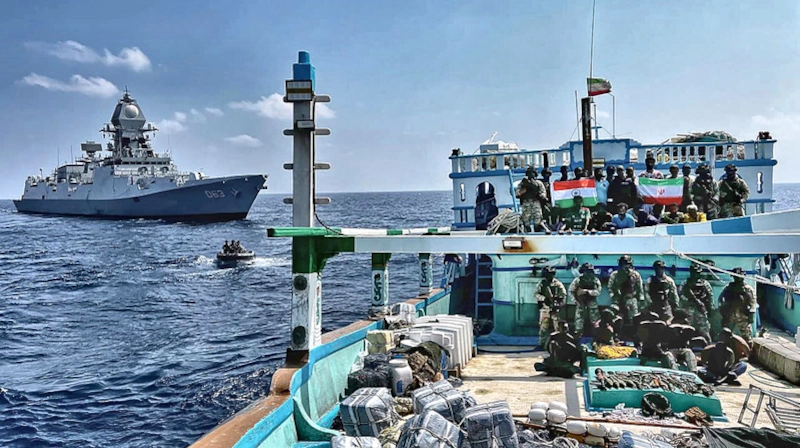
The Indian Navy has successfully liberated the hijacked fishing vessel Azini from armed pirates operating off the coast of Somalia following a coordinated maritime security operation lasting more than 48 hours. The operation resulted in the safe rescue of all 20 crew members without casualties or injuries, demonstrating the Navy’s ability to conduct complex counter-piracy missions through sustained maritime surveillance, tactical intervention and close coordination with the Indian Air Force.
The operation involved a mission-deployed Indian Navy warship, maritime reconnaissance aircraft and Marine Commandos, with additional personnel inserted through a precision airdrop conducted by an Indian Air Force C-17 transport aircraft. The coordinated deployment enabled Indian forces to locate and track the hijacked vessel, restrict its movements and execute a tactical intervention that brought the piracy incident to a successful conclusion.
Hijacked Fishing Vessel Posed Wider Maritime Security Threat
The fishing vessel Azini was reportedly hijacked by an armed pirate group off the northeastern coast of Somalia in October 2026. Beyond the immediate danger to its crew, the hijacking raised concerns that the vessel could be used as a mother ship to support further piracy operations against commercial shipping in the region.
In maritime piracy, a mother ship is a larger vessel used by pirate groups to transport personnel, fuel, provisions and smaller attack craft over considerable distances. Such vessels can extend the operational reach of pirates beyond coastal waters, allowing them to target merchant ships along international maritime routes. The potential use of Azini for this purpose made its recovery important not only for the safety of the captured crew but also for preventing further threats to shipping in the western Indian Ocean.
The waters off Somalia have historically been vulnerable to piracy because of their proximity to major maritime routes connecting the Indian Ocean with the Gulf of Aden and the Red Sea. Commercial vessels operating through these waters form part of international shipping networks that transport energy supplies, raw materials and manufactured goods between Asia, Europe, Africa and the Middle East. Maintaining maritime security in this region is therefore important for safeguarding seafarers and protecting international trade.
Indian Navy Deploys Warship and Reconnaissance Aircraft
Following reports of the hijacking, the Indian Navy assigned a mission-deployed warship to respond to the developing security situation. The warship operated in coordination with a maritime reconnaissance aircraft, enabling Indian forces to conduct persistent surveillance, identify the vessel’s location and monitor its movements.
The coordinated use of surface and aerial platforms provided the operational awareness required to track the hijacked fishing vessel and assess the developing situation. According to the Ministry of Defence, Indian naval forces employed calibrated non-kinetic measures to contain the vessel’s movement and prevent its escape while preparing for the intervention.
Non-kinetic measures generally involve methods that seek to influence or restrict an adversary’s actions without immediately resorting to destructive force. In this operation, the Navy’s use of such measures formed part of an effort to maintain control over the situation while prioritising the safety of the hostages aboard the fishing vessel.
The sustained surveillance and containment phase was particularly important because the hijacked vessel remained under the control of armed pirates. Any intervention therefore required careful coordination to minimise risks to the crew while preventing the pirates from escaping or using the vessel to threaten other ships.
Indian Air Force C-17 Airdrops Marine Commando Reinforcements
A significant feature of the rescue operation was the involvement of the Indian Air Force, which deployed a C-17 strategic transport aircraft to augment the Indian Navy’s Marine Commandos through a precision airdrop. The operation demonstrated the ability of the two services to combine maritime surveillance, naval intervention capabilities and long-range air mobility in responding to security threats far from the Indian coastline.
The C-17 Globemaster III is a heavy military transport aircraft capable of undertaking long-distance missions and delivering personnel and equipment through aerial deployment. Its involvement enabled the Indian Armed Forces to reinforce the personnel available for the maritime operation without relying exclusively on surface transportation.
The precision airdrop also highlighted the operational value of integrating specialised naval forces with strategic airlift capabilities. Such coordination can provide greater flexibility during maritime contingencies, particularly when additional personnel must be deployed rapidly to support an ongoing mission.
Marine Commandos, commonly known as MARCOS, constitute the Indian Navy’s specialised maritime commando force and are trained for demanding operations in maritime and coastal environments. Their participation in the Azini rescue reflected the specialised tactical requirements involved in securing a vessel held by armed pirates while protecting the crew.
The Ministry of Defence did not disclose the precise location of the airdrop, the number of commandos deployed or the detailed tactics used during the intervention. However, it confirmed that the deployment of additional personnel through the C-17 formed part of the coordinated operation that ultimately secured the vessel.
All 20 Crew Members Rescued Without Casualties
Following more than 48 hours of coordinated operations, Indian naval forces executed a tactical intervention that secured Azini and overcame the pirate threat. The intervention resulted in the safe release of all 20 crew members, with the Ministry of Defence confirming that there were no casualties or injuries.
The successful outcome reflected the importance of combining surveillance, containment and specialised tactical capabilities when responding to armed hijackings at sea. By maintaining awareness of the vessel’s movements and coordinating the deployment of naval and air assets, the Indian Armed Forces were able to bring the incident to a conclusion while protecting the lives of those aboard.
The official statement did not specify the number of pirates involved, whether any were apprehended or the subsequent disposition of the hijackers. It also did not identify the nationality of the rescued crew members or provide additional details regarding the vessel’s ownership and onward movement following its liberation.
Nevertheless, the recovery of the fishing vessel and the safe rescue of its entire crew represent a significant operational achievement, particularly given the complexity of conducting a counter-piracy intervention in international waters far from India’s mainland bases.
Reinforcing India’s Maritime Security Role in the Indian Ocean
The rescue of Azini underscores the importance of the Indian Navy’s sustained operational presence across the Indian Ocean Region. Mission-deployed Indian naval vessels contribute to maritime surveillance, counter-piracy operations, assistance to distressed vessels and the protection of commercial shipping along strategically important sea routes.
India’s maritime security interests extend well beyond its immediate coastline because international shipping routes across the Indian Ocean are essential to the country’s energy security, overseas trade and economic connectivity. Threats such as piracy, maritime terrorism and armed attacks against commercial vessels can affect the safety of seafarers and disrupt the movement of goods through these routes.
The coordinated operation also demonstrated the advantages of inter-service cooperation in addressing maritime threats. The integration of a naval warship, reconnaissance aircraft, Marine Commandos and an Indian Air Force C-17 enabled the Armed Forces to combine complementary capabilities during a demanding rescue mission. Such interoperability is particularly valuable when maritime contingencies require rapid reinforcement and specialised intervention at extended operational distances.
The Ministry of Defence described the operation as a demonstration of India’s commitment to serving as a First Responder and Preferred Security Partner in the Indian Ocean Region. The successful rescue supports this role by illustrating the country’s willingness and ability to respond to maritime emergencies that threaten human life and international shipping.
The liberation of Azini and the safe rescue of all 20 crew members highlight the Indian Navy’s operational preparedness in conducting complex counter-piracy missions. The deployment of naval and air assets over more than 48 hours, followed by a coordinated tactical intervention, demonstrated the effectiveness of sustained maritime surveillance and inter-service cooperation. The operation further reinforces India’s role in safeguarding seafarers, protecting vital maritime trade routes and contributing to a secure and stable maritime environment across the Indian Ocean Region.
Source: Press Information Bureau, Ministry of Defence, Government of India, November 3, 2026, 8:45 AM.
You may also like
-
Indian and Sri Lankan Coast Guards Strengthen Maritime Security Cooperation at 9th High-Level Meeting
-
Balu Forge Secures Quality Approval for Jet Engine Components, Expands Aerospace Manufacturing Capabilities
-
Sunita Tools Secures Ordnance Factory Qualification and Artillery Shell Forging Orders
-
Balu Forge Secures Order from Czech Armoured Vehicle Manufacturer, Expands European Defence Industry Presence
-
Balu Forge Secures New Orders for Indigenous 105 mm Artillery Shells from Indian Defence Manufacturing Unit
