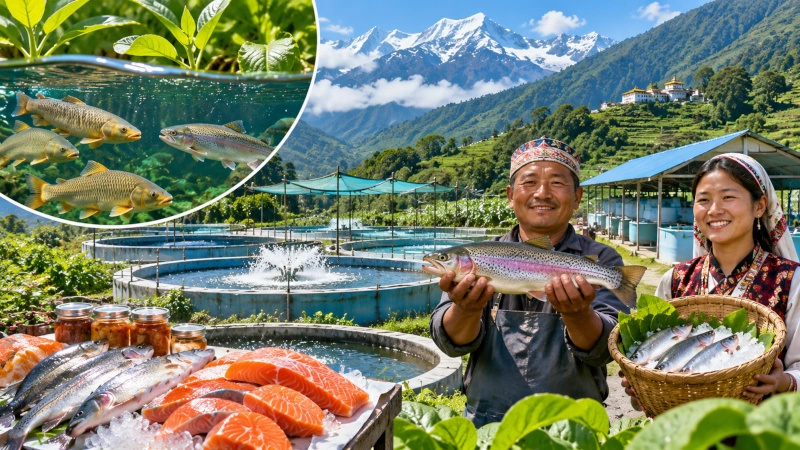
Soreng district in Sikkim has emerged as India’s first notified Organic Fisheries Cluster under the Pradhan Mantri Matsya Sampada Yojana (PMMSY), marking an important development in the country’s efforts to promote environmentally sustainable aquaculture and strengthen rural livelihoods. The initiative received further support with the launch of a Standard Operating Procedure (SOP) for Organic Certification of Fisheries in the Northeastern region and the inauguration of fisheries infrastructure projects worth ₹3.75 crore in Sikkim.
Union Minister for Fisheries, Animal Husbandry and Dairying Rajiv Ranjan Singh, also known as Lalan Singh, announced the developments during his visit to Mangan district in Sikkim on November 2, 2026. The visit formed part of the Centre’s programme of ministerial reviews across the Northeastern states, aimed at assessing the implementation of development schemes, strengthening coordination with state governments and obtaining direct feedback from beneficiaries.
The programme was attended by Sikkim’s Minister for Fisheries, Animal Husbandry, Veterinary Services, Dairying, Agriculture and Horticulture, Puran Kumar Gurung, along with Secretary of the Department of Fisheries Dr Abhilaksh Likhi, senior government officials, representatives of fisheries institutions, fish farmers and members of cooperative societies. The discussions focused on improving fisheries infrastructure, expanding market access and creating sustainable livelihood opportunities for communities engaged in aquaculture.
Soreng Establishes India’s First Organic Fisheries Cluster
The Organic Fisheries Cluster in Soreng represents a new approach to developing aquaculture around environmentally responsible production practices. The initiative seeks to promote fish farming without the use of harmful chemicals, antibiotics and pesticides while improving production quality, strengthening market linkages and increasing income opportunities for local fish farmers.
The cluster places particular emphasis on Amur carp, Indian Major Carps and trout, reflecting the diversity of fish species suitable for different aquaculture environments. By promoting organic production methods, the initiative aims to establish a distinct identity for fish and fish products originating from the region, potentially enabling farmers to access higher-value domestic and international markets.
Sikkim’s established organic agricultural ecosystem provides an important foundation for the initiative. The state has developed experience in promoting organic farming practices, creating opportunities to extend principles of environmentally responsible production into fisheries. However, organic aquaculture requires production-specific standards covering water quality, feed, fish health management and traceability, making the newly introduced certification framework particularly relevant.
The Soreng initiative is part of the Centre’s broader cluster-based strategy for fisheries development. Under PMMSY, 34 fisheries production and processing clusters have been notified across India, including organic fisheries clusters in Sikkim and Meghalaya. The approach is intended to integrate production, processing, value addition and marketing within identified geographical areas rather than treating each activity as an independent component of the fisheries economy.
New Certification Framework for Organic Fisheries
A major development during the ministerial visit was the launch of the Standard Operating Procedure for Organic Certification of Fisheries in the Northeastern region. The framework is intended to provide structured guidance for organic fish production while supporting traceability across different stages of the fisheries value chain.
Certification is particularly important for building consumer confidence in organically produced food products. In aquaculture, credible certification mechanisms can help establish whether production practices satisfy specified requirements and whether products can be traced through farming, handling and marketing processes. Such systems can also support market differentiation for producers seeking to supply buyers who place a premium on environmentally responsible production.
The Northeastern region has considerable potential for specialised fisheries development because of its diverse aquatic environments and opportunities for cultivating coldwater and freshwater fish species. Establishing a common certification framework could support greater consistency in production practices and help regional producers develop stronger market recognition.
The initiative is also expected to encourage fish farmers to adopt improved production management practices and participate in organised value chains. Its effectiveness will depend on the implementation of certification procedures, the availability of technical support and the ability of producers to meet the requirements necessary for accessing specialised markets.
Fisheries Infrastructure Projects Worth ₹3.75 Crore Inaugurated
The Union Minister also inaugurated fisheries infrastructure projects worth ₹375 lakh under PMMSY, covering several components essential for expanding aquaculture production and improving the efficiency of fisheries operations in Sikkim.
The projects include hatcheries, feed mills, cold storage facilities and production technologies such as Biofloc systems and Recirculatory Aquaculture Systems (RAS). These investments are intended to address important infrastructure requirements across the fisheries value chain, from fish seed production and feeding to cultivation, storage and marketing.
Hatcheries play a fundamental role in aquaculture by supporting the production and availability of fish seed, while feed mills contribute to more reliable access to fish nutrition. Cold storage facilities are essential for maintaining product quality and reducing post-harvest losses, particularly where producers must transport fish from relatively remote production areas to larger consumer markets.
Biofloc technology offers an approach to intensive aquaculture in which microbial communities help manage nutrients and organic waste within the production system. Recirculatory Aquaculture Systems, meanwhile, use water treatment and filtration processes to enable the reuse of water within controlled fish-rearing environments. Both technologies can support more efficient aquaculture operations when accompanied by appropriate technical expertise, infrastructure and management practices.
The introduction of these facilities is expected to strengthen Sikkim’s fisheries infrastructure and provide farmers with improved opportunities to increase production, maintain product quality and participate in organised markets.
Institutional Credit and Support for Fish Farmers
Financial assistance and improved access to institutional credit formed another component of the programme. Kisan Credit Cards were distributed to fish farmers to facilitate access to formal credit facilities, while cheques were presented to five beneficiaries under the Mukhya Mantri Matsya Uthpadhan Yojana, a state-level scheme supporting fisheries production and associated livelihoods.
Access to timely credit is important for fish farmers because aquaculture involves recurring expenditure on fish seed, feed, equipment, maintenance and other production requirements. Institutional financing can help eligible producers manage these expenses and invest in improvements that may otherwise be difficult to finance through personal savings.
During the visit, the Union Minister also inspected a Live Fish Vending Centre supported under PMMSY and interacted with members of fisheries cooperative societies to understand the challenges encountered by local producers. Fish feed was distributed to 15 farmers belonging to two fisheries cooperative societies, providing direct support to their production activities.
The programme included displays of fish, ornamental fish, value-added fisheries products, dairy products, animal products and locally grown organic vegetables. These exhibitions demonstrated the range of livelihood activities associated with the region’s agricultural and fisheries economy and highlighted opportunities for integrating production with processing and local marketing.
Sikkim Strengthens Rainbow Trout Market Linkages with ITBP
Another development highlighted by the Ministry was Sikkim’s agreement with the Indo-Tibetan Border Police (ITBP) for the institutional procurement of locally produced Rainbow Trout. The Memorandum of Understanding seeks to create a more dependable marketing arrangement for trout farmers by connecting regional production with demand from ITBP establishments.
Rainbow Trout is a commercially valuable coldwater fish whose cultivation is particularly relevant to suitable high-altitude environments. The development of reliable institutional buyers can provide producers with greater visibility over potential demand while encouraging improvements in production planning, quality management and supply coordination.
The proposed procurement arrangement envisages regular supplies of locally produced trout to ITBP establishments, subject to requirements concerning quality specifications, production capacity, pricing, inspection and delivery schedules. The agreement therefore represents a framework for developing an institutional market rather than confirmation that regular procurement has already commenced.
If implemented successfully, the arrangement could reduce some of the marketing uncertainties faced by trout farmers and strengthen the commercial viability of coldwater aquaculture. It may also provide a model for connecting local agricultural and fisheries producers with institutional consumers in other parts of the Northeastern region.
Building a Sustainable Fisheries Economy in Northeast India
The developments in Sikkim reflect the Centre’s emphasis on integrating infrastructure, technology, institutional financing, certification and market access into fisheries development programmes. The cluster-based approach under PMMSY seeks to address several interconnected challenges faced by fish farmers, including fragmented supply chains, inadequate storage infrastructure, limited processing facilities and difficulties accessing organised markets.
Organic fisheries development introduces an additional opportunity by allowing suitable regions to differentiate their products through recognised production standards and traceability. For Sikkim, where organic agriculture already forms an important part of the state’s development identity, the extension of sustainable practices into aquaculture could support greater diversification of the rural economy.
The combination of the Soreng Organic Fisheries Cluster, the newly launched certification framework and the ₹3.75 crore infrastructure investment provides a foundation for expanding organised aquaculture in the state. The proposed Rainbow Trout procurement arrangement with ITBP adds a market-oriented component by seeking to connect local fish production with institutional demand.
The long-term impact of these initiatives will depend on implementation, farmer participation, technical support and the development of dependable market channels. Nevertheless, the programme marks a significant effort to position Sikkim and the wider Northeastern region within India’s emerging ecosystem for sustainable, certified and commercially organised fisheries production.
Authenticity: ✅ Verified — Official Ministry of Fisheries, Animal Husbandry and Dairying announcement, published by PIB on 2 November 2026 at 3:37 PM. Press Information Bureau
Sikkim’s Soreng Becomes India’s First Organic Fisheries Cluster as Centre Launches New Certification Framework
New Delhi, November 2, 2026: Soreng district in Sikkim has emerged as India’s first notified Organic Fisheries Cluster under the Pradhan Mantri Matsya Sampada Yojana (PMMSY), marking an important development in the country’s efforts to promote environmentally sustainable aquaculture and strengthen rural livelihoods. The initiative received further support with the launch of a Standard Operating Procedure (SOP) for Organic Certification of Fisheries in the Northeastern region and the inauguration of fisheries infrastructure projects worth ₹3.75 crore in Sikkim.
Union Minister for Fisheries, Animal Husbandry and Dairying Rajiv Ranjan Singh, also known as Lalan Singh, announced the developments during his visit to Mangan district in Sikkim on November 2, 2026. The visit formed part of the Centre’s programme of ministerial reviews across the Northeastern states, aimed at assessing the implementation of development schemes, strengthening coordination with state governments and obtaining direct feedback from beneficiaries.
The programme was attended by Sikkim’s Minister for Fisheries, Animal Husbandry, Veterinary Services, Dairying, Agriculture and Horticulture, Puran Kumar Gurung, along with Secretary of the Department of Fisheries Dr Abhilaksh Likhi, senior government officials, representatives of fisheries institutions, fish farmers and members of cooperative societies. The discussions focused on improving fisheries infrastructure, expanding market access and creating sustainable livelihood opportunities for communities engaged in aquaculture.
Soreng Establishes India’s First Organic Fisheries Cluster
The Organic Fisheries Cluster in Soreng represents a new approach to developing aquaculture around environmentally responsible production practices. The initiative seeks to promote fish farming without the use of harmful chemicals, antibiotics and pesticides while improving production quality, strengthening market linkages and increasing income opportunities for local fish farmers.
The cluster places particular emphasis on Amur carp, Indian Major Carps and trout, reflecting the diversity of fish species suitable for different aquaculture environments. By promoting organic production methods, the initiative aims to establish a distinct identity for fish and fish products originating from the region, potentially enabling farmers to access higher-value domestic and international markets.
Sikkim’s established organic agricultural ecosystem provides an important foundation for the initiative. The state has developed experience in promoting organic farming practices, creating opportunities to extend principles of environmentally responsible production into fisheries. However, organic aquaculture requires production-specific standards covering water quality, feed, fish health management and traceability, making the newly introduced certification framework particularly relevant.
The Soreng initiative is part of the Centre’s broader cluster-based strategy for fisheries development. Under PMMSY, 34 fisheries production and processing clusters have been notified across India, including organic fisheries clusters in Sikkim and Meghalaya. The approach is intended to integrate production, processing, value addition and marketing within identified geographical areas rather than treating each activity as an independent component of the fisheries economy.
New Certification Framework for Organic Fisheries
A major development during the ministerial visit was the launch of the Standard Operating Procedure for Organic Certification of Fisheries in the Northeastern region. The framework is intended to provide structured guidance for organic fish production while supporting traceability across different stages of the fisheries value chain.
Certification is particularly important for building consumer confidence in organically produced food products. In aquaculture, credible certification mechanisms can help establish whether production practices satisfy specified requirements and whether products can be traced through farming, handling and marketing processes. Such systems can also support market differentiation for producers seeking to supply buyers who place a premium on environmentally responsible production.
The Northeastern region has considerable potential for specialised fisheries development because of its diverse aquatic environments and opportunities for cultivating coldwater and freshwater fish species. Establishing a common certification framework could support greater consistency in production practices and help regional producers develop stronger market recognition.
The initiative is also expected to encourage fish farmers to adopt improved production management practices and participate in organised value chains. Its effectiveness will depend on the implementation of certification procedures, the availability of technical support and the ability of producers to meet the requirements necessary for accessing specialised markets.
Fisheries Infrastructure Projects Worth ₹3.75 Crore Inaugurated
The Union Minister also inaugurated fisheries infrastructure projects worth ₹375 lakh under PMMSY, covering several components essential for expanding aquaculture production and improving the efficiency of fisheries operations in Sikkim.
The projects include hatcheries, feed mills, cold storage facilities and production technologies such as Biofloc systems and Recirculatory Aquaculture Systems (RAS). These investments are intended to address important infrastructure requirements across the fisheries value chain, from fish seed production and feeding to cultivation, storage and marketing.
Hatcheries play a fundamental role in aquaculture by supporting the production and availability of fish seed, while feed mills contribute to more reliable access to fish nutrition. Cold storage facilities are essential for maintaining product quality and reducing post-harvest losses, particularly where producers must transport fish from relatively remote production areas to larger consumer markets.
Biofloc technology offers an approach to intensive aquaculture in which microbial communities help manage nutrients and organic waste within the production system. Recirculatory Aquaculture Systems, meanwhile, use water treatment and filtration processes to enable the reuse of water within controlled fish-rearing environments. Both technologies can support more efficient aquaculture operations when accompanied by appropriate technical expertise, infrastructure and management practices.
The introduction of these facilities is expected to strengthen Sikkim’s fisheries infrastructure and provide farmers with improved opportunities to increase production, maintain product quality and participate in organised markets.
Institutional Credit and Support for Fish Farmers
Financial assistance and improved access to institutional credit formed another component of the programme. Kisan Credit Cards were distributed to fish farmers to facilitate access to formal credit facilities, while cheques were presented to five beneficiaries under the Mukhya Mantri Matsya Uthpadhan Yojana, a state-level scheme supporting fisheries production and associated livelihoods.
Access to timely credit is important for fish farmers because aquaculture involves recurring expenditure on fish seed, feed, equipment, maintenance and other production requirements. Institutional financing can help eligible producers manage these expenses and invest in improvements that may otherwise be difficult to finance through personal savings.
During the visit, the Union Minister also inspected a Live Fish Vending Centre supported under PMMSY and interacted with members of fisheries cooperative societies to understand the challenges encountered by local producers. Fish feed was distributed to 15 farmers belonging to two fisheries cooperative societies, providing direct support to their production activities.
The programme included displays of fish, ornamental fish, value-added fisheries products, dairy products, animal products and locally grown organic vegetables. These exhibitions demonstrated the range of livelihood activities associated with the region’s agricultural and fisheries economy and highlighted opportunities for integrating production with processing and local marketing.
Sikkim Strengthens Rainbow Trout Market Linkages with ITBP
Another development highlighted by the Ministry was Sikkim’s agreement with the Indo-Tibetan Border Police (ITBP) for the institutional procurement of locally produced Rainbow Trout. The Memorandum of Understanding seeks to create a more dependable marketing arrangement for trout farmers by connecting regional production with demand from ITBP establishments.
Rainbow Trout is a commercially valuable coldwater fish whose cultivation is particularly relevant to suitable high-altitude environments. The development of reliable institutional buyers can provide producers with greater visibility over potential demand while encouraging improvements in production planning, quality management and supply coordination.
The proposed procurement arrangement envisages regular supplies of locally produced trout to ITBP establishments, subject to requirements concerning quality specifications, production capacity, pricing, inspection and delivery schedules. The agreement therefore represents a framework for developing an institutional market rather than confirmation that regular procurement has already commenced.
If implemented successfully, the arrangement could reduce some of the marketing uncertainties faced by trout farmers and strengthen the commercial viability of coldwater aquaculture. It may also provide a model for connecting local agricultural and fisheries producers with institutional consumers in other parts of the Northeastern region.
Building a Sustainable Fisheries Economy in Northeast India
The developments in Sikkim reflect the Centre’s emphasis on integrating infrastructure, technology, institutional financing, certification and market access into fisheries development programmes. The cluster-based approach under PMMSY seeks to address several interconnected challenges faced by fish farmers, including fragmented supply chains, inadequate storage infrastructure, limited processing facilities and difficulties accessing organised markets.
Organic fisheries development introduces an additional opportunity by allowing suitable regions to differentiate their products through recognised production standards and traceability. For Sikkim, where organic agriculture already forms an important part of the state’s development identity, the extension of sustainable practices into aquaculture could support greater diversification of the rural economy.
The combination of the Soreng Organic Fisheries Cluster, the newly launched certification framework and the ₹3.75 crore infrastructure investment provides a foundation for expanding organised aquaculture in the state. The proposed Rainbow Trout procurement arrangement with ITBP adds a market-oriented component by seeking to connect local fish production with institutional demand.
The long-term impact of these initiatives will depend on implementation, farmer participation, technical support and the development of dependable market channels. Nevertheless, the programme marks a significant effort to position Sikkim and the wider Northeastern region within India’s emerging ecosystem for sustainable, certified and commercially organised fisheries production.
Reference
Ministry: Ministry of Fisheries, Animal Husbandry and Dairying, Government of India
Publication: Press Information Bureau
Date: 2 November 2026
Time: 3:37 PM IST
You may also like
-
India Advances Geothermal Energy Development with First Wells in Ladakh and National Policy Framework
-
Kalonunia Rice of West Bengal: The Fragrant Black-Husked Heritage Grain of North Bengal with GI Recognition
-
India’s Affle Announces $420 Million Acquisition of Israeli AI Advertising Company Perion
-
CISF Introduces Specialised Security Commands to Protect India’s Critical PSU and Industrial Infrastructure
-
Coal India Sets All-Time Monthly Production Record of 67.2 Million Tonnes in October 2026
