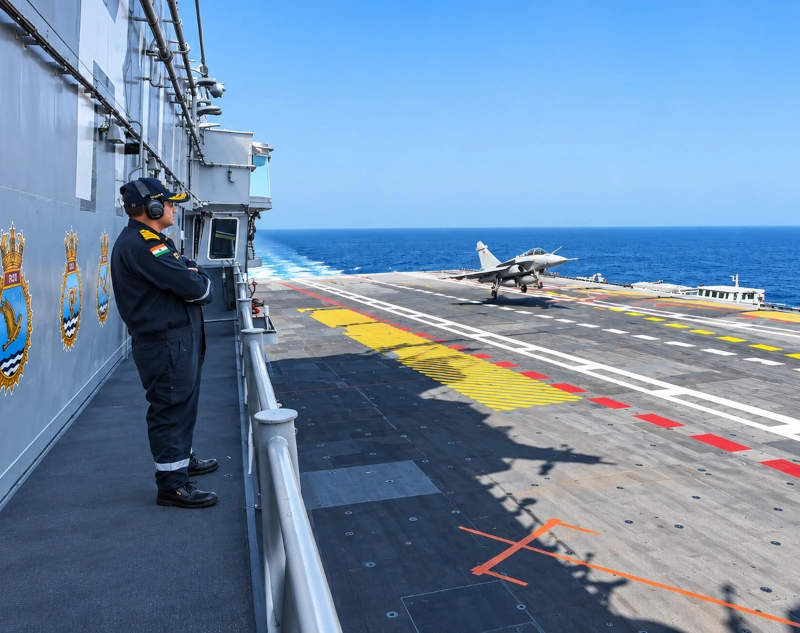
The Indian Navy has achieved a significant milestone in its naval aviation modernisation programme, with a Rafale Marine fighter aircraft successfully completing its first landing aboard India’s indigenously built aircraft carrier INS Vikrant. The French-built carrier-based fighter landed on the warship on October 29, 2026, successfully completing the manoeuvre on its maiden attempt as part of ongoing trials aimed at preparing the aircraft for future operations with the Indian Navy.
Confirming the development on October 30, the Indian Navy stated that the successful landing represented the first steps towards operationalising the Rafale Marine within its carrier-based aviation fleet. The Navy also released footage of the aircraft operating aboard INS Vikrant, highlighting the progress achieved in evaluating the fighter’s compatibility with India’s aircraft carrier infrastructure.
The development follows the intergovernmental agreement signed between India and France on April 28, 2025, for the procurement of 26 Rafale Marine aircraft at an estimated cost of ₹63,000 crore. The acquisition is intended to strengthen the Indian Navy’s carrier-based air defence, maritime strike and reconnaissance capabilities while supporting India’s broader naval aviation modernisation programme.
Rafale Marine Successfully Completes Maiden Carrier Landing
The successful landing on October 29 marked an important stage in the Indian Navy’s evaluation of the Rafale Marine fighter aircraft for operations aboard INS Vikrant. The aircraft completed its first landing attempt successfully, demonstrating progress in integrating the French naval fighter with the carrier’s arrested recovery system.
The ongoing evaluation programme is intended to assess the aircraft’s compatibility with India’s carrier operating arrangements and determine the modifications and operational procedures necessary for its eventual induction into naval service.
Before the carrier trials, the Rafale Marine underwent evaluations at the Indian Navy’s Shore-Based Test Facility at INS Hansa in Goa. The facility replicates important features of an aircraft carrier’s flight deck, including the ski-jump ramp and arrested recovery arrangements, allowing aircraft to be assessed under controlled conditions.
Testing at the shore-based facility provides engineers, pilots and naval aviation personnel with an opportunity to examine aircraft performance before conducting trials aboard an operational aircraft carrier. The transition to INS Vikrant represents a further stage in validating the aircraft’s suitability for Indian naval requirements.
The successful landing is particularly important because carrier operations demand precise coordination between pilots, flight deck personnel, aircraft handling teams and the ship’s aviation support systems. Unlike conventional land-based operations, aircraft must land within a restricted deck area while engaging specialised arresting equipment designed to bring them to a controlled stop.
Although the maiden landing represents an important technical achievement, it does not signify the completion of operational induction. Further evaluations, integration activities and preparations remain necessary before the Rafale Marine can enter regular service with the Indian Navy.
Understanding the Technical Challenge of Operating From INS Vikrant
One of the most important aspects of the Rafale Marine integration programme concerns the differences between French and Indian aircraft carrier operating configurations.
The Rafale Marine was originally developed for operations aboard the French Navy’s aircraft carrier Charles de Gaulle, which uses the Catapult Assisted Take-Off But Arrested Recovery system, commonly known as CATOBAR. Under this arrangement, a catapult provides additional acceleration during take-off, while arresting wires are used to recover aircraft during landing.
India’s aircraft carriers, INS Vikrant and INS Vikramaditya, employ the Short Take-Off But Arrested Recovery configuration, commonly known as STOBAR. Under this system, fighter aircraft accelerate using their own engine thrust and launch from a ski-jump ramp positioned at the forward end of the carrier’s flight deck.
During landing, aircraft operating under the STOBAR configuration use an arrestor hook to engage a wire installed across the flight deck, allowing the aircraft to decelerate rapidly within the limited available distance.
Although the recovery arrangements share important similarities with the French carrier system, the take-off requirements are significantly different. Aircraft operating from Indian carriers must achieve the necessary launch performance without assistance from a catapult.
Consequently, the Rafale Marine requires detailed evaluation of ski-jump launch characteristics, aircraft weight limitations, flight deck handling procedures and compatibility with the carrier’s support infrastructure.
The successful landing aboard INS Vikrant provides an important demonstration of compatibility with the ship’s recovery arrangements. However, the operational suitability of the aircraft across different mission configurations, payload conditions and launch requirements must be established through the wider evaluation programme.
India Signed ₹63,000 Crore Agreement for 26 Rafale Marine Fighters
The Indian Navy’s Rafale Marine programme received formal approval through an intergovernmental agreement signed between India and France on April 28, 2025.
According to the Ministry of Defence, the agreement provides for the acquisition of 26 Rafale aircraft, comprising 22 single-seat fighters and four twin-seat aircraft. The procurement package includes weapons, flight simulators, associated equipment, training arrangements and performance-based logistical support.
The agreement was signed by Defence Minister Rajnath Singh and French Minister of the Armed Forces Sébastien Lecornu. The signed documents and associated protocols were exchanged by Indian and French officials at Nausena Bhawan in New Delhi.
The procurement agreement also includes additional equipment for the Indian Air Force’s existing Rafale fleet, creating opportunities for greater logistical and technical commonality between the two services.
The Ministry of Defence has stated that deliveries under the agreement are scheduled to be completed by 2030. Training for Indian personnel will be conducted in both India and France, allowing naval aviation teams to develop the specialised expertise necessary to operate and maintain the new aircraft.
The acquisition is intended to strengthen India’s carrier-based fighter capabilities as the Navy continues modernising its aviation fleet and preparing for future operational requirements.
Rafale Marine Designed for Advanced Naval Combat Operations
The Rafale Marine is a twin-engine, multirole combat aircraft developed by French aerospace manufacturer Dassault Aviation for aircraft carrier operations.
The naval variant incorporates specialised structural features and equipment necessary to withstand the demanding conditions associated with carrier-based aviation. These include reinforced landing gear, an arrestor hook and systems designed to support operations from a moving warship.
According to the Ministry of Defence’s April 2025 backgrounder, the Rafale Marine is capable of reaching speeds of up to Mach 1.8 and operating at altitudes of approximately 50,000 feet.
The aircraft is designed to undertake multiple mission categories, including air defence, maritime strike, reconnaissance and attacks against designated land targets.
Its advanced avionics, radar systems, electronic warfare capabilities and precision-guided weapons are intended to improve the effectiveness of naval air operations across different operational environments.
Carrier-based fighter aircraft provide naval commanders with the ability to deploy combat air power from mobile platforms operating at sea. This capability supports the protection of naval formations, maritime surveillance and offensive operations without requiring the aircraft to operate exclusively from land-based airfields.
The introduction of the Rafale Marine is expected to strengthen the Indian Navy’s ability to conduct such operations across the Indian Ocean region and other areas of maritime interest.
INS Vikrant Demonstrates India’s Indigenous Shipbuilding Capabilities
The successful Rafale Marine landing also highlights the continuing evolution of INS Vikrant, India’s first indigenously designed and constructed aircraft carrier.
The warship was designed by the Indian Navy’s Warship Design Bureau and built by Cochin Shipyard Limited in Kochi, Kerala. It was commissioned into the Indian Navy on September 2, 2022, marking an important achievement in India’s indigenous naval shipbuilding programme.
The construction of INS Vikrant involved participation from Indian public-sector enterprises, private manufacturers, specialised engineering organisations and numerous micro, small and medium enterprises.
The programme also supported the development of indigenous warship-grade steel through cooperation involving the Indian Navy, Defence Research and Development Organisation and Steel Authority of India Limited.
The carrier has a displacement of approximately 45,000 tonnes and is designed to operate fixed-wing fighter aircraft and helicopters.
Its aviation facilities include a ski-jump flight deck and arrested recovery system, allowing it to support fighter operations under the STOBAR configuration.
The successful integration of different aircraft types is important to the carrier’s long-term operational flexibility. The Rafale Marine trials represent another stage in expanding the range of aviation capabilities that can be supported by the indigenously constructed warship.
INS Vikrant’s continuing development demonstrates the relationship between indigenous naval shipbuilding and the integration of advanced aviation technologies acquired through international defence partnerships.
Rafale Marine to Operate From India’s Two Aircraft Carriers
The Indian Navy currently operates two aircraft carriers, INS Vikrant and INS Vikramaditya, both configured for STOBAR operations.
The Rafale Marine acquisition is intended to strengthen the combat aviation capabilities available to these carriers, which presently rely on MiG-29K fighter aircraft for fixed-wing operations.
The Ministry of Defence has identified both INS Vikrant and INS Vikramaditya as platforms for the future deployment of Rafale Marine fighters.
Preparing the aircraft for operations aboard these ships requires extensive technical assessment, including flight deck compatibility, aircraft handling, maintenance procedures, logistical arrangements and integration with existing naval aviation systems.
The Indian Navy must also establish appropriate training procedures for pilots, technical personnel and flight deck crews responsible for operating the aircraft at sea.
Carrier aviation presents unique operational challenges because aircraft must function within restricted deck spaces while being exposed to changing weather conditions, ship movement and demanding launch and recovery requirements.
The ongoing trials are therefore essential to ensure that the Rafale Marine can be integrated safely and effectively into India’s carrier aviation environment.
The successful first landing aboard INS Vikrant represents measurable progress towards this objective, although routine operational deployments will depend on the completion of subsequent evaluation and induction activities.
Defence Agreement Includes Indigenous Weapons Integration
An important component of the Rafale Marine procurement agreement is its provision for the integration of indigenous Indian weapon systems.
According to the Ministry of Defence, the agreement includes transfer of technology arrangements intended to support the integration of Indian-developed weapons into the aircraft.
This provision is relevant to India’s efforts to strengthen domestic defence capabilities and improve the participation of Indian industries in advanced military aviation programmes.
Integrating indigenous weapons requires detailed engineering assessments, software compatibility evaluations, flight testing and operational qualification before the systems can be introduced into service.
The agreement establishes a framework for undertaking such activities, although individual weapon integration programmes will require their own development and validation processes.
The Ministry of Defence has also confirmed provisions for establishing Rafale fuselage production facilities in India.
Additional arrangements include maintenance, repair and overhaul facilities for aircraft engines, sensors and weapons.
These facilities are intended to support the long-term maintenance requirements of the Rafale fleet while creating opportunities for domestic aerospace manufacturers and specialised engineering companies.
The government has also highlighted the potential for employment generation and participation by Indian micro, small and medium enterprises.
The development of indigenous maintenance and manufacturing infrastructure could contribute to the sustainability of the aircraft programme by strengthening domestic technical capabilities and reducing dependence on overseas support for selected activities.
Commonality With Indian Air Force Rafale Fleet
India already operates the land-based Rafale fighter aircraft through the Indian Air Force, following an agreement signed with France in September 2016 for the procurement of 36 aircraft.
Although the Rafale Marine incorporates modifications specifically intended for aircraft carrier operations, the naval and land-based variants share several important technological systems and design features.
This commonality offers potential advantages in maintenance practices, technical training, logistical support and the availability of specialised expertise.
The Ministry of Defence has highlighted the benefits of such commonality in supporting the management of the two fleets.
The existing Indian Air Force Rafale programme has already established a foundation of operational experience, technical knowledge and support arrangements within India.
The Navy’s acquisition provides an opportunity to build upon this experience while developing the specialised capabilities necessary for carrier-based aviation.
However, the two variants operate in different environments, and the additional structural and operational requirements of the Rafale Marine mean that dedicated naval training and integration activities remain essential.
The ongoing carrier trials form part of the process of establishing these specialised operational capabilities.
Rafale Marine and India’s Indigenous Naval Fighter Programme
The introduction of the Rafale Marine is taking place alongside India’s continuing efforts to develop indigenous carrier-based fighter aircraft.
India is pursuing the Twin Engine Deck Based Fighter programme, which is intended to develop a domestically designed combat aircraft for future naval aviation requirements.
The programme forms part of the country’s broader objective of expanding indigenous expertise in advanced combat aircraft design, development and manufacturing.
The Rafale Marine is expected to strengthen the Navy’s carrier aviation capabilities while domestic development programmes continue.
This approach combines the acquisition of an established naval fighter platform with long-term investments in indigenous aerospace technology.
The development of carrier-based fighters presents considerable engineering challenges, particularly in areas such as aircraft structural strength, launch performance, arrested recovery, corrosion resistance and operations from restricted flight decks.
Experience gained from aircraft integration and carrier operations can contribute to the broader development of naval aviation expertise within the country.
The Rafale Marine programme therefore forms part of a wider effort to strengthen current operational capabilities while supporting the evolution of India’s future naval aviation ecosystem.
Strengthening India’s Maritime Defence Capabilities
India’s maritime security responsibilities extend across a strategically important region encompassing major international shipping routes, energy transportation corridors and critical waterways connecting the Indian Ocean with other parts of the world.
Aircraft carriers provide the Indian Navy with mobile aviation platforms capable of supporting fleet protection, reconnaissance, maritime security and combat missions.
The effectiveness of these platforms depends significantly on the capabilities of the aircraft they operate.
Modern carrier-based fighters can strengthen a naval formation’s ability to monitor surrounding areas, respond to potential aerial threats and conduct maritime strike operations when required.
The Rafale Marine acquisition is intended to improve these capabilities through the introduction of a modern multirole fighter equipped with advanced avionics and weapon systems.
The successful landing aboard INS Vikrant demonstrates progress in preparing the aircraft for operations within India’s carrier aviation framework.
As the integration programme advances, the Navy will continue developing the technical procedures, support infrastructure and operational expertise necessary to introduce the new aircraft into service.
A Significant Step Towards Future Naval Aviation Capabilities
The successful first landing of a Rafale Marine fighter aboard INS Vikrant on October 29, 2026, represents an important achievement in the Indian Navy’s ongoing aircraft carrier modernisation programme.
The trial demonstrates progress in evaluating the compatibility of the French-built fighter with India’s indigenous aircraft carrier and its specialised recovery system.
It also highlights the continuing importance of India–France defence cooperation in advanced military aviation and the role of international technological partnerships in strengthening India’s maritime capabilities.
The acquisition of 26 Rafale Marine aircraft, together with associated training, maintenance infrastructure and indigenous weapons integration provisions, is expected to contribute to the modernisation of India’s carrier-based fighter fleet.
At the same time, the programme supports India’s broader defence industrial objectives through the proposed establishment of domestic manufacturing and maintenance facilities.
Although the October 29 landing does not represent the completion of operational induction, it marks a significant stage in preparing the Rafale Marine for future service aboard Indian aircraft carriers.
The achievement reflects the continuing development of India’s naval aviation capabilities and the growing importance of integrating modern combat aircraft with indigenously constructed naval platforms.
References
Indian Navy, 30 October 2026. Official announcement confirming that a Rafale Marine aircraft successfully landed aboard INS Vikrant on its maiden attempt on October 29, 2026. The Navy stated that the ongoing trials represented the first steps towards operationalisation of the aircraft.
Source: https://x.com/indiannavy
Press Information Bureau, Ministry of Defence, Government of India, 28 April 2025. Inter-Governmental Agreement Inked with France for 26 Rafale-Marine Aircraft for Indian Navy. The official announcement provides details of the procurement agreement, aircraft numbers, training arrangements, weapons, maintenance support and technology transfer provisions.
Source: https://www.pib.gov.in/PressReleasePage.aspx?PRID=2124851
Press Information Bureau, Government of India, 29 April 2025. Rafale-Marine: Enhancing India’s Naval Strength. The official government backgrounder examines the aircraft’s capabilities, procurement package, planned deployment aboard INS Vikrant and INS Vikramaditya, and the significance of the programme for India’s naval aviation capabilities.
Source: https://www.pib.gov.in/PressNoteDetails.aspx?ModuleId=3&NoteId=154353&lang=1®=3
Press Information Bureau, Ministry of Defence, Government of India. Official information concerning the Rafale Marine acquisition, technology transfer provisions, indigenous weapons integration and the establishment of maintenance, repair and overhaul facilities in India.
Source: https://www.pib.gov.in/PressReleasePage.aspx?PRID=2124851
You may also like
-
Goodluck Defence Secures ₹58.20-Crore Domestic Order for 155mm Artillery Shells
-
Envirotech Systems Secures Indian Navy Contract for Acoustic Silencer Prototype
-
Munish Forge Secures ₹19.18-Crore Defence Order from Armoured Vehicles Nigam Limited
-
India Strengthens Myanmar Border Security as Manipur Completes 55 Km of Fencing
-
Quad Announces Over $85 Million Initiative to Expand Trusted Artificial Intelligence Across Indo-Pacific
