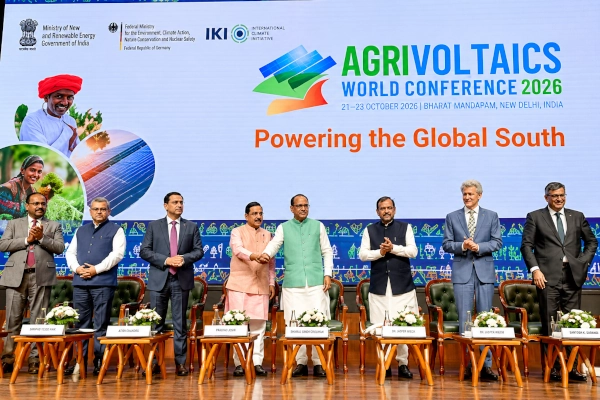
India has taken a significant step towards integrating agriculture with renewable energy by hosting the seventh AgriVoltaics World Conference (AWC 2026) at Bharat Mandapam, New Delhi, from October 21 to 23, 2026. The conference, being held in the Global South for the first time, brings together international experts, policymakers, researchers, industry leaders and startups to explore how agricultural land can simultaneously support food production and solar electricity generation.
Union Minister for Agriculture and Farmers Welfare Shivraj Singh Chouhan and Union Minister for New and Renewable Energy Pralhad Joshi jointly inaugurated the three-day conference on October 21. Organised under the theme “Powering the Global South,” the event focuses on transforming India’s farmers from Annadatas, or food providers, into Urjadatas, or energy producers, without compromising agricultural productivity.
A major announcement at the conference was the government’s plan to introduce an ambitious agrivoltaics programme under the next phase of the Pradhan Mantri Kisan Urja Suraksha evam Utthaan Mahabhiyan (PM-KUSUM). The proposed expansion aims to create new income opportunities for farmers while accelerating India’s transition towards renewable energy.
What Is Agrivoltaics and How Does It Benefit Farmers?
Agrivoltaics, also known as AgriPV, is an innovative approach that combines agricultural cultivation with solar electricity generation on the same land. Instead of dedicating farmland exclusively to solar installations, agrivoltaic systems position solar panels above or between crops, allowing agricultural activities to continue while generating clean electricity.
The concept follows the principle of “One Land, Two Harvests,” under which farmers can potentially earn income from both agricultural produce and electricity generation. Carefully designed systems can also regulate sunlight exposure, reduce excessive soil moisture loss and create more favourable growing conditions for certain crops.
Agrivoltaics is particularly relevant to India, where agricultural land is under increasing pressure from industrial expansion, urbanisation and competing infrastructure requirements. By enabling the dual use of existing farmland, the technology offers an alternative to converting productive agricultural land entirely into solar power installations.
The technology can support different agricultural activities, including horticulture, vegetables, spices, fruit cultivation, floriculture, fodder production and certain forms of livestock rearing. However, system designs must account for local climatic conditions, crop requirements, agricultural machinery and farming practices.
India Identifies 47.5 Million Hectares of Potential Agrivoltaic Land
Addressing the inaugural session, Pralhad Joshi highlighted the enormous technical potential for agrivoltaics across India.
Citing a study by The Energy and Resources Institute (TERI), the Minister stated that approximately 47.5 million hectares of agricultural land, representing nearly 30 per cent of India’s 160 million hectares of cropland, could be technically suitable for agrivoltaic installations.
The study examined a deployment scenario involving 16 million hectares of agricultural land and estimated annual electricity generation of approximately 12,775 terawatt-hours (TWh). This figure is significant when compared with India’s projected annual electricity demand of 5,250–10,020 TWh by 2050.
These estimates represent technical potential rather than confirmed generation capacity. Actual deployment would depend on crop compatibility, land availability, infrastructure, economic feasibility and local environmental conditions.
Maharashtra, Rajasthan, Andhra Pradesh, Madhya Pradesh, Karnataka and Uttar Pradesh together account for nearly 50 per cent of the country’s estimated agrivoltaic potential. Their agricultural landscapes, climatic conditions and solar resources provide opportunities for developing region-specific agrivoltaic models.
Next Phase of PM-KUSUM to Introduce Large-Scale Agrivoltaics Programme
One of the most important announcements at AWC 2026 concerned the proposed expansion of PM-KUSUM to support agrivoltaic capacity creation.
Pralhad Joshi announced that the next phase of the scheme would include one of the world’s most ambitious agrivoltaics programmes, aligning solar energy deployment with agricultural development and farmers’ income generation.
PM-KUSUM already supports decentralised solar power plants, standalone solar-powered irrigation pumps and the solarisation of existing grid-connected agricultural pumps. Its implementation has helped reduce dependence on diesel-powered irrigation and expand access to renewable energy in rural areas.
According to MNRE Secretary Santosh Kumar Sarangi, approximately 25 lakh agricultural pump sets have been solarised under the programme, benefiting around 25 lakh farmers. These installations have helped farmers reduce diesel consumption while supporting India’s efforts to lower petroleum import dependence.
The proposed agrivoltaic expansion will build on this experience by integrating electricity generation with continuing agricultural cultivation.
Joshi also acknowledged the additional infrastructure costs associated with agrivoltaic installations. Elevated solar panels, specialised mounting structures and tilted configurations can make these systems approximately 25–30 per cent more expensive than conventional ground-mounted solar plants.
The government aims to address this cost difference through support for agrivoltaic capacity development. The Ministry is also working with agricultural authorities, state energy departments and electricity distribution companies to develop procurement and financing models that can support wider implementation.
Small and Marginal Farmers Must Remain at the Centre of Agrivoltaic Development
Agriculture Minister Shivraj Singh Chouhan emphasised that India’s agrivoltaic policies must reflect the practical requirements of small and marginal farmers, who account for more than 85 per cent of the country’s farming community.
With India’s average agricultural landholding measuring approximately 0.96 hectares, large solar installations cannot simply follow the design principles used for conventional solar parks.
Chouhan stressed that agrivoltaic systems must allow farmers to continue ploughing, cultivating and changing crops according to seasonal requirements. Solar panel height, the spacing between supporting structures and access for agricultural machinery must therefore form essential considerations during project planning.
He also highlighted the importance of rainwater drainage and harvesting arrangements to prevent soil erosion and support efficient water management. Agrivoltaic infrastructure must strengthen agricultural productivity rather than restrict existing farming activities.
The Minister advocated greater participation by Farmer Producer Organisations (FPOs), which could help small farmers collectively access technology, financing, technical services and electricity markets.
Training rural youth and women in solar equipment installation, operation, maintenance and repair could also create employment opportunities within villages. Such participation would help establish local technical capabilities while supporting the long-term operation of agrivoltaic systems.
Agrivoltaics Could Improve Crop Yields and Reduce Water Consumption
The conference highlighted emerging research indicating that well-designed agrivoltaic systems can provide agricultural benefits beyond electricity generation.
Pralhad Joshi cited field studies suggesting that certain crops could experience yield improvements of approximately 10–20 per cent under suitable agrivoltaic conditions. Some systems have also demonstrated reductions of around 30 per cent in water consumption.
These benefits arise partly from the shading effects of solar panels, which can reduce excessive heat exposure and moderate the microclimate surrounding crops. Lower evaporation rates may help conserve soil moisture, particularly in regions experiencing high temperatures and water stress.
However, the agricultural performance of agrivoltaic systems depends on crop type, panel positioning, sunlight requirements and local climatic conditions. Crops requiring uninterrupted sunlight may respond differently from those that tolerate partial shade.
Precision farming technologies, automated irrigation, soil sensors and digital monitoring systems can further improve the performance of these installations. Their integration allows farmers to manage electricity generation and agricultural cultivation as complementary activities.
For regions facing increasingly unpredictable rainfall, rising temperatures and water scarcity, agrivoltaics offers another technological approach to strengthening climate-resilient agriculture.
India Crosses 308 GW of Non-Fossil Fuel Electricity Capacity
The conference also provided an opportunity to highlight India’s progress in expanding non-fossil fuel-based electricity infrastructure.
Pralhad Joshi stated that India’s installed non-fossil fuel electricity capacity had reached 308.03 GW, accounting for more than 55 per cent of the country’s total installed electricity capacity of approximately 560 GW.
The Minister highlighted the contribution of decentralised renewable energy programmes to this expansion. During the preceding year, decentralised solar capacity reached 16.3 GW, including 7.6 GW under PM-KUSUM and 8.7 GW from rooftop solar installations.
The PM Surya Ghar Muft Bijli Yojana has also contributed to rooftop solar adoption, with the programme crossing 63 lakh beneficiaries.
Agrivoltaics could complement these initiatives by creating additional opportunities for solar electricity generation within agricultural landscapes. Unlike conventional solar parks, such systems can integrate power generation into existing rural economic activities.
Their development could also support electricity supply near agricultural processing centres, irrigation facilities, warehouses and rural enterprises.
Electricity Generation Costs and Commercial Viability
Economic viability remains an important consideration in expanding agrivoltaics beyond demonstration projects.
Pralhad Joshi noted that the average cost of electricity supply during 2025–26 was approximately ₹7 per unit. Some agrivoltaic assessments, under specific assumptions, indicated potential electricity generation costs of ₹3.20–₹3.30 per unit.
These figures suggest opportunities for competitive electricity generation through efficient project design, suitable financing arrangements and appropriate policy support.
Nevertheless, agrivoltaic economics differ from conventional solar projects because of additional structural requirements, agricultural compatibility and maintenance considerations.
For farmers, commercial arrangements will also determine whether electricity generation provides a dependable additional income stream. Cooperation among farmers, project developers, electricity distribution companies and financial institutions will therefore be important in creating viable business models.
The next phase of PM-KUSUM is expected to place greater emphasis on aligning agricultural programmes with renewable energy development, improving access to financing and creating practical models suited to different farming communities.
Solar Farming Could Create Over Three Lakh Employment Opportunities
Beyond electricity generation and agricultural productivity, agrivoltaics offers opportunities for rural employment and entrepreneurship.
According to the AgriPV Manual prepared by the Center for Study of Science, Technology and Policy, the sector could support approximately 1.10 lakh to 3.32 lakh full-time-equivalent jobs.
Employment opportunities could emerge in project planning, solar equipment manufacturing, installation, electrical maintenance, agricultural monitoring, irrigation management and technical services.
The integration of digital technologies with farming also creates demand for skilled personnel capable of operating sensors, monitoring equipment and automated agricultural systems.
Farmer Producer Organisations, rural entrepreneurs, technical training institutions and startups could participate in developing these services. Local maintenance networks would be particularly important in supporting installations across geographically dispersed agricultural areas.
By creating additional economic activities within villages, agrivoltaics could help diversify rural employment while strengthening the connection between agriculture and India’s expanding clean energy industry.
India Hosts Global Conference with Over 1,200 Delegates
The seventh AgriVoltaics World Conference has attracted more than 1,200 delegates, including over 150 international participants. The gathering includes policymakers, scientists, researchers, renewable energy companies, agricultural experts, startups, investors and development organisations.
The Ministry of New and Renewable Energy is hosting the conference with support from Germany’s Federal Ministry for the Environment, Climate Action, Nature Conservation and Nuclear Safety and in partnership with Conexio-PSE.
The inaugural programme included addresses by Shivraj Singh Chouhan and Pralhad Joshi, along with a video message from German Federal Environment Minister Carsten Schneider. German Ambassador to India and Bhutan Dr. Jasper Wieck also delivered special remarks.
Minister of State for New and Renewable Energy and Power Shripad Yesso Naik, MNRE Secretary Santosh Kumar Sarangi and Agriculture Secretary Atish Chandra participated in the proceedings.
The conference includes a dedicated India Focus Track and two parallel scientific tracks covering technological innovation, agricultural productivity, climate resilience, policy frameworks, financing and farmer-oriented business models.
Its international participation provides opportunities for India to exchange practical experiences with countries facing similar challenges involving agricultural land, food security, water availability and rural energy access.
New Agrivoltaics Policy Handbook and Technical Resources Launched
The conference featured the launch of several knowledge resources intended to support agrivoltaic research, policymaking and implementation.
The India Agrivoltaics Alliance introduced a Decision-Making Tool designed to assist stakeholders in evaluating agrivoltaic opportunities. The International Water Management Institute presented a Book of Abstracts containing scientific contributions associated with the conference.
The Ministry of New and Renewable Energy also launched an AgriPV Policy Handbook to support the development of appropriate policy frameworks for integrating agriculture with solar electricity generation.
Another important initiative highlighted at the event was the Global Agrivoltaics Climate-Zone Technical Framework.
The framework aims to assist governments, researchers, farmers, developers and financial institutions in identifying suitable technological approaches for different climatic and agricultural environments.
Such resources can contribute to the development of technical standards, project evaluation methods and agricultural safeguards while supporting the transition from isolated pilot installations towards wider commercial deployment.
Startups and Deep-Tech Companies Explore New Agrivoltaic Technologies
Innovation and entrepreneurship form an important component of AWC 2026.
A dedicated AgriVoltaics Pitch Hub provides a platform for startups and technology companies to present emerging solutions to investors, industry representatives and international experts.
The initiative seeks to connect clean-energy innovators with venture capitalists, research institutions and businesses interested in developing commercially viable agrivoltaic technologies.
Potential areas of innovation include elevated solar mounting systems, automated panel positioning, intelligent irrigation, crop monitoring, digital agricultural platforms and integrated energy management.
Technology developers can also explore solutions suited to smaller agricultural holdings, where equipment affordability, installation flexibility and ease of maintenance are essential.
By encouraging direct engagement between startups, researchers and investors, the conference aims to accelerate the development of technologies that can operate effectively under Indian agricultural conditions.
Connecting Agrivoltaics with Rural Logistics and Cold-Chain Infrastructure
The conference also highlighted opportunities to integrate agrivoltaic development with existing rural infrastructure.
Pralhad Joshi noted that more than 7.70 lakh geo-tagged rural facilities had been mapped under the Pradhan Mantri Gram Sadak Yojana. Additionally, over 400 integrated cold-chain projects had received approval under the PM Kisan SAMPADA Yojana.
The Minister suggested that mapping information from agricultural facilities could be integrated with electricity-grid infrastructure to identify suitable locations for agrivoltaic projects.
Such planning could help position renewable energy installations near agricultural markets, warehouses, processing centres and cold-chain facilities.
Improved coordination between electricity generation and agricultural infrastructure would support more efficient use of renewable energy while strengthening rural logistics and food supply chains.
The approach also creates opportunities to combine solar electricity generation with agricultural value addition, helping farming communities participate in activities beyond primary crop production.
India and Germany Strengthen Agrivoltaics Cooperation
International collaboration is central to the conference, particularly as countries across Asia, Africa and Latin America seek practical solutions to food security, rising energy demand and climate-related agricultural challenges.
Germany’s participation reflects the continuing importance of Indo-German cooperation in renewable energy research, technological development and sustainable agriculture.
Pralhad Joshi acknowledged the contributions of German institutions, the Indo-German Cooperation on Agrivoltaics and the International Solar Alliance in advancing the sector.
The Minister also highlighted international policy approaches that could provide useful lessons for India.
Italy has introduced a €1.7 billion funding programme supporting agrivoltaic development involving farmers, solar companies and research institutions. Japan has opened agricultural land categories to agrivoltaic installations while encouraging smaller systems through preferential electricity tariffs.
Germany has linked agrivoltaic support to continued agricultural cultivation and minimum crop-yield requirements, helping ensure that solar installations do not undermine farming activities.
Drawing upon such international experience, India aims to develop models suited to its agricultural structure, particularly the requirements of small and marginal farmers.
India Positions Agrivoltaics as a New Model for Rural Development
The AgriVoltaics World Conference 2026 marks an important development in India’s efforts to combine agricultural productivity, renewable energy generation and rural economic development.
With an estimated 47.5 million hectares of technically suitable agricultural land, India possesses substantial potential to develop agrivoltaic systems adapted to different crops, climatic regions and farming practices.
The planned expansion under PM-KUSUM could help establish the policy and financing foundations required to bring agrivoltaics into mainstream agricultural development. Equally important will be practical system designs that protect cultivation, conserve water and provide farmers with reliable economic benefits.
The participation of international researchers, Indian startups, agricultural organisations and renewable energy companies is expected to accelerate innovation while supporting the development of affordable technologies.
As India advances towards a more sustainable agricultural and energy economy, agrivoltaics offers a promising model in which farmland continues producing food while contributing to national electricity generation.
The transformation of Annadatas into Urjadatas represents a broader vision of rural development, empowering India’s farmers to participate directly in the clean energy economy while safeguarding the country’s agricultural future.
References
1. Press Information Bureau, Ministry of New and Renewable Energy, Government of India
India Hosts Agrivoltaics World Conference 2026.
Published: October 21, 2026, 6:08 PM IST.
2. Press Information Bureau, Ministry of New and Renewable Energy, Government of India
India Hosts Agrivoltaics World Conference 2026 for the First Time in the Global South.
Published: October 21, 2026, 5:40 PM IST.
3. The Energy and Resources Institute (TERI)
Agrivoltaics technical potential estimates for India, as cited by the Ministry of New and Renewable Energy during AWC 2026.
4. Center for Study of Science, Technology and Policy (CSTEP)
AgriPV Manual. Employment potential estimates cited during the conference.
5. Ministry of New and Renewable Energy (MNRE)
AgriPV Policy Handbook, launched at the AgriVoltaics World Conference 2026.
You may also like
-
India and New Zealand Strengthen Trade Ties with Electronic Origin Data Exchange Agreement Under FTA
-
Piyush Goyal to Visit Germany and Netherlands with 100 Indian Businesses and Startups to Strengthen Trade and Investment
-
Marcha Rice of Bihar: The GI-Tagged Aromatic Heritage of West Champaran
-
Gobindabhog Rice: West Bengal’s Fragrant Heritage Grain of Bhog, Payesh and Festive Cuisine
-
UDAN Completes 10 Years with 687 Air Routes as India Plans 100 New Regional Airports and 200 Helipads
