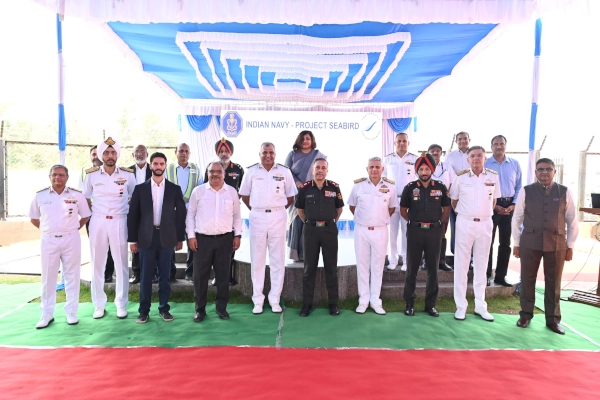
India’s ambitious Project Seabird naval infrastructure programme at Karwar, Karnataka, has reached another milestone with the inauguration of new residential facilities, essential utilities and supporting infrastructure under Phase IIA. The development strengthens the Indian Navy’s efforts to establish Karwar as a major naval base capable of supporting warships, submarines, aircraft and thousands of naval personnel.
Chief of Defence Staff General NS Raja Subramani, who also serves as Secretary of the Department of Military Affairs, inaugurated the facilities on October 8, 2026. Vice Admiral Vivek Dahiya, Director General Seabird, and other senior naval officers attended the ceremony.
The latest development forms part of a much larger infrastructure expansion that includes a dual-use Naval Air Station, a full-fledged Naval Dockyard and extensive logistics facilities. Significantly, Project Seabird sources more than 90% of its materials and equipment domestically, demonstrating India’s growing capabilities in indigenous defence infrastructure development.
New Residential Infrastructure Inaugurated at Naval Base Karwar
The newly inaugurated residential facilities are located at East of Manzil Creek (EOMC) and Amadalli within the Naval Base Karwar complex. They have been developed to accommodate senior sailors, naval defence civilians and personnel responsible for maintaining the security of the installation.
The new accommodation includes 60 dwelling units for married senior sailors and another 60 dwelling units for naval defence civilians. The development also provides inliving accommodation for 156 Defence Security Corps (DSC) personnel and a kindergarten school to serve families residing within the naval township.
These facilities are supported by essential trunk utility infrastructure and amenities required for residential communities. Such infrastructure provides the services necessary to sustain an expanding military establishment, including utility distribution and connections to common facilities.
Hyderabad-based NCC Limited constructed the residential buildings and associated amenities, while Cemindia Projects India Limited executed the trunk infrastructure works. The participation of Indian construction companies reflects the role of domestic industry in developing large-scale defence installations.
Project Seabird Phase IIA Expands India’s Naval Infrastructure
Project Seabird is one of India’s most significant naval infrastructure development programmes. Located along the Arabian Sea coast in Karnataka’s Uttara Kannada district, the project is intended to expand the Indian Navy’s capacity to accommodate and support major surface combatants, submarines and associated maritime operations.
Phase IIA focuses on developing the infrastructure required for a modern naval base, including berthing facilities, ship maintenance installations, aviation infrastructure, logistics networks and residential townships.
A major component of the expansion is the planned dual-use Naval Air Station, which will provide additional aviation infrastructure alongside the naval base. The project also includes a full-fledged Naval Dockyard to support ship maintenance, repair and operational requirements.
Earlier Ministry of Defence releases have identified four covered dry berths as another component of Phase IIA. These facilities form part of the wider effort to strengthen the Navy’s ability to maintain and support its expanding fleet.
Together, these developments will allow Karwar to accommodate a larger number of naval platforms while providing the supporting infrastructure needed for sustained maritime operations.
Karwar’s Growing Role in Indian Naval Operations
Karwar occupies an important geographical position on India’s western coastline, providing access to the Arabian Sea and the wider Indian Ocean Region. The naval base contributes to the Indian Navy’s operational presence along the western seaboard and supports maritime security in strategically important waters.
The expansion of facilities at Karwar will improve the Navy’s ability to base, maintain and support ships and submarines. Dedicated naval infrastructure is essential for ensuring that modern warships receive the technical support, logistics and maintenance services required throughout their operational lives.
The development of a full-fledged dockyard and associated aviation facilities will further strengthen the base’s capabilities. These installations will help integrate ship operations, aircraft support and shore-based logistics within a larger naval infrastructure network.
The continued expansion of Karwar also supports the Indian Navy’s long-term efforts to develop infrastructure alongside its growing fleet. Modern warships and submarines require sophisticated shore facilities, making investments in naval bases an important part of India’s maritime capability development.
More Than 90% Domestic Sourcing Supports Aatmanirbhar Bharat
One of the defining features of Project Seabird is its emphasis on domestic industrial participation. According to the Ministry of Defence, more than 90% of the materials and equipment used in the project are sourced within India.
This extensive domestic sourcing supports the Government of India’s Aatmanirbhar Bharat initiative by strengthening demand for Indian construction materials, engineering products, electrical equipment and infrastructure technologies.
Large defence infrastructure programmes require coordinated participation from numerous industries, including civil engineering, structural fabrication, mechanical systems, electrical installations and specialised utility services. Project Seabird provides opportunities for Indian companies to participate in the development of infrastructure designed for demanding naval applications.
Domestic procurement also helps build industrial expertise and strengthens supply chains associated with defence infrastructure. As these capabilities expand, Indian companies gain experience in executing technically complex projects that support national security requirements.
The involvement of NCC Limited and Cemindia Projects India Limited in the latest facilities illustrates how Indian engineering and construction firms contribute directly to the country’s maritime defence infrastructure.
Naval Township to Support Approximately 10,000 Personnel
Project Seabird’s expansion includes the development of residential communities capable of supporting the personnel required to operate and maintain a major naval base.
According to the Ministry of Defence, the expanded establishment is planned to house approximately 10,000 uniformed and civilian personnel, along with their families. This makes residential accommodation, educational facilities, utilities and community infrastructure essential elements of the programme.
The newly inaugurated housing facilities represent another stage in this development. They follow earlier residential infrastructure inaugurations under Phase IIA, including additional accommodation commissioned in October 2025 and February 2026.
Developing residential facilities alongside operational infrastructure helps create a more integrated naval establishment. Housing, schools and essential amenities support the welfare of personnel and their families while enabling the Navy to maintain an effective workforce at the base.
The latest inauguration therefore represents progress not only in physical construction but also in establishing the community infrastructure necessary for a growing naval installation.
Project Seabird Creates Employment and Economic Opportunities in Uttara Kannada
The expansion of Naval Base Karwar is expected to generate substantial economic activity across the Uttara Kannada region through construction, industrial procurement, logistics and supporting services.
The Ministry of Defence has previously reported that ongoing construction under Phase IIA created approximately 7,000 direct and 25,000 indirect jobs. These figures reflect the scale of economic activity associated with the development of the naval base and its supporting infrastructure.
Construction and engineering activities create demand for skilled workers, technicians, transport operators, equipment suppliers and local service providers. As the base expands, additional economic opportunities are expected to emerge through maintenance services, commercial establishments and other supporting activities.
The presence of a larger naval community can also stimulate demand for housing, retail services, education, healthcare and local transportation. Such developments can contribute to the economic growth of Karwar and neighbouring areas.
The Ministry of Defence expects the project to support local industry and tourism while creating employment opportunities. Its long-term contribution will extend beyond naval operations by strengthening the region’s infrastructure and economic ecosystem.
Environmental Standards and Green Building Development
Project Seabird incorporates environmental requirements alongside its infrastructure expansion. The Ministry of Defence has stated that the project conforms to applicable norms of the Ministry of Environment, Forest and Climate Change (MoEFCC) and the Indian Green Building Council (IGBC).
Upon completion, the project is intended to achieve an IGBC Gold rating, reflecting its stated commitment to recognised green building standards.
Environmental considerations are particularly important for large coastal infrastructure projects because construction and operations must account for surrounding land, water resources and coastal ecosystems.
The project’s planned green building rating provides a framework for incorporating environmental performance into infrastructure design and development. Achieving the intended certification will form part of its broader effort to combine modern defence infrastructure with established environmental standards.
The emphasis on domestic sourcing and green building practices also connects Project Seabird with India’s wider objectives of sustainable infrastructure development and industrial self-reliance.
Project Seabird Strengthens India’s Long-Term Maritime Preparedness
The inauguration of additional infrastructure at Karwar marks another stage in the development of a modern naval base capable of supporting India’s expanding maritime responsibilities.
While warships, submarines and naval aircraft form the operational strength of a navy, their effectiveness depends heavily on the infrastructure available for maintenance, logistics, personnel accommodation and deployment support.
Project Seabird addresses these requirements through the development of an integrated naval establishment combining operational facilities, aviation infrastructure, dockyard capabilities and residential communities.
The latest additions under Phase IIA strengthen this foundation while demonstrating the capacity of Indian companies to execute large-scale defence infrastructure projects with substantial domestic sourcing.
With more than 90% indigenous materials and equipment, expanding naval facilities and growing employment opportunities, Project Seabird represents a significant investment in India’s maritime future. Its continued development will strengthen the Indian Navy’s operational infrastructure, support the growth of domestic industry and reinforce India’s commitment to self-reliance in national defence.
References
- Press Information Bureau, Ministry of Defence — October 9, 2026. Inauguration of Project Seabird Infrastructure by General N S Raja Subramani, CDS and Secretary, DMA.
https://www.pib.gov.in/PressReleseDetailm.aspx?PRID=2321333 - Press Information Bureau, Ministry of Defence — February 22, 2026. Inauguration of Residential Accommodation at Naval Base Karwar Under Project Seabird Phase IIA.
https://www.pib.gov.in/PressReleasePage.aspx?PRID=2231600 - Press Information Bureau, Ministry of Defence — October 14, 2025. Inauguration of Residential Accommodation as Part of Project Seabird Phase IIA.
https://www.pib.gov.in/PressReleasePage.aspx?PRID=2178955
You may also like
-
BEML Secures ₹75.58 Crore Export Order for Heavy Mobility Military Vehicles in Southeast Asia
-
DRDO Seeks Semi-Autonomous Guided Installation Vehicle and Specialised Pod Storage System
-
Indian Navy to Commission Indigenous Anti-Submarine Warfare Ship Mangrol on October 12
-
OBSC Perfection Secures ₹8.9 Crore Israeli Defence Order for Precision Fuze Components
-
India and Russia Explore New Defence Co-Production and Joint Technology Development Opportunities
