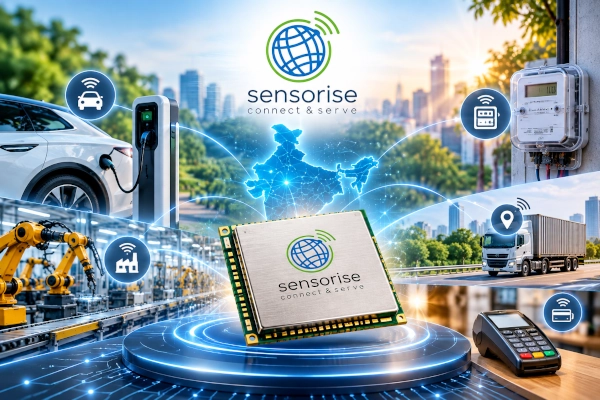
Indian IoT connectivity company Sensorise Smart Solutions has introduced the Wega M1, a domestically designed and manufactured 4G cellular module, at India Mobile Congress (IMC) 2026 in New Delhi. The module aims to strengthen India’s indigenous electronics ecosystem by providing a locally developed connectivity solution for electric vehicles, smart meters, industrial equipment and other Internet of Things (IoT) applications.
Union Communications Minister Jyotiraditya Scindia unveiled the Wega M1 on October 8, 2026. Developed using Qualcomm’s 216 LTE IoT Modem, the new module combines cellular connectivity, embedded SIM capabilities and remote network management features. Sensorise plans to begin commercial availability in the first quarter of 2027, initially working with selected enterprise customers.
The development represents another step towards building domestically manufactured components for India’s expanding connected-device infrastructure, particularly in sectors requiring reliable machine-to-machine (M2M) communication.
Wega M1 Offers an Indian Alternative to Imported Cellular Modules
Cellular communication modules are essential components of connected electronic devices. They allow machines to exchange information through mobile networks without requiring direct human intervention. Such modules enable smart electricity meters to transmit consumption data, electric vehicles to communicate with digital platforms and industrial equipment to support remote monitoring.
India’s growing IoT market has traditionally depended on imported cellular modules. Sensorise developed the Wega M1 to provide equipment manufacturers with an Indian alternative while supporting domestic electronics manufacturing and supply-chain diversification.
The company has adopted a pin-compatible design approach intended to simplify integration into existing hardware. This feature can help original equipment manufacturers replace compatible imported modules without undertaking extensive circuit-board redesigns, although actual compatibility depends on the specifications of the existing equipment.
By addressing a component used across multiple industries, Sensorise aims to expand the availability of domestically developed connectivity hardware for India’s electronics manufacturers.
Qualcomm 216 LTE IoT Modem Powers the Wega M1
The Wega M1 incorporates Qualcomm’s 216 LTE IoT Modem, a cellular connectivity platform optimised for compact, power-efficient IoT devices. The chipset supports LTE Cat 1bis connectivity, allowing equipment to communicate through existing 4G mobile networks.
According to Qualcomm’s official technical documentation, the 216 LTE IoT Modem supports peak download speeds of up to 10 Mbps and upload speeds of up to 5 Mbps. These capabilities are suitable for connected devices that regularly exchange operational information without requiring the bandwidth associated with smartphones or high-speed broadband applications.
The modem also incorporates power-management capabilities and positioning support using cellular and Wi-Fi network information. Its architecture is designed for applications where compact hardware, energy efficiency and dependable connectivity are important.
Qualcomm India has confirmed its support for Sensorise’s development. Manmeet Singh, Business Head for Automotive, Connectivity, Broadband and IoT at Qualcomm India, welcomed the introduction of an India-developed module based on the company’s cellular technology.
The partnership combines Qualcomm’s modem technology with Sensorise’s module development and connectivity management capabilities, creating a product intended for domestic equipment manufacturers.
eSIM and Multi-Operator Support Enable Flexible Connectivity
One of the Wega M1’s principal features is its support for embedded SIM technology and remote SIM provisioning. Unlike conventional removable SIM cards, eSIM technology enables compatible devices to manage operator profiles remotely, simplifying connectivity administration across large deployments.
The module also supports multi-operator and multi-IMSI functionality. IMSI, or International Mobile Subscriber Identity, identifies a mobile subscription on a cellular network. Support for multiple operator identities provides flexibility in managing connectivity arrangements across different network environments.
For businesses operating thousands of connected devices, remote provisioning can reduce the need for physical SIM replacement. This is particularly useful for smart meters, industrial monitoring systems and vehicle telematics equipment installed across geographically dispersed locations.
Sensorise has also integrated its QoSIM connectivity monitoring and analytics capabilities into the Wega M1. These functions are intended to help enterprise customers monitor network performance and manage connected-device operations more efficiently.
Applications Across Electric Vehicles, Smart Meters and Industrial Equipment
The Wega M1 targets several sectors undergoing rapid digital transformation. Electric vehicles increasingly depend on cellular connectivity for telematics, fleet monitoring, diagnostics and communication with digital service platforms.
In the electricity sector, smart meters require reliable communication links to transmit consumption information and support remote monitoring. Cellular modules allow utilities to collect data from distributed installations without depending exclusively on fixed-line communication infrastructure.
Industrial IoT represents another important application. Manufacturing equipment, remote sensors and monitoring systems can use cellular connectivity to transmit operational information, enabling equipment diagnostics and improved visibility across industrial facilities.
The module also targets point-of-sale terminals, asset-tracking devices and logistics systems. These applications require compact communication hardware capable of maintaining network connectivity during routine commercial operations.
By supporting multiple industries through a common connectivity platform, Sensorise aims to simplify the deployment and management of connected devices across India’s expanding IoT ecosystem.
Designed for Long-Term Deployment and Regulatory Requirements
Industrial IoT devices often remain operational for considerably longer periods than consumer electronics. Smart meters, utility equipment and industrial monitoring systems may require dependable connectivity throughout extended service lives.
Sensorise states that the Wega M1 has been designed for a product lifecycle of approximately 10–15 years, supporting equipment manufacturers developing long-term connected-device deployments.
The company has also incorporated applicable Department of Telecommunications requirements, Mandatory Testing and Certification of Telecommunication Equipment considerations, information security and data-governance requirements into its design approach.
These provisions are particularly relevant as India strengthens its regulatory framework for connected telecommunications equipment. However, designing a product with regulatory requirements in mind is distinct from obtaining all applicable certifications and commercial deployment approvals.
Sensorise positions domestic module development, SIM personalisation and secure connectivity management as complementary elements of India’s evolving telecommunications manufacturing ecosystem.
Sensorise Targets Commercial Rollout in Early 2027
Sensorise plans to introduce the Wega M1 commercially during the first quarter of 2027, beginning with selected anchor customers. The initial deployments will provide opportunities to integrate the module into commercial equipment and expand its use across different industrial applications.
Karn Nagpal, President of Sensorise, described the launch as an important milestone in the company’s efforts to develop trusted connectivity infrastructure for India. He highlighted the growing opportunities for integrated eSIM and cellular module solutions as IoT deployments expand.
The company is also developing a product roadmap to address future network enhancements and emerging connectivity requirements. Its existing business spans M2M eSIM services, telecommunications connectivity, mobility, utilities, retail, logistics and industrial applications.
Sensorise’s longer-term ambition aligns with India’s vision of supporting a substantially larger connected-device ecosystem through domestically developed technologies and components.
Made-in-India Connectivity Hardware Strengthens the IoT Ecosystem
The Wega M1 launch highlights the growing role of Indian companies in developing specialised telecommunications hardware rather than relying exclusively on imported finished modules. By combining domestic design and manufacturing with established semiconductor technology, Sensorise is creating an additional option for Indian equipment manufacturers.
The development also illustrates the importance of building domestic capabilities across the electronics value chain, including module engineering, embedded connectivity, device integration and network management.
As India expands smart metering, electric mobility and industrial automation, locally developed cellular modules can contribute to supply-chain diversification and support the wider adoption of connected technologies.
With commercial deployment planned for early 2027, the Wega M1 represents a step towards strengthening India’s indigenous IoT manufacturing capabilities and developing a more integrated domestic connectivity ecosystem.
References
- Sensorise Smart Solutions — Official Website. Company information, IoT connectivity solutions, eSIM technologies and domestic manufacturing initiatives.
https://sensorise.net/ - Sensorise Smart Solutions — Official Company Announcements, India Mobile Congress 2026. Product launch activities and participation in IMC 2026.
https://www.linkedin.com/company/sensorise-smart-solutions/ - Sensorise — Wega M1 Product Launch Announcement, October 8, 2026. Company announcement distributed through ANI, covering module specifications, Qualcomm collaboration, regulatory considerations and commercialisation plans.
https://news.webindia123.com/news/Articles/Business/20261008/4508447.html - Qualcomm — 216 LTE IoT Modem, Official Product Specifications. Technical information on LTE Cat 1bis connectivity, power efficiency, positioning and supported applications.
https://www.qualcomm.com/modems/products/216-lte-iot-modem - Qualcomm — Industrial Connectivity and IoT Solutions. Official information on Qualcomm’s technologies for industrial and connected-device applications.
https://www.qualcomm.com/internet-of-things/applications/industrial-connectivity
You may also like
-
India Post and Blue Dart Join Forces to Expand Parcel Delivery Across Urban and Rural India
-
DRDO Seeks Semi-Autonomous Guided Installation Vehicle and Specialised Pod Storage System
-
JISA Softech Unveils Indigenous QuLens-CryptoBind Quantum-Safe Cybersecurity Platform at Pragati Q-Foundry 2026
-
Katarni Rice — Bihar’s Fragrant Ceremonial Grain from the Gangetic Plains
-
Nayan Technologies Selected by JSW MG Motor to Advance AI-Based Road Monitoring and Smart Mobility
