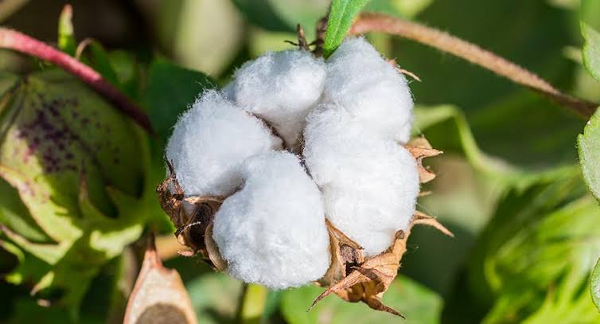
India’s effort to build a globally recognised premium cotton identity is gaining momentum through the Kasturi Cotton Bharat programme, which combines quality certification, QR-based verification and blockchain-enabled traceability across the textile value chain.
The latest official government data shows that 3,29,550 bales had been certified under Kasturi Cotton Bharat as of June 30, 2026, including 3,22,400 bales associated with the Cotton Corporation of India. The figure confirms that the programme has moved beyond its initial branding phase into a larger traceable supply network for Indian cotton.
This official figure is higher than the 2.13 lakh-bale number reported for the 2025–26 cotton marketing season in some industry reports.
Kasturi Cotton Bharat Builds a Premium Indian Cotton Identity
Kasturi Cotton Bharat was created to improve the global positioning of Indian cotton by combining standardised quality parameters with verifiable origin and traceability.
The programme is led by the Ministry of Textiles and implemented with the Cotton Corporation of India and TEXPROCIL. Its objective is to create a recognised Indian cotton brand built around quality, purity, consistency and sustainability.
This approach addresses a long-standing challenge for Indian cotton. India is one of the world’s largest cotton producers, but global buyers increasingly evaluate not only fibre quality but also consistency, traceability and documented sourcing.
Kasturi Cotton Bharat is intended to create that additional layer of assurance.
Certification Covers Long-Staple and Extra-Long-Staple Cotton
The programme certifies cotton that meets defined fibre-quality requirements.
According to the Ministry of Textiles, certification covers long-staple cotton with a staple length of 28 mm or more and extra-long-staple cotton with a staple length of 35 mm or more. Testing is carried out through agencies accredited by the National Accreditation Board for Testing and Calibration Laboratories.
The Kasturi Cotton system also evaluates parameters such as fibre strength, uniformity, micronaire value, moisture, trash content and colour characteristics.
This helps move Indian cotton away from generic commodity classification towards measurable quality categories that international buyers can verify.
Blockchain Gives Cotton a Digital Identity
One of the most important features of Kasturi Cotton Bharat is its blockchain-based traceability architecture.
Certified bales receive QR-linked identification, allowing cotton to be tracked as it moves through ginning, spinning, weaving, processing, garment manufacturing and final sale.
The official Kasturi Cotton Bharat platform states that buyers and consumers can verify certified cotton through QR codes and access information linked to its movement through the supply chain.
This creates a digital trail that connects physical cotton with verifiable supply-chain data.
Traceability Is Becoming More Important in Global Textile Trade
The importance of this system is increasing as international textile buyers demand more information about where raw materials originate and how they move through manufacturing networks.
Traceability has become particularly relevant for brands selling into markets where sourcing standards, sustainability reporting and supply-chain compliance are becoming more stringent.
For Indian mills and apparel exporters, a cotton bale with verifiable quality and origin can offer greater credibility than an equivalent untraceable commodity.
Kasturi Cotton therefore seeks to turn traceability itself into a commercial advantage.
The Programme Is Expanding Across the Supply Chain
The Ministry of Textiles reported that 116 units had renewed registration under the programme, including 41 ginning units and 75 supply-chain participants.
The registered ecosystem includes ginners, traders, spinners, processors, garment manufacturers and other textile businesses.
This is important because the value of blockchain traceability depends on participation across multiple stages rather than certification at the ginning stage alone.
The wider the network becomes, the easier it is to maintain traceability from bale to finished garment.
Kasturi Cotton Uses Stricter Sampling Requirements
The official Kasturi Cotton Bharat framework requires random sampling and testing of 5% of bales in a lot, compared with a lower sampling share under basic BIS requirements.
This higher level of testing is designed to increase confidence that the fibre quality represented by a certified lot remains consistent throughout the shipment.
Consistency matters particularly for spinning mills and garment exporters, where variations in fibre length, strength or contamination can affect yarn quality and manufacturing performance.
CCI Is Playing a Major Role
The Cotton Corporation of India has emerged as a major contributor to the certified volume under the programme.
Of the 3,29,550 bales certified by June 30, 2026, the Ministry of Textiles reported that 3,22,400 bales were from CCI.
CCI’s involvement provides scale and links the certification system directly with India’s formal cotton procurement infrastructure.
The corporation also plays a broader role in supporting cotton farmers through Minimum Support Price operations and quality-focused procurement.
Kasturi Cotton Fits Into Wider Cotton-Sector Reform
The programme is increasingly being integrated into a broader effort to modernise India’s cotton economy.
The Government has approved the Kapas Kanti Cotton Productivity Mission, with an outlay of ₹5,659.22 crore over five years, aimed at improving productivity, quality, processing, branding and traceability. Kasturi Cotton Bharat forms part of that wider strategy.
The approach combines farmer support, improved processing, digital procurement, fibre quality and downstream branding rather than treating cotton as only an agricultural commodity.
India Produced Nearly 291 Lakh Bales in 2025–26
India’s provisional cotton production for the 2025–26 season stood at 290.91 lakh bales, according to official government data.
Cotton productivity was estimated at 431 kg per hectare, while total cultivated area stood at 114.82 lakh hectares.
Against that scale, Kasturi Cotton remains a relatively small share of national production. Its significance lies less in volume today and more in creating a premium quality and traceability segment that can expand over time.
From Commodity Cotton to Branded Indian Fibre
Kasturi Cotton Bharat represents a shift in how India seeks to position its cotton internationally.
Instead of competing primarily on production scale and price, the programme adds verified quality, traceability and branding to the fibre itself.
The model gives exporters a stronger way to demonstrate origin and quality while giving international buyers greater confidence in Indian sourcing.
As certification expands across ginners, mills, processors and apparel manufacturers, Kasturi Cotton Bharat is building the foundation for a more transparent and premium Indian cotton value chain.
The programme strengthens India’s ability to move from being simply a major cotton producer towards becoming a recognised global supplier of certified, traceable and higher-value cotton.
References
- Ministry of Textiles / Press Information Bureau — Official update on Kasturi Cotton Bharat, certification and traceability, 2026.
- Kasturi Cotton Bharat — Official programme website and certification framework.
- TEXPROCIL — Official Kasturi Cotton Bharat implementation and blockchain traceability material.
- Cotton Corporation of India — Official participation in Kasturi Cotton Bharat.
- Ministry of Textiles — Official cotton production data for 2025–26.
- Ministry of Textiles — Kapas Kanti Cotton Productivity Mission and cotton-sector reform measures.
You may also like
-
Airtel Extends Free International Roaming Across Its New Postpaid Plans
-
India Helps Build a Machine Hotter Than the Sun: INOX India’s Cryogenic Role in ITER
-
India’s Telecom Subscriber Base Rises 10.8% to 1.33 Billion as Broadband Crosses 1.06 Billion
-
India’s Data Centre Capacity Set to Reach 2 GW by End-2026 as AI and Hyperscale Demand Accelerate
-
India’s Services Activity Rises to Three-Month High in September as Domestic Demand Strengthens
