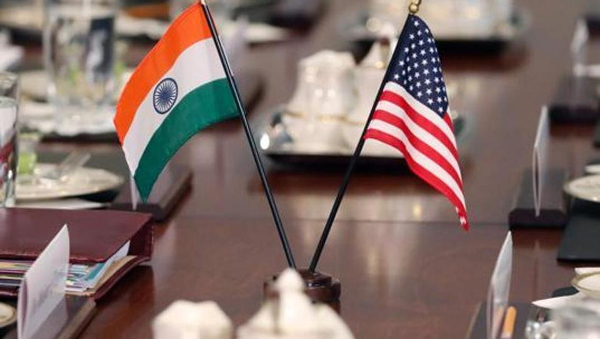
India and the United States are building a broader framework for cooperation across the Indian Ocean, combining economic connectivity, maritime security, digital infrastructure and emerging technologies. The centrepiece of this effort is the Indian Ocean Strategic Venture, a bilateral initiative formally launched by Prime Minister Narendra Modi and US President Donald Trump during their meeting in Washington in February 2025.
The official India-US framework presents the initiative as a whole-of-government mechanism intended to coordinate investments in economic connectivity and commerce across the Indian Ocean region. It forms part of a wider effort by New Delhi and Washington to strengthen infrastructure, secure maritime routes and develop trusted technology networks across a region central to international trade and energy flows.
Indian Ocean Strategic Venture Creates a New Bilateral Framework
The Indian Ocean Strategic Venture, or IOSV, was announced in the February 13, 2025 India-US Joint Leaders’ Statement. The two governments agreed to deepen dialogue and cooperation across the Indian Ocean while coordinating investments intended to improve economic connectivity and commerce.
The initiative also reflects Washington’s formal recognition of India’s role as a development partner, humanitarian assistance provider and net security contributor in the Indian Ocean Region.
Rather than functioning solely as a defence arrangement, IOSV links strategic cooperation with physical infrastructure, commercial connectivity and technology. This gives India and the United States a framework through which their capabilities in infrastructure development, finance, maritime operations and digital systems can complement each other.
Ports and Economic Connectivity Could Become Central to Cooperation
The official framework places economic connectivity at the heart of IOSV. Ports and associated logistics infrastructure are therefore naturally relevant to the initiative because the Indian Ocean contains some of the world’s busiest shipping routes and connects South Asia with the Middle East, Africa and Southeast Asia.
India has already developed extensive economic and infrastructure relationships with Indian Ocean countries, while the United States brings significant financial, technological and private-sector capabilities. Coordinating these strengths could support infrastructure that improves regional trade without requiring participating countries to depend upon a single source of financing or technology.
The February 2025 joint statement does not publicly identify individual port projects in Sri Lanka, Maldives or Mauritius under IOSV. Reports that specific projects in these countries are under consideration should therefore be treated as emerging discussions rather than formally announced bilateral projects until either government provides additional details.
Undersea Cables Form a Major Part of the Connectivity Strategy
Digital connectivity is already an explicitly confirmed component of the India-US approach to the Indian Ocean.
The February 2025 leaders’ statement welcomed Meta’s planned multibillion-dollar undersea cable project, designed eventually to extend more than 50,000 kilometres and connect five continents. India separately expressed its intention to invest in the maintenance, repair and financing of undersea cables across the Indian Ocean using trusted vendors.
Undersea cables carry the overwhelming majority of international digital communications, making their security and resilience increasingly important to both economic infrastructure and national security. Greater Indian capability in cable maintenance and repair would also reduce dependence on distant support facilities when faults occur within the Indian Ocean.
The emphasis on trusted vendors indicates that digital infrastructure is being treated not simply as a commercial service but as part of a wider strategic architecture.
India-US Technology Cooperation Extends to 6G Networks
Telecommunications cooperation between India and the United States extends beyond submarine cables.
An official India-US Information and Communications Technology Working Group statement issued in January 2025 confirmed cooperation on the development of principles, standards and research supporting open and interoperable 6G networks. The two sides also agreed to promote trusted and resilient undersea cable and satellite systems.
Their telecommunications agenda includes efforts to expand supplier diversity and promote Open Radio Access Network technologies. These programmes are intended to create more open communications ecosystems while reducing excessive dependence on individual technology suppliers.
Together, these initiatives provide a technological foundation that could eventually complement IOSV connectivity projects across the wider Indian Ocean.
Maritime Security Remains a Parallel Strategic Priority
Economic connectivity is being developed alongside deeper maritime cooperation.
The February 2025 India-US leaders’ statement reaffirmed support for freedom of navigation, lawful commerce and adherence to international law across the Indo-Pacific. India and the United States also agreed to expand military cooperation across sea, air, land, space and cyberspace.
Maritime surveillance is another important component. The two countries announced plans to strengthen interoperability through maritime patrols and other cooperative activities, while India continues to expand its own maritime-domain awareness capabilities across the Indian Ocean.
Greater situational awareness can help regional governments address challenges including illegal fishing, narcotics trafficking, human trafficking and other illicit maritime activity. It can also improve monitoring of unusual or potentially security-sensitive vessel movements.
Indian Ocean Surveillance Has Growing Strategic Importance
The ability to understand activity across the Indian Ocean has become increasingly important as naval deployments, survey vessels, commercial shipping and critical subsea infrastructure expand across the region.
India has steadily strengthened maritime-domain awareness through naval surveillance aircraft, coastal radar networks, satellite systems and information-sharing arrangements with regional partners.
The February 2025 India-US framework also envisaged completion of India’s procurement of six additional P-8I maritime patrol aircraft after agreement on sale terms. India already operates P-8I aircraft extensively for long-range maritime reconnaissance and anti-submarine operations.
Additional cooperation in surveillance, information sharing and maritime patrols would support India’s ability to maintain awareness across its extended maritime neighbourhood.
Western Indian Ocean Emerging as a Strategic Focus
India and the United States have also committed to developing what the February 2025 joint statement described as new plurilateral anchor partnerships across the Western Indian Ocean, Middle East and Indo-Pacific.
These partnerships are intended to expand cooperation spanning defence, technology, energy, critical minerals and commerce. The approach suggests that future projects may involve combinations of India, the United States and regional countries rather than relying exclusively on bilateral arrangements.
This model is particularly relevant to the Western Indian Ocean, where India maintains close relationships with island states and East African countries while also possessing geographic proximity, maritime capabilities and established development partnerships.
India Brings a Distinctive Development Role to the Indian Ocean
India’s position within the initiative differs from that of an external power operating primarily through finance or military deployments. New Delhi has longstanding political, commercial, cultural and security relationships across the Indian Ocean and has increasingly invested in capacity building, infrastructure, humanitarian assistance and maritime security.
India has also become an important first responder during natural disasters and maritime emergencies in its neighbourhood.
That experience gives New Delhi a potentially important role in shaping infrastructure programmes around the requirements of individual partner countries rather than treating the Indian Ocean as a single strategic theatre.
Strategic Infrastructure Is Becoming Part of India-US Cooperation
The Indian Ocean Strategic Venture represents an expansion of India-US relations beyond traditional defence cooperation. Ports, telecommunications networks, undersea cables, maritime awareness and emerging communications technologies are increasingly being treated as interconnected elements of regional resilience.
Some of the specific projects reported to be under discussion have not yet been formally announced by either government. However, the underlying framework for coordinated Indian and American investment in Indian Ocean connectivity is firmly established in official bilateral documents.
For India, the initiative reinforces its position at the geographical centre of the Indian Ocean while combining its regional relationships and infrastructure capabilities with American finance and technology. The growing partnership places connectivity, security and trusted infrastructure at the heart of a wider effort to keep the Indian Ocean open, resilient and increasingly integrated with India’s economic and strategic rise.
References
The White House — United States-India Joint Leaders’ Statement, February 13, 2025.
https://www.whitehouse.gov/briefings-statements/2025/02/united-states-india-joint-leaders-statement/
United States Department of State — Joint Statement on the U.S.-India Information and Communications Technology Working Group, January 2025.
https://2021-2025.state.gov/office-of-the-spokesperson/releases/2025/01/joint-statement-on-the-u-s-india-information-and-communications-technology-working-group/
You may also like
-
UltraTech Cement Nears 2 GW Green Power Capacity as Decarbonisation Drive Accelerates
-
GST 2.0 Simplifies Registration and Accelerates Refunds for Indian Businesses
-
Swiss President Guy Parmelin Begins Three-Day State Visit to India as TEPA Enters Second Year
-
Dibrugarh Opens International River Cargo Route as Methanol Shipment Sails for Dhaka
-
Kaipad Rice — The Grain of Kerala’s Tidal Fields
