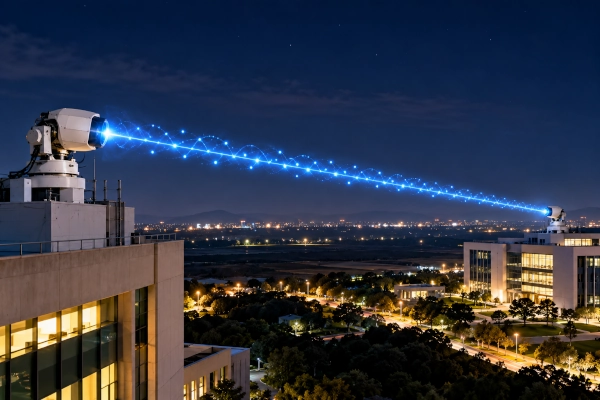
India has successfully demonstrated its first free-space Quantum Key Distribution link over a distance of 5.56 kilometres, marking an important advance in the country’s development of quantum-secure communication infrastructure.
The demonstration was conducted by QNu Labs in collaboration with the Bhaskaracharya National Institute for Space Applications and Geo-informatics, or BISAG-N, and the Indian Institute of Technology Gandhinagar. The field trial connected BISAG-N and IIT Gandhinagar through a secure quantum communication channel during the night of September 27–28, 2026.
Quantum Keys Transmitted Across a 5.56 km Free-Space Link
Unlike fibre-based quantum communication, free-space QKD transmits quantum signals through the atmosphere using optical systems. Such links are important for locations where laying dedicated fibre may be difficult and are also relevant to the development of future ground-to-air and satellite quantum communication networks.
During the Gujarat trial, QNu Labs used its Pointing, Acquisition and Tracking system to maintain the optical connection across the 5.56 km separation. The system achieved a stable Quantum Bit Error Rate below 5 per cent while generating secure cryptographic keys at approximately 230–260 bits per second.
The generated keys were subsequently integrated with BISAG-N’s Vedic Kavach platform. According to the Ministry of Electronics and Information Technology, the combined system successfully demonstrated end-to-end encryption and decryption of test messages.
How Quantum Key Distribution Protects Communications
Quantum Key Distribution does not directly transmit the underlying message. Instead, it allows two communicating points to establish cryptographic keys using quantum states.
The security principle comes from quantum physics. Measurement of a quantum state can alter that state, allowing a properly designed QKD system to detect interference or attempted interception during the key-exchange process.
Once both endpoints establish a trusted key, conventional encryption systems can use it to protect the actual data being transmitted. QKD is therefore being explored as one layer of protection for communications that may require extremely high levels of security.
QNu Labs Armos Forms the Hardware QKD Layer
The demonstration used QNu Labs’ indigenous Armos QKD system over the free-space optical channel. Armos provides the hardware-based quantum key distribution component of the architecture.
Because optical communication over open air must maintain precise alignment between transmitting and receiving systems, the Pointing, Acquisition and Tracking system formed an important part of the experiment. Maintaining stable tracking enabled the quantum link to operate across several kilometres despite the practical challenges associated with atmospheric transmission.
The successful field test moves the technology beyond a controlled laboratory environment and demonstrates its operation between two separate institutions.
Vedic Kavach Adds Post-Quantum Cryptography
The experiment also combined QKD with BISAG-N’s Vedic Kavach platform, which uses post-quantum cryptography and quantum random number generation.
Post-quantum cryptography takes a different approach from QKD. Instead of relying on quantum communication hardware, it uses mathematical algorithms designed to withstand attacks from future cryptographically relevant quantum computers.
Combining these technologies creates a layered architecture. QKD can provide quantum-generated keys when the optical channel is available, while post-quantum cryptographic systems can continue protecting communications when maintaining the physical quantum link is impractical or temporarily disrupted.
This hybrid approach is particularly relevant to real-world secure networks, where resilience and continuous availability are as important as the cryptographic technique itself.
Quantum Bit Error Rate Shows Link Quality
One of the significant technical results from the trial was the reported Quantum Bit Error Rate of below 5 per cent.
QBER measures the proportion of quantum bits received incorrectly compared with those transmitted. Environmental conditions, detector behaviour, optical losses and interference can increase the error rate, while an abnormally high QBER can also indicate that the quantum channel is no longer trustworthy.
Maintaining the reported error level across a 5.56 km atmospheric link therefore provides an important measure of the stability achieved during the demonstration.
The secure key generation rate of 230–260 bps was sufficient for the trial’s encryption and decryption demonstration. QKD keys are normally used to secure cryptographic operations rather than carrying the entire volume of application data themselves.
BISAG-N, IIT Gandhinagar and QNu Labs Combine Capabilities
The project brought together government research infrastructure, academia and an Indian quantum-technology company.
BISAG-N is an autonomous scientific society under the Ministry of Electronics and Information Technology working in areas including satellite communication, space applications and geo-informatics.
IIT Gandhinagar provided a research environment for testing the technology under practical conditions. Cmde Manish Tripathi (Retd.), In-charge of ISTF at IIT Gandhinagar, said the demonstration offered a valuable field environment for advancing practical quantum communication technologies while integrating academic research with indigenous technology.
QNu Labs, founded in 2016, has been developing quantum-secure communication technologies in India. Its participation in the demonstration reflects the growing role of domestic companies in translating quantum research into deployable communication systems.
Longer-Distance and Satellite Quantum Communication
The 5.56 km experiment is also relevant to India’s longer-term work on free-space and satellite-based quantum communication.
Free-space optical QKD is one of the technologies that can eventually support communication between terrestrial stations, airborne platforms and satellites. Extending such systems over longer distances will require improvements in optical tracking, atmospheric compensation, photon detection, link stability and overall network integration.
QNu Labs co-founder and CEO Sunil Gupta said the demonstration provides a pathway towards longer-distance quantum-secure networks and future satellite quantum communication.
The experiment should therefore be viewed as an infrastructure-building milestone rather than simply a distance record. It demonstrates that multiple indigenous security technologies can be integrated into an operational communication chain.
Building India’s Quantum-Secure Communication Infrastructure
Quantum computing presents a long-term challenge to several cryptographic systems used today. Governments, research institutions and technology companies around the world are consequently developing both post-quantum cryptography and quantum communication technologies.
India’s latest demonstration shows how these approaches can operate together rather than being treated as competing solutions. Hardware-based QKD, quantum random number generation and post-quantum algorithms can each protect different parts of a secure communications architecture.
The successful 5.56 km free-space QKD link gives India another field-tested building block for future quantum-secure networks. Continued development of indigenous optical systems, cryptographic platforms and quantum communication technologies is strengthening the technological foundation required for resilient communications in the quantum era.
References
Press Information Bureau, Ministry of Electronics & Information Technology, Government of India — India’s First 5.56 km Free-Space Quantum Key Distribution Link Demonstrated, October 3, 2026.
https://www.pib.gov.in/PressReleseDetailm.aspx?PRID=2318656&lang=1®=3
You may also like
-
Solar Defence Facility Images Show Large Loitering Munition Airframe Linked to 150 Kg CSIR-NAL Programme
-
Jindal Defence Taurus T9 Machine Pistols Move Through Indian Army Integration Under 550-Weapon Order
-
India’s Expanding Free Trade Network Could Cover 75% of Global Trade
-
LC3: The Indian-Backed Cement Technology That Could Change How India Builds
-
India’s Quantum-Secure Network Reaches 1,000 km as National Quantum Mission Advances Towards 2,000-km Goal
