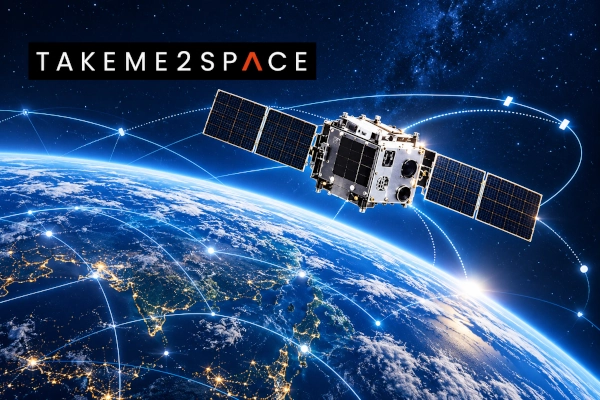
Indian space startup TakeMe2Space has advanced its orbital-computing programme with the launch of MOI-1A aboard SpaceX’s Transporter-18 mission from California on October 1, 2026.
The Hyderabad-based company said the 14-kg spacecraft travelled aboard an orbital transfer vehicle deployed from the Falcon 9. MOI-1A is designed as a commercial computing platform in low Earth orbit, combining multispectral imaging with onboard artificial-intelligence processing.
MOI-1A Restores Momentum After PSLV-C62 Setback
MOI-1A succeeds MOI-1, which was lost during the PSLV-C62 mission on January 12, 2026 after the launch vehicle suffered a third-stage anomaly. TakeMe2Space said the satellite itself had remained nominal until the launch failure.
The company subsequently rebuilt the mission around MOI-1A and secured a place on Transporter-18. The launch follows its earlier MOI-TD technology-demonstration mission, which tested onboard AI inference, sensor fusion and high-speed data handling in space.
The progression from MOI-TD to MOI-1A marks TakeMe2Space’s shift from experimental validation towards a commercial service model.
117 TOPS of Computing Power in Orbit
According to TakeMe2Space, MOI-1A carries an onboard AI system capable of up to 117 trillion operations per second, or 117 TOPS.
The computing stack uses an NVIDIA Jetson Orin NX processor with 16 GB of memory and 2 TB of onboard storage. The spacecraft also carries a nine-band multispectral imager for Earth-observation applications.
TakeMe2Space lists pointing accuracy of better than 0.025 degrees and peak spacecraft power of 120 watts.
The combination of imaging, storage and onboard computation allows MOI-1A to process data before it is transmitted to Earth.
Processing Data in Space Instead of Sending Everything to the Ground
Conventional Earth-observation missions generally capture imagery and transmit large volumes of raw data to ground stations for processing.
TakeMe2Space is developing a different model. Its satellites are intended to run applications directly in orbit, allowing selected data to be analysed before transmission.
This can reduce downlink requirements and shorten the time between image capture and usable information. Applications identified by the company include object detection, environmental monitoring, vegetation analysis, water detection, infrastructure assessment and change detection.
The concept effectively turns the satellite into a remote computing platform rather than treating it only as a sensor.
OrbitLab Gives Users Access to Orbital Computing
MOI-1A is intended to operate through TakeMe2Space’s OrbitLab platform, which allows customers and researchers to deploy applications to the spacecraft without owning a satellite.
Users can define an area of interest, configure imaging requirements and run compatible applications or AI models onboard.
This model lowers the entry barrier for universities, developers and commercial users that need access to satellite imagery and computing but do not require a dedicated spacecraft.
OrbitLab is therefore central to TakeMe2Space’s commercial proposition: offering computing and imaging capacity in orbit as a shared service.
Nine-Band Imaging Supports Earth-Observation Workloads
MOI-1A’s multispectral imager provides the data layer for many of its onboard applications.
The system captures information across nine spectral bands, allowing the spacecraft to support analytical tasks beyond conventional visual imaging.
TakeMe2Space says its processing pipeline can handle functions such as calibration, geometric correction, cloud masking, vegetation analysis and change detection.
Running these operations onboard can reduce the amount of data that needs to be transmitted and allow users to receive processed outputs more quickly.
First Commercial Node in a Larger Orbital Network
TakeMe2Space describes MOI-1A as the first commercial satellite in its planned orbital data-centre architecture.
The company intends to develop a network of compute-equipped satellites capable of processing and storing information in low Earth orbit. Its initial architecture is planned around six satellites with onboard computing capability.
MOI-1A will therefore serve as both a commercial platform and a test of how well this distributed model performs under operational conditions.
The mission will help validate the company’s approach to onboard processing, remote application deployment, imaging and customer access.
A New Direction for India’s Private Space Sector
MOI-1A represents a different category of Indian private-space activity. Instead of focusing only on launch services, satellite manufacturing or conventional Earth observation, TakeMe2Space is building infrastructure around computing in orbit.
That approach reflects a broader evolution in the space economy, where satellites are increasingly expected to process information rather than simply collect and transmit it.
With MOI-1A now in space, TakeMe2Space has moved its orbital-computing programme into a more advanced operational phase. The mission adds another dimension to India’s expanding private-space ecosystem by combining satellite hardware, artificial intelligence and cloud-style computing into a single commercial platform.
References
- TakeMe2Space — Official Company Update, 3 October 2026
https://www.linkedin.com/company/tm2space/ - TakeMe2Space — Official MOI Satellite Technology Page
https://www.tm2.space/moi-satellite - TakeMe2Space — Official OrbitLab Platform
https://www.tm2.space/orbitlab - TakeMe2Space — Official Missions Page
https://www.tm2.space/missions - TakeMe2Space — Official Website
https://www.tm2.space/ - SpaceX — Official Transporter-18 Launch Record
https://www.spacex.com/launches/
You may also like
-
EON Space Labs and Dhruva Space Advance Indian Space Hardware on Transporter-18 Mission
-
SatLeo Labs’ TAPAS-1 Reaches Orbit, Advancing India’s Private Thermal-Imaging Capability
-
Bank of Baroda Enters Pension Fund Management After PFRDA Appointment
-
SCI and India’s Push for a Larger Indigenous Maritime Fleet
-
Takshak Heavyweight Torpedo: How India’s Indigenous Submarine Weapon Compares With the World’s Leading Torpedoes
