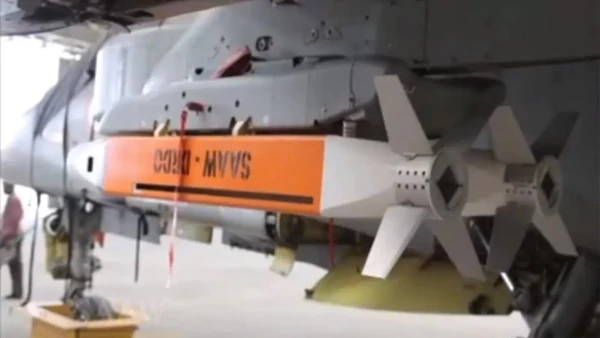
India is strengthening its precision strike capabilities through the development of advanced variants of the Smart Anti-Airfield Weapon (SAAW), combining satellite navigation and electro-optical guidance technologies. The weapon family represents an indigenous effort to provide the Indian Air Force (IAF) with accurate stand-off strike capability against critical enemy infrastructure.
The SAAW has been developed by the Defence Research and Development Organisation (DRDO) and is designed as a long-range precision-guided glide weapon capable of engaging targets such as airfield infrastructure, hardened structures and other fixed military assets.
Unlike conventional unguided bombs, smart weapons use navigation and guidance systems to improve accuracy, allowing aircraft to strike targets from safer distances while reducing exposure to enemy air defence systems.
SAT-SAAW Adds Satellite-Guided Precision to the Weapon Family
The Satellite Smart Anti-Airfield Weapon (SAT-SAAW) is the latest major development in the SAAW programme. The system uses satellite-based navigation guidance to improve accuracy against fixed targets.
The Ministry of Defence signed a contract with Bharat Dynamics Limited (BDL) on 23 September 2026 for the procurement of 160 SAT-SAAW systems and associated equipment for the Indian Air Force. The contract, valued at ₹810.79 crore, was placed under the Buy (Indian–Indigenously Designed, Developed and Manufactured) category.
The induction of SAT-SAAW will strengthen the IAF’s ability to conduct precision strikes against enemy air bases, runways, aircraft shelters and other strategic infrastructure. Its integration also supports India’s wider objective of increasing indigenous content in advanced aerospace weapons.
EO-SAAW Introduces Terminal Guidance Capability
Alongside the satellite-guided variant, DRDO has also worked on an Electro-Optical (EO) seeker-based version of SAAW.
An electro-optical seeker provides the weapon with an imaging-based terminal guidance capability, allowing it to refine its aim point during the final phase of flight. This technology can improve precision against targets where higher accuracy is required or where satellite navigation alone may not provide sufficient engagement flexibility.
The EO-SAAW development reflects a broader trend in modern precision weapons, where multiple guidance options are used depending on mission requirements, target type and battlefield conditions.
Different Guidance Systems Provide Operational Flexibility
The development of satellite-guided and electro-optical variants gives the SAAW family greater flexibility.
The satellite-guided SAT-SAAW is suited for pre-planned strikes against known fixed targets where accurate coordinates are available. The EO-guided version provides additional precision through image-based terminal targeting, which can help against specific structures or targets requiring greater accuracy.
Together, these technologies represent two different approaches to precision engagement while using the same broader weapon family.
Indigenous Precision Weapons Support India’s Defence Modernisation
The SAAW programme is part of India’s broader effort to develop indigenous air-launched weapons, reducing dependence on imported precision munitions.
The Indian Air Force already operates several precision strike systems, including the BrahMos air-launched missile, SPICE-2000 precision-guided weapons and other guided munitions. Indigenous systems such as SAAW add another layer of capability by providing locally developed options for specific strike missions.
The involvement of Indian companies such as BDL in production also strengthens the domestic defence manufacturing ecosystem by linking research, development and serial production.
Future of India’s Stand-Off Strike Capability
The expansion of the SAAW family highlights the growing importance of precision-guided weapons in modern warfare. By combining satellite navigation, electro-optical guidance and indigenous manufacturing, India is building a more flexible strike capability suited for future aerospace operations.
The progression from development trials to production contracts marks an important step in strengthening India’s indigenous aerospace weapon ecosystem and expanding the country’s ability to design and manufacture advanced precision systems.
References
- Ministry of Defence, Government of India — Contract signed with Bharat Dynamics Limited for procurement of 160 Satellite Smart Anti-Airfield Weapons (23 September 2026)
- Defence Research and Development Organisation (DRDO) — Smart Anti-Airfield Weapon programme updates
- Bharat Dynamics Limited — Indigenous missile and guided weapon manufacturing programmes
You may also like
-
HAL to Take Full Control of HATSOFF Helicopter Training Venture After Acquiring CAE Stake
-
Solar Defence Facility Images Show Large Loitering Munition Airframe Linked to 150 Kg CSIR-NAL Programme
-
Jindal Defence Taurus T9 Machine Pistols Move Through Indian Army Integration Under 550-Weapon Order
-
India Demonstrates First 5.56 km Free-Space Quantum Key Distribution Link
-
Russian Navy Delegation Visits Southern Naval Command and Indian Naval Academy
