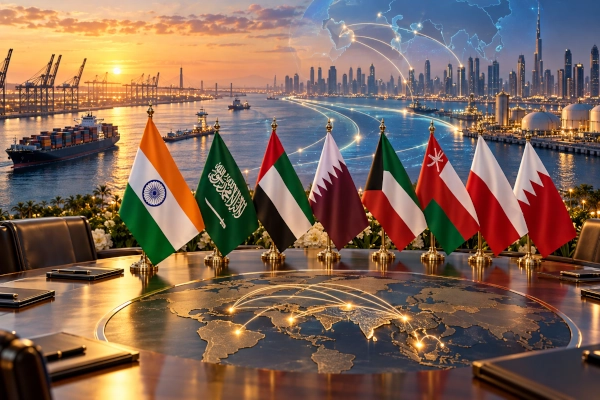
India and the Gulf Cooperation Council (GCC) have reviewed progress under the India–GCC Joint Action Plan 2024–28 as the two sides move ahead with negotiations for a comprehensive India–GCC Free Trade Agreement.
External Affairs Minister S. Jaishankar co-chaired the India–GCC Troika Ministerial Meeting in New York on the sidelines of the 81st Session of the United Nations General Assembly. The meeting reviewed implementation of the joint action plan and discussed ways to expand cooperation across trade, investment, energy, food security, health, emerging technologies, culture and people-to-people ties.
India–GCC Joint Action Plan 2024–28 Gains Momentum
The India–GCC Joint Action Plan 2024–28 was adopted at the first India–GCC Joint Ministerial Meeting for Strategic Dialogue held in Riyadh in September 2024.
The framework covers a broad set of areas including security, trade, transportation, energy, agriculture, health and culture, giving India and the six-member Gulf grouping a structured mechanism for expanding cooperation over several years.
The GCC comprises Saudi Arabia, the United Arab Emirates, Qatar, Kuwait, Oman and Bahrain, making it one of India’s most important regional groupings for energy, trade, investment and expatriate links.
India–GCC FTA Negotiations Formally Launched in 2026
The economic dimension of the relationship has gained further momentum with the launch of negotiations for the India–GCC Free Trade Agreement.
India and the GCC signed the Terms of Reference for the proposed FTA on February 5, 2026, setting out the scope and modalities for the negotiations. The Government of India said the agreement is intended to create greater predictability and stability in the economic relationship.
A Joint Statement signed on February 24, 2026 formally launched negotiations for a comprehensive and mutually beneficial agreement. The Ministry of Commerce and Industry said the proposed FTA is expected to support the smoother flow of goods and services, attract investment, create employment opportunities and strengthen food and energy security.
Trade and Investment Remain Central to the Partnership
Trade and investment are among the most important pillars of the India–GCC relationship.
GCC economies are major destinations for Indian exports ranging from engineering goods and pharmaceuticals to food products, textiles, jewellery and services. At the same time, Gulf-based sovereign wealth funds and companies have expanded investments in Indian infrastructure, logistics, renewable energy, digital platforms and manufacturing.
A comprehensive India–GCC FTA could deepen these links by providing clearer market-access rules, improving the treatment of services and investment and reducing friction in cross-border trade.
The agreement could also help Indian companies use Gulf economies as commercial gateways to markets across West Asia, Africa and Europe.
Energy Security Remains a Strategic Priority
Energy continues to occupy a central place in India–GCC relations.
Several GCC states are major suppliers of crude oil, liquefied natural gas and other energy products to India. At the same time, the relationship is gradually expanding beyond traditional hydrocarbons into renewable energy, green hydrogen, clean fuels and energy-transition technologies.
This gives the partnership both immediate and long-term importance. Conventional energy supplies remain essential to India’s economic growth, while cooperation in cleaner energy technologies could shape the next phase of bilateral investment.
Food Security and Agriculture Gain Greater Importance
Food security has also become an important area of India–GCC cooperation.
Gulf countries import substantial quantities of food because of geographical and climatic limitations, while India has a large agricultural base and an expanding food-processing industry.
Closer cooperation can therefore extend beyond agricultural exports into cold chains, warehousing, food processing, logistics and long-term supply arrangements.
These areas have gained strategic importance as international conflicts and shipping disruptions have highlighted the vulnerability of global food supply chains.
Health and New Technologies Added to the Agenda
The latest ministerial meeting also highlighted health and new technologies as areas where India and the GCC want deeper cooperation.
India has established capabilities in pharmaceuticals, vaccines, healthcare services and digital health, while Gulf states are investing heavily in advanced hospitals, biotechnology and health infrastructure.
Technology cooperation is also expanding into areas such as artificial intelligence, fintech, digital payments, cybersecurity and advanced manufacturing.
The inclusion of these sectors shows how the India–GCC relationship is gradually moving beyond its traditional focus on energy and labour mobility.
Indian Community Remains an Important Link
Jaishankar also thanked GCC governments for their support to the Indian community in the Gulf.
Millions of Indians live and work across the six GCC member states, creating one of the strongest people-to-people links between India and any region of the world.
These communities contribute to Gulf economies across construction, healthcare, engineering, technology, finance, retail and professional services while maintaining deep social and economic connections with India.
Labour mobility, worker welfare and skills recognition therefore remain important elements of the wider partnership.
Maritime Security Becomes More Important
The current discussions also took place against a background of growing concern over the security of international shipping routes.
Jaishankar reiterated India’s commitment to freedom of navigation and the safety of seafarers and commercial shipping during the India–GCC meeting.
This issue is particularly important for India because a significant share of its energy imports and merchandise trade moves through maritime routes connecting the Gulf, Arabian Sea, Red Sea and Mediterranean.
Any prolonged disruption along these corridors can affect freight rates, insurance costs, energy prices and supply chains.
India–GCC Partnership Moves Beyond a Traditional Energy Relationship
The latest meeting reflects a broader transformation in India–GCC relations.
Energy remains a major foundation, but trade, investment, food security, health, technology, transport and maritime security are becoming increasingly important parts of the relationship.
The India–GCC Joint Action Plan 2024–28 provides a framework for this expansion, while the ongoing India–GCC Free Trade Agreement negotiations could give the economic relationship a more permanent institutional structure.
For India, deeper engagement with the GCC offers access to capital, energy, markets and strategic connectivity. For Gulf economies seeking diversification, India offers one of the world’s largest consumer markets, a growing manufacturing base and rapidly expanding capabilities in technology, healthcare and services.
The progress of the FTA negotiations will therefore be closely watched as both sides seek to transform a long-standing relationship into a broader economic and strategic partnership.
References
Ministry of External Affairs, Government of India — Annual Report 2024–25; India–GCC Joint Ministerial Meeting for Strategic Dialogue and adoption of the Joint Action Plan 2024–28.
Akashvani News / News On AIR — “India, GCC Review Progress Under Joint Action Plan 2024–28,” September 26, 2026.
Press Information Bureau, Ministry of Commerce & Industry — “India and Gulf Cooperation Council Sign Terms of Reference for India–GCC Free Trade Agreement,” February 5, 2026.
Press Information Bureau, Ministry of Commerce & Industry — “India and Gulf Cooperation Council Sign Joint Statement on the India–GCC Free Trade Agreement,” February 24, 2026.
Press Information Bureau, Ministry of Commerce & Industry — Official overview of India’s ongoing trade negotiations and the India–GCC FTA process.
You may also like
-
India Signs UN Convention Against Cybercrime as Global Digital Security Cooperation Expands
-
India Launches Commercial Bio-Based Biodegradable PLA Plastic Under BioE3 Initiative
-
Australian PM Albanese Credits Modi as India’s Energy Access Expands on Historic Scale
-
Duryodhana Wins Shalya Through Hospitality: Gifts, Obligation and Political Leverage Before the Kurukshetra War
-
Goa Mussarat Mango — The Red-Blushed Monserrate of Goa and the Late-Summer Orchard Heritage of the Konkan Coast
