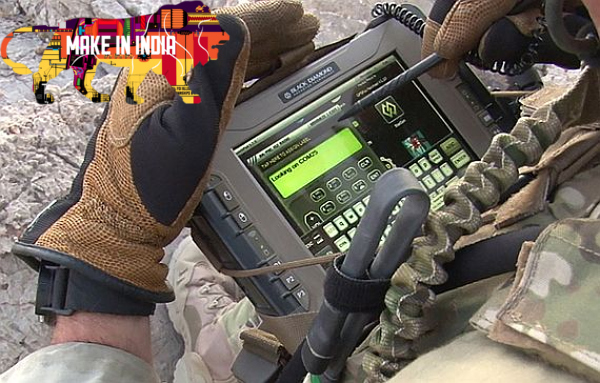
Bengaluru-based Alpha Design Technologies has reportedly emerged as the lowest bidder for an Indian Army requirement covering 600 indigenous man-pack Software Defined Radios, marking an important stage in the Army’s continuing transition towards secure, networked and software-configurable battlefield communications.
Alpha Design Technologies, which is controlled by Adani Defence & Aerospace, competed against Bharat Electronics Limited and another industry team for the requirement. According to reporting published on September 23, 2026, Alpha Design and BEL successfully cleared the technical evaluation, after which their commercial bids were opened.
The reported L1 position does not by itself constitute a final contract award. It means Alpha Design has emerged as the lowest-priced technically qualified bidder at the commercial evaluation stage. Any eventual procurement will still depend on completion of the applicable acquisition procedures and formal placement of an order by the Ministry of Defence or the Indian Army.
Requirement Covers 600 Man-Pack Software Defined Radios
The immediate procurement reportedly covers 600 man-pack Software Defined Radios intended for use by Indian Army personnel operating in tactical environments.
Unlike traditional radios whose operating characteristics are largely determined by fixed hardware, a Software Defined Radio shifts many communication functions into software. Frequency management, waveforms, encryption, networking protocols and other functions can therefore be modified or upgraded without replacing the entire radio hardware.
This approach is particularly valuable for modern armed forces because battlefield communication requirements change rapidly. A software-defined platform can accommodate new waveforms, security standards and networking capabilities through software upgrades while retaining the basic radio system.
The radios are intended to provide secure voice and data communication while functioning within increasingly networked battlefield formations.
Alpha Design and BEL Cleared the Technical Evaluation
According to the latest report, Alpha Design Technologies and defence PSU Bharat Electronics were the two companies that cleared the technical evaluation and progressed to the commercial-bid stage.
The evaluation reportedly involved a series of user and environmental trials, including field testing, operations at high altitude and trials under desert conditions. These tests are particularly important for man-portable military communications equipment because Indian Army units operate across radically different environments, from high-altitude Himalayan deployments to extreme heat and dust in desert sectors.
A tactical radio intended for Army service must therefore function reliably despite temperature variations, vibration, dust, rough handling and prolonged field deployment.
The commercial bids of the technically qualified companies were subsequently opened, with Alpha Design reportedly emerging as L1.
L1 Status Is Not the Same as a Contract Award
The distinction between being L1 and receiving an order is important.
In Indian defence procurement, a company must first satisfy the technical requirements of the tender before its commercial offer becomes relevant. Once technically compliant companies are identified, their commercial bids can be compared and the lowest acceptable bidder may emerge as L1.
This normally places the company in the leading position for subsequent commercial negotiations and contract finalisation, but it does not automatically mean that a purchase order has already been issued.
For this reason, the current development should be described as Alpha Design emerging as the reported lowest bidder for the 600-radio requirement rather than as having secured a final Indian Army contract.
BEL Was a Serious Competitor in the Programme
Bharat Electronics’ participation is notable because the defence PSU already possesses a substantial portfolio of indigenous Software Defined Radios for the Indian armed forces.
BEL officially lists several SDR families covering man-portable, tactical, naval and airborne applications. Its man-pack systems are designed to provide secure V/UHF voice, data and video communication and can incorporate software-reconfigurable waveforms, indigenous security features and electronic counter-countermeasure capabilities.
BEL’s current man-pack SDR products also support Mobile Ad Hoc Networking, allowing radios to form self-configuring and self-healing tactical networks without depending on fixed communications infrastructure.
The fact that BEL reportedly cleared the technical evaluation therefore indicates that the Army competition involved mature indigenous communication systems rather than purely developmental prototypes.
Software Defined Radios Are Becoming Central to Network-Centric Warfare
The importance of SDR technology extends well beyond replacing older radio sets.
Modern battlefield networks increasingly depend on soldiers, vehicles, command posts, sensors, artillery units, drones and surveillance systems exchanging information in real time. Radios must therefore handle not only conventional voice communication but also digital data, location information, imagery and command-and-control traffic.
Software Defined Radios can provide multiple waveforms through a common hardware architecture, enabling different units and platforms to communicate while supporting encrypted and frequency-agile operations.
The technology also makes it easier to introduce improved communications protocols as battlefield networks evolve.
For an Army operating large fleets of armoured vehicles, artillery systems, drones and electronic sensors, establishing a common family of interoperable radios can therefore become an important element of battlefield digitisation.
Indigenous Software and Encryption Are Particularly Important
The latest reporting indicates that indigenous software development formed an important part of the Army requirement.
Alpha Design reportedly developed key internal software and algorithms in India in order to comply with the procurement conditions. The company also works with international technology partners and may source certain components from overseas, but the software architecture required under the Army tender reportedly had to satisfy domestic-development requirements.
This is important because the strategic value of an SDR lies not only in its physical radio hardware but also in the waveforms, encryption systems and software that control its operation.
Control over those elements gives the armed forces greater independence when modifying communication networks, introducing new capabilities or responding to emerging electronic-warfare threats.
Secure battlefield communications are particularly sensitive because compromise of encryption or waveform technology can expose military networks to interception, disruption or exploitation.
MANET Capability Changes the Battlefield Network
One of the most important capabilities available in modern SDR systems is Mobile Ad Hoc Networking, commonly known as MANET.
Traditional radio networks often depend on predetermined communication structures. MANET-enabled radios can instead automatically create a network between participating radios, adapting as personnel and platforms move across the battlefield.
If one radio or route becomes unavailable, the network can potentially redirect data through other nodes. This produces a self-forming and self-healing communications architecture that is particularly valuable in mobile combat operations.
BEL’s officially published man-pack SDR specifications illustrate the type of capability available within India’s domestic communications industry. Its system supports IP-based networking, voice and data communication, frequency hopping and secure digital operation.
Comparable capabilities are increasingly important for linking soldiers, command posts and combat platforms into a common tactical network.
Army Requirement Could Extend Far Beyond 600 Radios
The immediate 600-unit requirement may represent only a relatively small initial procurement compared with the Army’s broader need for modern tactical communication equipment.
The September 23 report states that a subsequent requirement could involve approximately 16,000 man-pack radios, while the longer-term requirement may eventually extend to several tens of thousands of units.
These larger figures have not yet been officially announced by the Ministry of Defence and should therefore be treated as reported future requirements rather than confirmed procurement quantities.
The potential scale nevertheless illustrates why the current 600-radio competition is significant. A successful initial procurement can provide operational data, establish compatibility standards and influence the architecture adopted for later communication systems.
For military radios, compatibility becomes particularly important because different formations and platforms must be capable of exchanging information securely.
Common Waveforms Could Become Crucial
A major challenge in modern military communications is interoperability.
Different radios may operate in similar frequency bands but remain unable to communicate effectively if they use different waveforms, encryption standards or networking protocols. This can become particularly problematic when systems are procured from multiple suppliers over several years.
Software Defined Radios offer a potential solution because compatible waveforms can be loaded across different hardware platforms, provided the architecture and security requirements allow it.
The Army’s longer-term communications strategy will therefore have to consider not only the performance of individual radio sets but also whether man-pack, handheld, vehicle-mounted and other SDR variants can communicate seamlessly across a common battlefield network.
This can become especially important when infantry units operate alongside tanks, artillery formations, drones and command vehicles.
Alpha Design Already Has Experience in Military Electronics
Alpha Design Technologies has developed a substantial presence in Indian defence electronics over several decades and operates across communications, electro-optics, electronic warfare, avionics, simulators and space-related systems.
The company became part of Adani Defence & Aerospace following Adani’s acquisition of a controlling interest, giving the group an established defence-electronics manufacturing and engineering base in Bengaluru.
Adani Defence has subsequently expanded across missiles, ammunition, unmanned systems, aircraft maintenance, radar technologies and other defence sectors.
An Indian Army SDR order would strengthen the group’s position in secure tactical communications, a segment that is increasingly important as the armed forces move towards more integrated digital command networks.
Private Industry Is Competing Directly With Defence PSUs
The reported competition between Alpha Design and BEL also illustrates a broader transformation within India’s defence industry.
For decades, sophisticated military electronics were dominated by defence public-sector enterprises and government laboratories. Private companies are now increasingly developing systems that compete directly with established DPSUs in Army, Navy and Air Force procurement programmes.
This does not necessarily displace the public sector. Instead, it creates multiple domestic technology sources and can give the armed forces greater choice between competing Indian systems.
Competition can also encourage companies to invest in indigenous software, engineering and manufacturing because technical performance must be demonstrated before commercial bids are evaluated.
The SDR procurement therefore provides another example of private Indian industry moving from component manufacturing towards ownership and integration of complete defence systems.
The 600-Radio Order Would Be an Initial Operational Step
If Alpha Design’s reported L1 position proceeds to a formal award, the 600-radio procurement would provide the Indian Army with an additional batch of indigenous tactical communication systems while giving the company an important operational reference.
The radios would still represent only one component of a much larger battlefield communications architecture. Future requirements are expected to involve man-pack, handheld, vehicle-mounted and other variants capable of functioning across a secure and interoperable network.
The strategic importance of the programme therefore lies less in the number 600 than in the technology being adopted.
A modern military increasingly depends on information moving securely between sensors, commanders and weapons. Software Defined Radios provide the communications layer that makes such network-centric operations possible.
For India, developing that layer domestically also reduces dependence on foreign-controlled software, waveforms and encryption technology.
References
Bharat Electronics Limited — Official product information for SDR Manpack, Software Defined Radio and tactical communications systems.
Bharat Electronics Limited — Defence Communication Products portfolio, including V/UHF SDR Man Portable and other SDR systems.
Bharat Electronics Limited — Export Product Catalogue: Software Defined Radio Manpack technical characteristics.
Bharat Electronics Limited — Centre of Excellence for Communication, indigenous communications technology and SDR development programmes.
Adani Group / Adani Defence & Aerospace — Official corporate information on Alpha Design Technologies and indigenous defence electronics activities.
The Times of India — “Bengaluru firm emerges L1 for army’s 600 software-defined radio order,” September 23, 2026.
The Times of India — Reported details regarding technical evaluation, user trials, high-altitude and desert trials, commercial bid opening and Alpha Design Technologies’ L1 position, September 23, 2026.
You may also like
-
Indian Navy Seeks Six Indigenous LCU Mk V Amphibious Ships Under Make in India
-
India’s Drone Ecosystem Expands Beyond 600 Companies as Military Demand Moves Towards Large-Scale Procurement
-
Prostarm Builds 1.2 GWh BESS Manufacturing Base in Haryana as Indian Grid-Storage Orders Expand
-
Hughes Precision Raises ₹250+ Crore to Expand Ammunition Manufacturing, Enters Medium-Calibre Segment
-
India-Germany P-75(I) Submarine Partnership Moves Closer to Decision as TKMS-MDL Negotiations Advance
