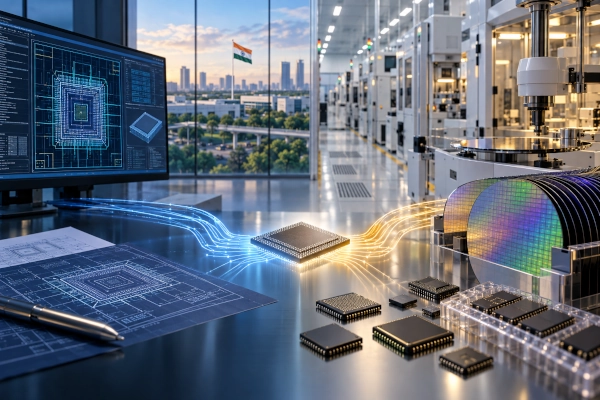
India’s semiconductor market is projected to expand more than threefold over the next decade, rising from about US$64 billion in 2026 to more than US$200 billion by 2035. The projection comes from the EY-IESA report Semicon India 2.0: From Capacity Creation to Ecosystem Leadership, which argues that India now has an opportunity to convert rapidly growing chip demand into a deeper domestic manufacturing and innovation base.
The report places the current market at roughly ₹5.94 lakh crore and projects it to reach around ₹18.57 lakh crore by 2035. The scale of that growth reflects the increasing semiconductor content across consumer electronics, vehicles, industrial equipment, telecommunications networks, data centres and advanced digital infrastructure.
Consumer Electronics Remains the Largest Demand Segment
Consumer electronics currently accounts for about 30% of India’s semiconductor demand, making it the single largest end-use segment. The automotive sector contributes another 16%, while industrial applications account for around 15%.
These traditional demand centres are now being joined by newer technology-intensive sectors. Artificial intelligence infrastructure, data centres, electric mobility, advanced telecommunications, automation and next-generation manufacturing are expected to increase chip consumption considerably over the coming years.
The report suggests that this shift will make semiconductor availability increasingly important not only for electronics companies, but also for automotive manufacturers, industrial groups, telecom operators and digital infrastructure providers.
Semiconductor Imports Have Risen More Than Fivefold
India’s dependence on imported semiconductors has increased sharply as domestic electronics production has expanded.
Semiconductor imports rose from around ₹0.38 lakh crore in FY2016–17 to ₹2.62 lakh crore in FY2024–25, representing an increase of more than five times over eight years. In dollar terms, imports increased from approximately US$5.7 billion to US$30.3 billion.
The report estimates a compound annual growth rate of about 23% during this period. This rise reflects the growth of electronics manufacturing in India, but it also underlines the continued dependence on overseas fabrication and semiconductor supply chains.
For India, the next stage of the semiconductor strategy will therefore depend on converting domestic consumption into greater local production rather than allowing higher demand to translate only into higher imports.
Electronics Production Has Expanded Nearly Sixfold
The semiconductor opportunity is closely linked to the rapid expansion of India’s wider electronics manufacturing sector.
Electronics production increased from around ₹1.90 lakh crore in FY2014–15 to approximately ₹11.30 lakh crore in FY2024–25, representing nearly a sixfold increase over the decade.
Electronics exports also grew sharply during the same period, increasing about elevenfold. This expansion has created a much larger domestic customer base for semiconductor components and strengthened the economic case for building local chip manufacturing, packaging and design capabilities.
The report argues that semiconductor manufacturing can become a natural extension of India’s existing electronics ecosystem rather than developing as an isolated industry.
India Holds a Major Share of Global Chip-Design Talent
One of India’s strongest advantages remains its semiconductor engineering workforce.
The country is estimated to account for nearly 20% of the world’s semiconductor design engineers, giving it a substantial base in chip architecture, verification, embedded systems and electronic design.
For decades, many multinational semiconductor companies have operated major design and engineering centres in India. The challenge now is to connect this engineering capability more closely with domestic fabrication, packaging, product development and commercialisation.
Building that connection could allow India to move from being primarily a design and engineering centre towards becoming a more complete semiconductor economy.
Advanced Packaging Identified as a Major Opportunity
The EY-IESA report identifies advanced semiconductor packaging as one of the areas where India could build competitive strength relatively quickly.
As chip architectures become more complex, semiconductor performance increasingly depends on how multiple dies, memory units and processors are integrated within a package. Technologies such as chiplets, 2.5D packaging, 3D integration and system-in-package solutions are becoming central to next-generation computing and AI hardware.
Developing advanced packaging capability could allow India to capture more value from semiconductor manufacturing even before it achieves very large-scale fabrication capacity across every chip category.
Compound Semiconductors and Photonics Offer New Growth Areas
The report also highlights compound semiconductors and photonics as high-potential sectors.
Compound semiconductor materials such as silicon carbide and gallium nitride are increasingly used in power electronics, electric vehicles, renewable-energy systems, radar, telecommunications and high-frequency applications.
Photonics, meanwhile, is becoming increasingly important in data communications, sensing, defence electronics and computing infrastructure.
These areas could give India opportunities to build specialised capabilities without competing only in conventional silicon manufacturing, where established global producers already operate at enormous scale.
Chip-to-System Integration Could Become a Key Strength
Another priority identified in the report is chip-to-system integration, where semiconductor design is closely linked with the development of complete electronic products.
India already has strengths in software, embedded systems, electronics design and system engineering. Combining these capabilities with semiconductor manufacturing could allow domestic companies to design chips specifically for Indian and global applications rather than producing only standard components.
This approach could be particularly important in sectors such as automotive electronics, telecom equipment, industrial automation, defence systems and artificial intelligence hardware.
Integrated Semiconductor Clusters Recommended
The report recommends the development of integrated manufacturing clusters where fabrication plants, packaging facilities, materials suppliers, equipment manufacturers, research centres and engineering talent can operate within the same industrial ecosystem.
Semiconductor manufacturing depends on highly specialised supply chains, including gases, chemicals, wafers, precision equipment and testing infrastructure. Clustering these activities can reduce logistics costs, improve supply-chain resilience and make large manufacturing projects easier to sustain.
The report also calls for closer alignment between state-level semiconductor policies and the next phase of the national semiconductor programme.
Talent Development Will Need to Go Beyond Chip Design
India already has a large design workforce, but semiconductor manufacturing requires additional skills in fabrication, materials science, process engineering, packaging, equipment maintenance and quality control.
The report therefore recommends specialised certification and training programmes that can prepare engineers and technicians for semiconductor fabs and packaging facilities.
Building this workforce will be particularly important as new manufacturing projects move from construction into commercial operation.
From Capacity Creation to Ecosystem Leadership
India’s semiconductor policy has so far focused heavily on attracting fabrication, packaging and design investments. The next phase will depend on whether these individual projects can develop into a broader industrial ecosystem.
The EY-IESA report argues that India now has the domestic demand, electronics manufacturing scale and engineering talent needed to support that transition.
With the semiconductor market projected to cross US$200 billion by 2035, the opportunity is no longer limited to reducing imports. It is increasingly about building an industry that combines design, manufacturing, packaging, materials, systems integration and export capability within India.
References
EY and India Electronics and Semiconductor Association — Semicon India 2.0: From Capacity Creation to Ecosystem Leadership.
You may also like
-
India Ranks First Among 41 Markets in Swedish Global Business Climate Survey 2026
-
Pace Robotics Moves Construction Automation From Pilot Stage to Commercial Deployment
-
JCBL Receives DRDO Technology for Indigenous 20-Tonne Heavy Drop System for C-130J and C-17
-
DRDO Moves 30 kW Laser Weapon Towards Production, Industry Partner Selection Planned Within Six Months
-
IG Defence Validates KAL Long-Range Strike Drone’s Integrated Systems in Pokhran Trial
