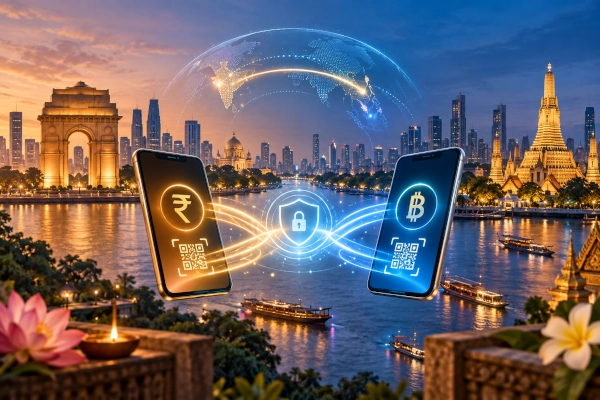
India and Thailand are moving to deepen financial connectivity through two complementary initiatives: a proposed linkage between India’s Unified Payments Interface and Thailand’s PromptPay network, and a local-currency settlement mechanism using the Indian rupee and Thai baht.
The developments form part of a broader effort to strengthen bilateral trade, investment and business integration as the two countries expand their economic partnership beyond conventional merchandise trade.
UPI and PromptPay Networks Being Connected
Technical teams from India and Thailand are working on linking UPI with PromptPay, Thailand’s major real-time retail payment platform. The objective is to enable easier cross-border digital payments between users and merchants in the two countries.
If implemented, the connection could allow Indian visitors in Thailand and Thai visitors in India to make retail payments through familiar domestic payment platforms without depending as heavily on cards, cash or conventional international payment channels.
The initiative would also provide smaller merchants with a simpler mechanism for accepting payments from foreign customers, potentially reducing friction in tourism-related transactions and everyday retail commerce.
UPI has increasingly become an instrument of India’s international digital-economic engagement. The platform is already operational or integrated in several overseas markets, and India has been seeking additional bilateral linkages with national payment networks.
Rupee–Baht Settlement Also Under Discussion
Alongside digital retail payments, India and Thailand are examining a mechanism that would allow bilateral commercial transactions to be settled directly in Indian rupees and Thai baht.
A functioning local-currency settlement mechanism could reduce the need for companies to convert transactions through a third currency. This can potentially lower foreign-exchange conversion costs and reduce exposure to currency volatility for exporters, importers and other businesses.
The initiative is particularly relevant as bilateral trade volumes rise and companies in the two countries develop deeper manufacturing and supply-chain relationships.
Part of a Wider India–Thailand Economic Push
The payment initiatives emerged within a broader programme of economic cooperation being developed between the two countries.
Indian Commerce and Industry Minister Piyush Goyal and Thai Deputy Prime Minister and Commerce Minister Suphajee Suthumpun recently discussed ways to expand bilateral trade and investment, strengthen business-to-business engagement and improve market access.
Both sides have emphasised co-creation and joint investment rather than limiting the relationship to the exchange of finished products. Areas identified for collaboration include information technology, pharmaceuticals, processed food, green industries, automobiles, construction, hospitality and other manufacturing and service sectors.
The India–Thailand Joint Trade Committee is expected to play a central role in supervising these initiatives and preparing a detailed action plan for future cooperation.
Digital Payments Could Support Tourism
Tourism provides one of the clearest practical use cases for a UPI–PromptPay connection.
Thailand remains a major international destination for Indian travellers, while India is also seeking to attract more visitors from Thailand and the wider Southeast Asian region.
A direct payment link could enable travellers to pay restaurants, shops, hotels and smaller merchants through QR-based systems already familiar in their home countries.
Reducing dependence on cash exchanges and international cards could make small-value transactions faster and more convenient while potentially lowering payment costs.
Benefits for Small Businesses
The system could also be useful for smaller enterprises participating in cross-border commerce.
Large corporations already have access to international banking systems, hedging mechanisms and sophisticated payment infrastructure. Smaller merchants and SMEs can face disproportionately higher costs when handling cross-border payments and foreign currencies.
A combination of interoperable digital payment systems and local-currency settlement could gradually reduce some of these barriers and make bilateral commerce more accessible to smaller businesses.
Bilateral Trade Continues to Expand
India and Thailand already maintain a substantial economic relationship. Thailand identifies India as its largest trading partner in South Asia.
During the first seven months of 2026, bilateral trade reached approximately $13.97 billion, representing growth of just over 8 per cent compared with the same period a year earlier.
Thai exports to India remained considerably larger than its imports from India, underlining the importance New Delhi places on improving market access and developing more balanced trade.
Beyond Payments to Joint Investment
The latest discussions also indicate that financial connectivity is being paired with investment cooperation.
Several Indian technology companies are preparing investments in Thailand’s data-centre sector, including through joint ventures with Thai businesses. Thai investors have meanwhile expressed interest in partnerships with Indian companies.
Both governments are attempting to convert this interest into concrete pilot projects under a broader co-creation and co-investment approach.
Payments infrastructure can support this strategy by making transactions between companies and consumers easier and by reducing some of the financial friction associated with cross-border activity.
Connecting India More Deeply With Southeast Asia
The India–Thailand initiatives also fit into India’s wider effort to integrate its digital and financial infrastructure with Southeast Asian economies.
India is already seeking greater economic integration with ASEAN through trade agreements, supply chains, connectivity projects and digital systems.
A successful UPI–PromptPay linkage would add another layer to this relationship by connecting two major national instant-payment ecosystems.
The rupee–baht settlement mechanism, meanwhile, could provide businesses with an additional option for conducting trade directly in the currencies of the two countries.
Together, these initiatives point towards a more interconnected India–Thailand economic relationship in which trade, investment, tourism and digital payments increasingly operate within the same framework.
References
Ministry of Commerce and Industry, Government of India — Meeting between Commerce and Industry Minister Piyush Goyal and Thai Deputy Prime Minister and Commerce Minister Suphajee Suthumpun, 9 September 2026.
The Nation Thailand — Thailand and India advance strategic partnership with data-centre investments and cross-border payment links, 19 September 2026.
Government of India — UPI international expansion and cross-border digital-payment initiatives, 2026.
ASEAN–India trade and economic cooperation documents, Government of India.
You may also like
-
Governing for the India That Can Be: India’s Political Shift From Managing Problems to Building Solutions
-
India–Taiwan Deep-Tech Investment Link Expands With ₹1,000-Crore Advanced Manufacturing Fund
-
Micron Begins Global Shipments of DRAM and NAND Products From Sanand as India’s Semiconductor Manufacturing Scales Up
-
India Records $20.8 Billion Balance-of-Payments Surplus in July as Foreign-Exchange Inflows Surge
-
Moody’s Raises India’s FY2026-27 Growth Forecast to 7% as Economy Shows Resilience Amid Global Shocks
