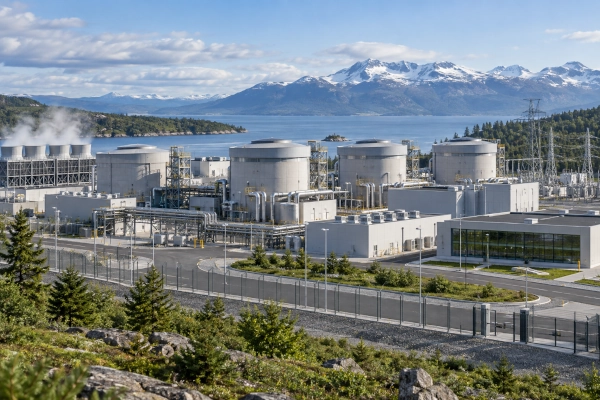
India’s indigenous Small Modular Reactor programme is beginning to move from reactor design towards the more difficult task of industrial deployment. At the centre of this transition is the Bharat Small Modular Reactor, being developed by the Bhabha Atomic Research Centre as part of the country’s Nuclear Energy Mission. The Department of Atomic Energy has officially confirmed that BARC is developing the reactor with the participation of domestic industry, drawing on manufacturing capabilities already established through India’s indigenous nuclear programme.
Recent media reports have identified NTPC, Reliance Industries, Adani Group and Larsen & Toubro as companies involved in discussions over possible commercial deployment of a larger Bharat Small Modular Reactor configuration. Those company-specific discussions have not yet been formally announced by the Department of Atomic Energy, but they fit within the government’s broader effort to bring Indian industry more deeply into nuclear power development, manufacturing and future deployment.
Bharat Small Modular Reactor Takes Shape
BARC is developing three indigenous small-reactor platforms under the Nuclear Energy Mission. The principal power-generation design is the 220 MWe Bharat Small Modular Reactor, commonly referred to as the BSMR-200. It is being developed as an indigenous pressurised water reactor suited to applications where conventional large nuclear plants may not be appropriate.
Alongside the BSMR-200, BARC is developing the 55 MWe SMR-55 for smaller electricity requirements and a High Temperature Gas-Cooled Reactor with a capacity of up to 5 MWth. The high-temperature reactor is intended primarily for industrial process heat and hydrogen production, extending the role of nuclear energy beyond conventional electricity generation.
The Nuclear Energy Mission carries a budgetary allocation of ₹20,000 crore for research, development and deployment of indigenous small modular reactors. The government has set a target of operationalising at least five indigenous SMRs by 2033. This makes the Bharat SMR programme a strategic element of India’s wider effort to expand nuclear generation while creating new reactor designs for industrial and decentralised applications.
First BSMR-200 Planned at Tarapur
BARC has already identified Tarapur in Maharashtra as the site for the lead BSMR-200 demonstration unit. The project is intended to validate the reactor design, construction methodology, operating systems, safety architecture and economics before any wider commercial rollout is considered.
Government information placed before Parliament estimates the development and construction outlay for the BSMR-200 at around ₹5,960 crore. The first reactor will therefore function not only as a power-generating unit but also as the reference plant for establishing the manufacturing, regulatory and operating experience required for subsequent reactors.
The Tarapur project will also be important for determining how far India can standardise future SMR construction. Standardisation is central to the economic case for modular reactors because the technology is expected to benefit from repeated manufacturing of common components rather than highly customised reactor construction at each site.
BARC Is Already Looking Beyond 220 MWe
The programme has been designed with further scaling in mind. In August 2026, the Department of Atomic Energy officially told Parliament that experience from the 220 MWe demonstration reactor could be used to increase the Bharat SMR’s capacity to around 300 MWe.
A reactor in the 300 MWe class would be capable of serving larger industrial facilities while retaining many of the deployment advantages associated with smaller modular systems. It is this larger configuration that recent media reports have connected with discussions involving major Indian energy and engineering companies.
According to those reports, BARC has been exploring possible participation from NTPC, Reliance Industries, Adani Group and Larsen & Toubro in the future commercial deployment of an approximately 300 MWe version of the reactor. Until the Department of Atomic Energy or the companies themselves announce specific projects, investment commitments or implementation agreements, these discussions should be treated as exploratory.
Domestic Industry Is Already Part of the Official Strategy
The broader industrial-development model is officially established. The Department of Atomic Energy has stated that BARC is pursuing indigenous SMR development with domestic industry and is drawing on the engineering and manufacturing capabilities built during decades of work on India’s Pressurised Heavy Water Reactor programme.
India already has a substantial nuclear manufacturing base. Domestic companies have supplied heavy forgings, reactor vessels, steam generators, pumps, heat exchangers, specialised piping, control systems and other nuclear-grade components for the country’s existing reactor fleet. The Bharat SMR programme can therefore build on an industrial ecosystem that has already been developed rather than creating a nuclear manufacturing base from the beginning.
Companies such as Larsen & Toubro, Bharat Heavy Electricals Limited, Bharat Forge and several specialised suppliers have participated in India’s nuclear programme for years. Their experience with demanding nuclear-grade manufacturing standards provides an important foundation for any future move towards repeated modular reactor production.
SHANTI Act Opens a New Industrial Model
The commercial possibilities surrounding small modular reactors have also expanded because of changes in India’s nuclear policy framework. The Sustainable Harnessing and Advancement of Nuclear Energy for Transforming India Act, or SHANTI Act, 2025, has created a framework for greater private participation in the nuclear-energy sector while retaining government licensing, safety oversight and regulatory control.
The government has linked these reforms with the Nuclear Energy Mission and its long-term objective of expanding India’s nuclear power capacity to 100 GWe by 2047. Achieving that level of expansion will require a larger industrial base than the traditional public-sector model alone could provide.
Small modular reactors are particularly relevant to this shift because their commercial viability depends heavily on repeated construction of standardised units. The model therefore requires not only reactor designers and government laboratories but also utilities, heavy-engineering companies, specialised manufacturers, construction contractors and long-term investors.
DAE Begins Formal Consultation With Industry
The Department of Atomic Energy has already begun structured consultations with Indian industry on the country’s future nuclear roadmap. On 14 May 2026, DAE organised an Industry Consultation on Nuclear Energy Roadmap at its headquarters in Mumbai under the chairmanship of the Secretary, Department of Atomic Energy.
Senior officials from DAE and its constituent units participated alongside representatives from major Indian industries. The discussions covered the nuclear-energy roadmap, implementation of the SHANTI Act, expansion of industrial participation and deeper collaboration between the government and domestic companies.
The official account did not assign individual companies to particular reactor projects, but the consultation demonstrated that wider industry participation is becoming an organised part of India’s nuclear expansion strategy rather than remaining confined to equipment supply contracts.
Why India Wants Small Modular Reactors
India’s SMR programme is intended to address applications that are not always well suited to conventional large nuclear stations. One potential use is captive electricity generation for energy-intensive sectors such as steel, aluminium, chemicals and refining, where reliable round-the-clock power is essential and pressure to reduce carbon emissions is increasing.
Another major possibility is the replacement of ageing coal-fired generating capacity. Existing thermal-power sites already have transmission links, cooling systems, transport infrastructure and trained personnel. Smaller nuclear reactors could potentially make use of some of this existing infrastructure while supplying dependable low-carbon electricity.
SMRs could also be deployed in regions where electricity demand is not large enough to justify a conventional gigawatt-scale reactor. In addition, BARC’s High Temperature Gas-Cooled Reactor could open applications in industrial process heat and hydrogen production, allowing nuclear energy to support sectors that are difficult to decarbonise through electricity alone.
SMRs Could Help Decarbonise Heavy Industry
Industrial decarbonisation is likely to become one of the most important applications for the Bharat SMR family. Renewable energy can supply a growing share of industrial electricity demand, but many industrial processes require continuous power and, in some cases, high-temperature heat.
Nuclear reactors can provide both dependable electricity and process heat without direct carbon emissions from combustion. A smaller reactor located near a major industrial complex could therefore reduce dependence on coal- or gas-fired captive power plants while providing a stable source of energy.
Such deployment would represent a significant change from India’s traditional nuclear-power model, where large generating stations supply electricity to the grid. The Bharat SMR programme is therefore also an attempt to broaden the role of nuclear technology within the industrial economy.
Standardisation Will Determine Commercial Success
The economic case for small modular reactors depends heavily on standardisation and repeated manufacturing. Large nuclear plants achieve economies of scale by producing very large amounts of electricity from a single unit. Smaller reactors must instead rely on simpler designs, repeatable construction and factory-scale manufacturing of common components.
If each SMR project becomes heavily customised, many of the expected cost and schedule advantages could disappear. The programme therefore needs a high degree of design discipline, repeatable manufacturing standards and a supplier base capable of producing the same components in quantity.
This is where large Indian engineering and manufacturing companies could become especially important. Repeated production of reactor vessels, steam systems, control equipment and modular components could reduce costs over time while also creating a deeper domestic nuclear supply chain.
BSMR Builds on India’s Existing Reactor Experience
The Bharat SMR is not being developed in isolation from India’s existing nuclear programme. BARC is drawing on decades of experience accumulated through the indigenous Pressurised Heavy Water Reactor programme and the domestic nuclear manufacturing ecosystem created around it.
India progressed from 220 MWe PHWRs to 540 MWe units and subsequently to the standardised 700 MWe indigenous PHWR design now forming an important part of the national nuclear expansion programme. This long development path has given Indian engineers, manufacturers and regulators experience across reactor construction, heavy engineering, quality assurance, fuel handling and long-term operation.
The Bharat SMR programme allows India to use this existing experience while developing a compact pressurised-water reactor platform intended for modular deployment. BARC has also highlighted the use of indigenous heavy forgings for reactor pressure vessels, another area where domestic manufacturing capability has expanded substantially.
A 300 MWe Commercial Reactor Could Be the Next Step
The proposed evolution from the BSMR-200 towards an approximately 300 MWe commercial version represents the logical next stage of the programme. BARC first needs to establish the technology through the lead reactor at Tarapur and gather operating and construction experience from that project.
That experience can then be used to refine the design, confirm costs, improve construction schedules and determine how much of the reactor can be standardised for repeated production. Only after these factors are demonstrated can a larger commercial deployment model be evaluated properly.
The reported discussions involving major Indian companies should therefore be viewed in this context. India is beginning to consider who could finance, manufacture, construct and eventually operate indigenous modular reactors once the technology moves beyond the demonstration stage.
Nuclear Expansion Will Require Industry at Scale
India’s target of 100 GWe of nuclear generating capacity by 2047 is far larger than anything the country’s existing nuclear structure has previously attempted. Reaching that level will require simultaneous expansion of indigenous PHWRs, fast breeder reactors, foreign-cooperation light-water reactors and new technologies such as SMRs.
Government laboratories can design and validate reactor systems, but a programme of this scale cannot depend on research institutions alone. It will require heavy-engineering companies, specialised component manufacturers, construction firms, utilities, financial institutions and a much larger nuclear-qualified supplier base.
The decision to develop indigenous SMRs with domestic industry reflects this reality. The reactor design and the industrial ecosystem around it will have to advance together if the programme is to reach commercial scale.
From Reactor Design to a Nuclear Manufacturing Ecosystem
The most important development surrounding the Bharat Small Modular Reactor may ultimately be larger than the reactor itself. India is attempting to create a model in which indigenous nuclear technology can move systematically from BARC laboratories into an industrial ecosystem capable of manufacturing and deploying multiple commercial units.
The BSMR-200 at Tarapur is intended to provide the first demonstration platform. A future 300 MWe version could become the bridge towards larger commercial deployment. Private and public-sector participation under the new policy framework could then determine whether the technology can be reproduced at sufficient scale to make a meaningful contribution to India’s power and industrial sectors.
The identities of the eventual commercial partners remain to be formally announced. What is already clear from official policy is that India’s SMR programme is no longer being conceived solely as a government laboratory project. It is being developed as the foundation of a wider indigenous nuclear manufacturing and deployment ecosystem.
References
Department of Atomic Energy / Press Information Bureau — Deployment of Small Modular Reactors, 5 August 2026
https://www.pib.gov.in/PressReleasePage.aspx?PRID=2294813
Department of Atomic Energy / Press Information Bureau — Nuclear Energy Mission & Bharat Small Modular Reactors, 5 August 2026
https://www.pib.gov.in/PressReleasePage.aspx?PRID=2294814
Department of Atomic Energy / Press Information Bureau — Progress Under Nuclear Energy Mission, 23 July 2026
https://www.pib.gov.in/PressReleasePage.aspx?PRID=2288294
Department of Atomic Energy / Press Information Bureau — Small Modular Reactors for Clean and Low-Carbon Energy, 4 February 2026
https://www.pib.gov.in/PressReleasePage.aspx?PRID=2223305
Department of Atomic Energy / Press Information Bureau — Nuclear Energy Mission, 11 March 2026
https://www.pib.gov.in/PressReleasePage.aspx?PRID=2238311
Department of Atomic Energy — Industry Consultation on Nuclear Energy Roadmap, 14 May 2026
https://dae.gov.in/industry-consultation-on-nuclear-energy-roadmap/
Bhabha Atomic Research Centre — Republic Day Address 2026
https://www.barc.gov.in/presentations/20260126.pdf
Bhabha Atomic Research Centre — Founder’s Day Address 2025
https://www.barc.gov.in/presentations/fdch25.pdf
Media Reference for Company-Specific Discussions — Mint, 17 September 2026
https://www.livemint.com/industry/energy/nuclear-power-plants-in-india-bhabha-atomic-research-centre-adani-group-reliance-industries/amp-11789550664329.html
You may also like
-
India’s Co-Orbital Counter-Space Path: What Official Sources Actually Reveal
-
Tata Electronics Brings Malaysia’s Kelington Into Dholera Fab as India–Malaysia Semiconductor Links Deepen
-
India–Thailand Trade Nears $14 Billion in Seven Months as Economic Ties Broaden
-
India’s Net Direct Tax Collections Rise Nearly 13% to ₹12.12 Lakh Crore as Corporate Advance Tax Strengthens
-
Rataul Mango — Baghpat’s Fragrant Jewel and the Orchard Legacy of the Yamuna-Hindon Doab
