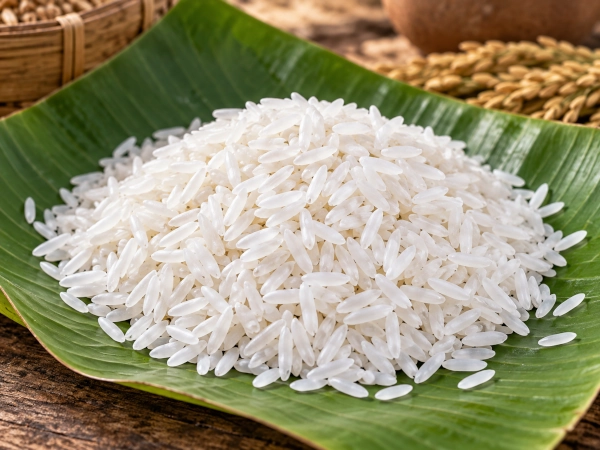
Among West Bengal’s traditional aromatic rices, Gobindabhog Rice occupies an especially important cultural and culinary place. This indigenous non-basmati variety is known for its small, short-bold white kernels, pleasant aroma and soft texture after cooking. It is cultivated mainly across the southern and central districts of West Bengal, including Purba Bardhaman, Bankura, Hooghly, Nadia, Murshidabad, Birbhum, Howrah and North 24 Parganas.
Gobindabhog is much more than a premium scented rice. Its name reflects its deep association with religious offerings, particularly bhog prepared for Govinda, a name of Krishna. Over generations, the rice became closely associated with temple food, festive meals, payesh, pulao and other traditional Bengali dishes in which aroma and texture are central to the final preparation.
A Rice Rooted in South Bengal
Gobindabhog is native to the Lower Gangetic plains and the Rarh region of Bengal, where farmers have cultivated it for centuries. Its traditional growing zone extends across districts such as Bardhaman, Hooghly, Nadia, Bankura, Birbhum, Murshidabad, Howrah and North 24 Parganas.
This geographical spread covers contrasting agricultural landscapes, from fertile alluvial tracts to the red and lateritic soils of western Bengal. The variety developed within these environments through long-term farmer selection, giving it a regional identity shaped by both ecology and traditional cultivation practice.
Gobindabhog has a long history as a cultivated rice of Bengal. Historical and agricultural studies describe it as a traditional variety maintained for several centuries, with references appearing in older district records and regional agricultural literature.
Why It Is Called Gobindabhog
The name itself reveals the rice’s cultural importance. Gobinda refers to Lord Krishna, while bhog means food offered to a deity. The variety is widely understood to have acquired its name because of its long-standing use in preparing ritual food offered to Govinda.
This association helped preserve Gobindabhog even when higher-yielding varieties became available. In Bengali households and temples, aromatic rice was often preferred for religious offerings because fragrance, purity and sensory quality carried cultural significance beyond ordinary household consumption.
Over time, Gobindabhog became closely connected with puja offerings, festive cooking and ceremonial meals, giving the grain an identity that is both agricultural and devotional.
Small Grain, Distinctive Aroma
Gobindabhog is visually very different from long-grained basmati. It has short-bold white kernels and a pleasant aroma that becomes more noticeable during cooking. The paddy grains are typically golden-yellow, while the milled rice remains compact and fine.
Scientific characterisation has also shown that Gobindabhog has relatively low amylose content, helping explain its soft cooked texture. The grain is therefore valued not for dramatic elongation after cooking but for fragrance, tenderness and the way it absorbs the flavours of milk, ghee, spices and other ingredients.
These characteristics make it particularly suitable for traditional Bengali preparations where aroma and softness are more important than grain separation.
A Classic Non-Basmati Aromatic Rice
Gobindabhog belongs to India’s large but often underappreciated group of non-basmati aromatic rices. West Bengal possesses considerable diversity in scented rice, including Tulaipanji, Kalonunia, Radhunipagal, Kataribhog, Radhatilak and several other traditional varieties.
These rices developed in different ecological pockets and acquired strong regional identities through farming and cuisine. Gobindabhog became one of the most commercially recognised because its combination of fragrance, cooking quality and cultural importance gave it a strong domestic market.
Its identity demonstrates that premium Indian aromatic rice extends far beyond the basmati-growing regions of northern India.
Traditional Cultivation
Gobindabhog is typically grown during the kharif season, relying substantially on monsoon conditions. Traditional plants are relatively tall and the crop generally requires around 140 to 145 days to mature under normal conditions.
The variety is also photosensitive, meaning that flowering is influenced by day length. Such characteristics are common among traditional rice landraces and help explain why they are strongly adapted to specific seasonal and geographical conditions.
For generations, farmers preserved Gobindabhog seed through repeated local selection. This ensured continuity of aroma and grain quality, but it also meant that maintaining varietal purity depended heavily on farmer knowledge and careful seed conservation.
Lower Yield, Higher Value
Gobindabhog illustrates the central challenge facing many traditional aromatic rices. Its yield is lower than that of several modern high-yielding varieties, but its market value is based on qualities that conventional productivity measurements do not capture.
Fragrance, cooking quality and cultural identity allow it to command a premium price. This distinction is crucial for conservation because farmers need adequate economic returns if they are to continue cultivating a traditional variety rather than replacing it with a more productive commercial crop.
The future of Gobindabhog therefore depends on maintaining a market in which quality, authenticity and cultural value are rewarded rather than treating all rice as a uniform commodity.
The Rice of Bhog and Temple Cuisine
The strongest cultural association of Gobindabhog is with bhog, particularly rice-based offerings prepared during religious observances. Its soft texture and fragrant character make it especially suitable for dishes prepared for deities and subsequently distributed as prasad.
In Bengali cuisine, Gobindabhog is widely used for khichuri, especially the rich festive varieties prepared during Durga Puja and other religious occasions. Its grains absorb ghee, spices, lentils and vegetables effectively, producing a soft and intensely aromatic preparation.
The rice’s association with worship also helps explain why it retained a prestige that extended beyond its agricultural value. In many households, Gobindabhog was traditionally reserved for occasions when ordinary rice was considered insufficiently special.
Payesh, Pulao and Bengali Festive Cooking
Gobindabhog is equally important in Bengali sweet and festive cuisine. Its short grain and aromatic character make it particularly well suited for payesh, Bengal’s traditional rice pudding prepared with milk, sugar or jaggery and often flavoured with cardamom, nuts or dried fruits.
Unlike long-grained varieties, Gobindabhog gradually softens into the milk while retaining enough structure to give the dessert body. Its natural fragrance complements the sweetness without requiring strong additional flavouring.
The rice is also widely used for Bengali-style pulao, where its compact grains absorb ghee and spices while retaining their characteristic aroma. In many traditional recipes, the rice contributes as much to the flavour of the dish as the ingredients added to it.
An Important Farmers’ Variety
Gobindabhog’s agricultural importance was formally recognised even before its GI registration. The variety was registered as a Farmers’ Variety under the Protection of Plant Varieties and Farmers’ Rights framework, recognising the role of farming communities in conserving and maintaining this traditional genetic resource.
This recognition is significant because Gobindabhog is not merely a commercial product name. It is a distinct traditional rice variety with identifiable plant, grain and cooking characteristics.
Formal recognition also reinforces the importance of farmers as custodians of agricultural biodiversity rather than treating traditional varieties as anonymous genetic material.
Conservation Through Farmer Networks
Efforts to protect West Bengal’s aromatic rice diversity have increasingly involved organised farmer groups. Agricultural institutions in the state have worked with thousands of farmers cultivating indigenous scented rice varieties across multiple districts.
Gobindabhog has been one of the important varieties within these programmes. Farmer organisations in districts such as Nadia, Hooghly, Bardhaman and Murshidabad have been linked with technical support, seed conservation and marketing initiatives.
Such networks are particularly important for heritage crops because they help maintain seed purity, coordinate cultivation and strengthen farmers’ ability to access premium markets.
Building a Premium Value Chain
Efforts have also been made to create a more organised value chain for Gobindabhog and other Bengal aromatic rices. These initiatives include improved milling, packaging, collective branding, farmer organisation and market linkages designed to move the crop beyond loose local sale and into premium markets.
This transition matters because much of the economic value of speciality rice can otherwise be captured after the farm gate rather than by the producer. Better packaging, branding and traceability allow farmers and producer groups to benefit more directly from the reputation of the variety.
GI protection strengthens this system by giving geographical authenticity a formal legal basis.
The GI Journey
Gobindabhog Rice received Geographical Indication protection through a joint application by the State Agriculture Management & Extension Training Institute (SAMETI) and Bidhan Chandra Krishi Viswavidyalaya.
The official GI record gives the following details:
Geographical Indication: Gobindabhog Rice
GI Application Number: 531
Category: Agricultural
Class: 30
State: West Bengal
Registered Proprietors: State Agriculture Management & Extension Training Institute (SAMETI) and Bidhan Chandra Krishi Viswavidyalaya
Date of Filing: 24 August 2015
GI Journal: No. 96
Journal Availability Date: 15 June 2017
Certificate Number: 297
Certificate Date: 24 October 2017
Current Registration Valid Until: 23 August 2035
The renewed validity through 2035 is important because some older public listings may still display the original registration period that ended in 2025.
The Protected Geographical Area
The recognised geographical area for Gobindabhog covers major parts of Bardhaman, Bankura, Hooghly, Nadia, Murshidabad, Birbhum, Howrah and North 24 Parganas.
This broad geographical spread reflects the historical cultivation of the variety across south and central Bengal rather than association with a single village or district. At the same time, the GI framework links the recognised product to this established regional cultivation zone and its traditional production system.
The designation therefore helps prevent the name from becoming detached from the agricultural communities and landscapes that created its reputation.
What GI Protection Means
GI protection gives Gobindabhog a legal identity tied to its place of origin. Rice marketed under the protected name is expected to correspond to the recognised geographical area and product characteristics rather than merely resembling the grain in appearance.
This becomes increasingly important as premium traditional rice gains popularity. Without protection, a well-known heritage name can easily be applied to unrelated varieties, weakening consumer confidence and reducing the value of genuine production.
The GI therefore helps support authenticity, traceability and collective marketing while giving farmers a stronger basis for differentiating Gobindabhog from ordinary aromatic rice.
Towards Stronger Quality Standards
Gobindabhog has also formed part of efforts to create formal quality standards for India’s non-basmati aromatic rices. Agricultural institutions in West Bengal have worked toward grading systems that recognise the distinctive qualities of varieties such as Gobindabhog and Tulaipanji.
Such standardisation can become important for premium domestic marketing and exports because it allows buyers to assess grain quality using recognised specifications rather than relying solely on reputation.
Combined with GI protection, grading standards can strengthen consumer confidence and help position Gobindabhog as a high-value regional product.
A Living Part of Bengal’s Agricultural Heritage
Gobindabhog Rice represents an unusually strong combination of agriculture, cuisine and religious tradition. Its small white kernels and distinctive fragrance have made it prized in Bengali cooking, while its association with bhog has preserved a cultural identity stretching across generations.
Its survival also demonstrates the importance of farmer-led conservation. Despite comparatively modest yields, communities continued to grow Gobindabhog because its aroma, culinary performance and ceremonial value could not easily be replaced by modern high-yielding varieties.
GI recognition has now added formal protection to that inherited reputation. With renewed registration valid until 2035, Gobindabhog stands today as one of West Bengal’s most important protected aromatic rices—a grain whose fragrance carries the agricultural landscape, temple traditions and festive food culture of Bengal.
You may also like
-
India Hosts Agrivoltaics World Conference 2026, Unveils Plans for Major Solar Farming Expansion Under PM-KUSUM
-
Piyush Goyal to Visit Germany and Netherlands with 100 Indian Businesses and Startups to Strengthen Trade and Investment
-
Marcha Rice of Bihar: The GI-Tagged Aromatic Heritage of West Champaran
-
UDAN Completes 10 Years with 687 Air Routes as India Plans 100 New Regional Airports and 200 Helipads
-
Ashok Leyland Developing Hydrogen-Powered Stallion Military Truck, Exploring Autonomous Vehicles and Drones
