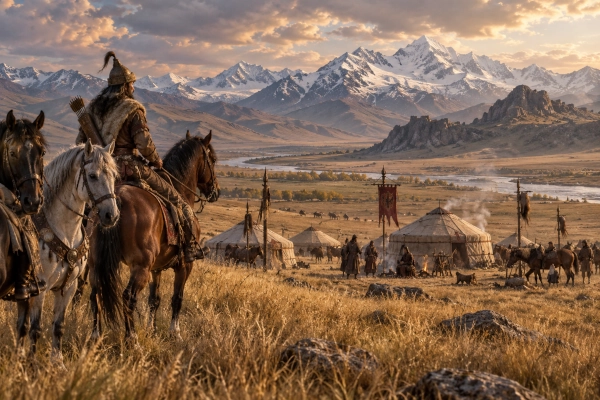
The Mahabharata places the Shakas within a world that extends beyond the principal kingdoms of the Indian subcontinent. They appear among the peoples encountered during the Pandavas’ campaigns, among the visitors at Yudhishthira’s Rajasuya, and among the forces gathering for Duryodhana. Read together, these episodes give the Shakas a place in the epic’s accounts of conquest, royal prestige and military alliances.
The name Shaka, also written Saka or Śaka, belongs to a broad historical family of Central Asian peoples associated with the Scythians. It cannot consistently be treated as the name of one kingdom with a single capital. Understanding their place in Mahabharata geography therefore requires examining both the epic’s individual references and the wider historical setting of the peoples who carried this name.
Who Were the Shakas?
Ancient Iranian and Indian sources use the name Saka for peoples connected with the broad Scythian world. These communities included Iranian-speaking populations whose territories and movements extended across parts of the Eurasian steppe. Here, “Iranian” describes a linguistic and cultural relationship; it does not mean that all these peoples originated within the borders of modern Iran.
Archaeology reveals a society more varied than the familiar image of wandering horsemen. The Fitzwilliam Museum’s account of Saka discoveries in eastern Kazakhstan describes pastoralists, agriculturalists, settled communities, warriors and skilled craftspeople. Elaborate gold ornaments and monumental burial mounds reveal wealth, technical knowledge and social distinctions. Horses held an important place, but they formed part of a wider economic and cultural life.
Where Were the Shaka Lands on a Modern Map?
A broad modern geographical guide includes parts of Kazakhstan, Uzbekistan, Tajikistan, Kyrgyzstan and Afghanistan, together with adjoining regions. These countries should not be understood as the components of one united Shaka empire. They help locate different areas of settlement, contact and movement across a long period, rather than the borders of a kingdom described in one Mahabharata passage. The wider Saka distribution also extended beyond this selection of modern states.
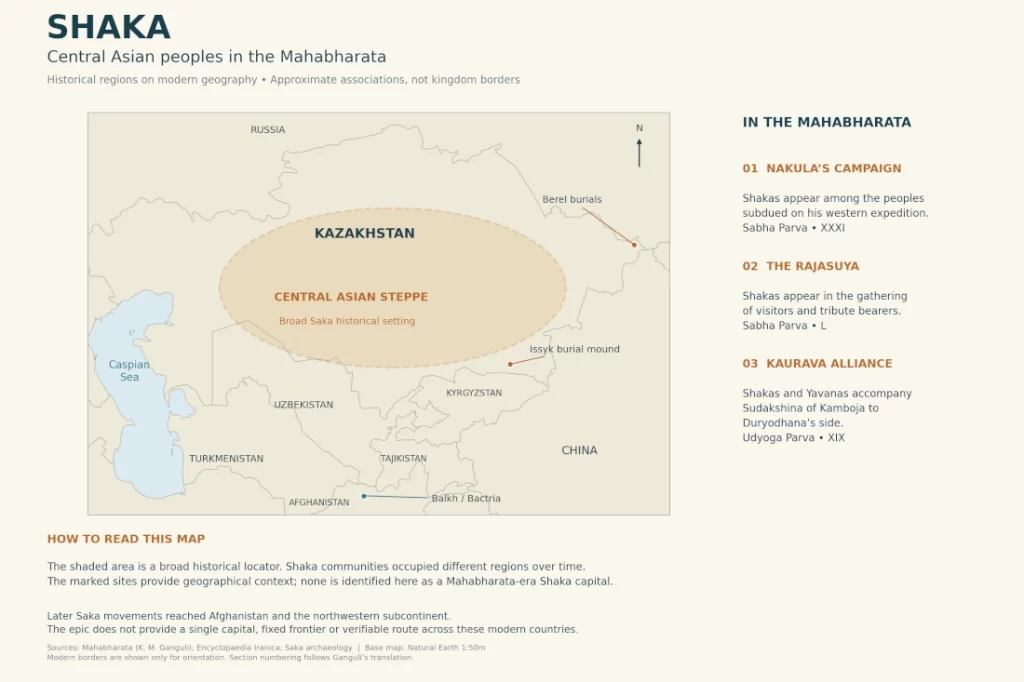
Kazakhstan provides particularly strong archaeological anchors through sites such as Berel, Shilikty and Eleke Sazy. Farther south, historical research traces Saka movements into Afghanistan and onward towards the northwestern subcontinent. These different settings must remain distinct: evidence for Saka communities in Central Asia does not establish the starting point of every Shaka contingent named in the epic. ,
Nakula’s Western Campaign and the Submission of the Shakas
One of the clearest references occurs in the Sabha Parva, during the campaigns preceding Yudhishthira’s Rajasuya sacrifice. Nakula receives the western direction. His expedition brings him into contact with numerous rulers and communities, including the Madras, whose king Shalya is his maternal uncle.
Near the end of the account, the narrative names the Shakas alongside the Pahlavas, Kiratas and Yavanas among the peoples Nakula subdues. He returns to Indraprastha with tribute for Yudhishthira. Within the story, their submission contributes to the recognition of the Pandava king’s supremacy before the sacrifice.
This passage provides a western orientation for these Shakas, but it offers no detailed itinerary to a named Central Asian capital. It cannot establish that Nakula marched across the entire territory of modern Kazakhstan or Uzbekistan. Its geographical value lies in placing Shaka communities within the western political horizon of the expedition.
Shaka Visitors at Yudhishthira’s Rajasuya
The Shakas appear again in Duryodhana’s description of the wealth assembled for Yudhishthira’s Rajasuya. Recalling the spectacle, he lists visitors from many regions and the valuable offerings they brought. Shakas occur among the crowds waiting for admission, and again within a collective list of peoples bringing horses, elephants and gold.
The gifts belong to a grouped description. It would therefore be misleading to assign every item exclusively to the Shakas or infer that their Central Asian homelands supplied elephants. The passage presents the extraordinary breadth of Yudhishthira’s recognition through an expansive catalogue of peoples and possessions.
Their appearance also serves the larger plot. Duryodhana recounts this wealth because the Pandavas’ prosperity has intensified his resentment. The Shakas thus become part of the spectacle of royal success that he finds unbearable. They are present at a moment when ceremonial prestige deepens the rivalry between the cousins.
Sudakshina Brings Shaka Forces to Duryodhana
The Udyoga Parva supplies a direct military connection. As the opposing armies assemble, Sudakshina, king of the Kambojas, arrives on Duryodhana’s side accompanied by Yavanas and Shakas. The narrative gives the combined force the strength of an akshauhini. That number describes the army arriving with Sudakshina, rather than a separately counted Shaka army.
This incident establishes Shaka participation in the Kaurava coalition. It also shows how troops identified by different regional names could gather around a common leader. Sudakshina remains the king of Kamboja in this passage; his command does not make Kamboja and Shaka interchangeable geographical names.
The reference moves beyond a list of distant peoples. The Shakas have a stated place in the mobilisation for Kurukshetra, connected to a named ruler and a definite side in the conflict. Their presence adds to the range of regional forces drawn into the struggle between the Pandavas and Kauravas.
From Tribute to War: Reading the Episodes Together
These passages show Shakas in different political relationships: submitting during Nakula’s campaign, appearing at Yudhishthira’s ceremony, and joining Duryodhana’s military coalition. They do not identify every group as the same contingent or provide a single Shaka ruler whose actions can be followed through all three episodes.
One reasonable interpretation is that the narrative accommodates several communities or changing relationships under the same broad name. However, it does not explicitly explain a Shaka defection from Yudhishthira to Duryodhana. The references therefore should not be joined through an invented account of betrayal, a broken treaty or a diplomatic dispute.
The Historical Route Towards Afghanistan and India
Historical research places substantial southward Saka movements into Afghanistan around the middle of the second century BCE. Their presence became associated with Bactria and other regions farther south and west. Part of Drangiana acquired the name Sakastan, meaning the land of the Sakas, preserved in the later name Sistan. These developments provide a historical setting for understanding how a Central Asian name became closely connected with the lands adjoining India.
Indo-Scythian rulers subsequently established power in parts of the northwestern subcontinent. Coins and inscriptions provide evidence for rulers such as Maues and for their interaction with existing political and monetary traditions. This documented history helps explain the enduring importance of the Shaka name in South Asia. It does not independently authenticate Nakula’s campaign or identify a historically documented king as the leader of the epic’s Shaka troops.
What the Shaka References Add to Mahabharata Geography
The strongest geographical conclusion is that the Mahabharata includes Shakas within its wider western world of tribute, political contact and military recruitment. Their presence broadens the story beyond the courts at Hastinapura and Indraprastha, while the individual episodes explain why they matter to the narrative.
“Shaka lands” is therefore more accurate than a precisely bounded “Shaka kingdom.” Central Asia supplies the broad historical association; the epic supplies specific encounters and alliances. Keeping those forms of evidence distinct allows us to appreciate the reach of Mahabharata geography without assigning a capital, border or campaign route that its passages do not establish.
You may also like
-
Yavana in the Mahabharata: Greek Connections, Pandava Campaigns and the Warriors of Kurukshetra
-
India and Sri Lanka Launch SAMHiTA Manuscript Digitisation Project to Preserve Ancient Buddhist Heritage
-
ASI Uses Ground-Penetrating Radar to Investigate Ancient Buddhist Stupa at Ujjain After Nearly 90 Years
-
Pahlava: The Parthian World Beyond India’s Northwestern Frontiers in the Mahabharata
-
Namami Gange in 2026: 368 Projects Completed, 4,339 MLD Sewage Treatment Capacity Created as Ganga Rejuvenation Advances
