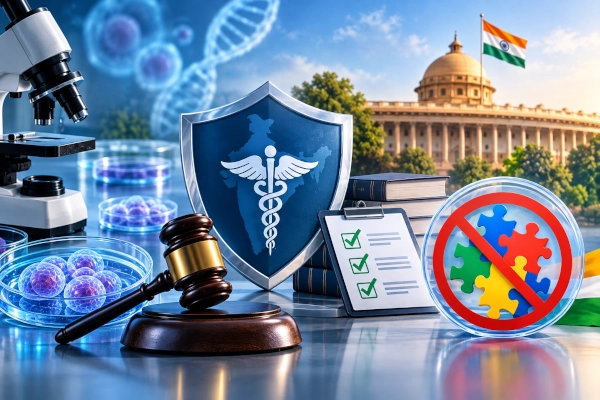
The Union Health Ministry has asked States and Union Territories to strengthen compliance with India’s regulatory framework governing stem-cell therapy, reiterating that such treatments can be offered as routine clinical care only for medical conditions recognised under the applicable framework.
The advisory places particular emphasis on the use of stem cells for autism. The Ministry has reiterated that therapeutic use of any type of stem cell for autism must remain restricted to duly approved clinical trials and should not be offered as a routine or standard treatment.
The direction is significant because stem-cell treatments have increasingly been promoted for a wide range of medical conditions, even where sufficient evidence regarding their safety and effectiveness has not been established. The government’s intervention is therefore aimed at ensuring that experimental applications are not presented to patients as established therapies.
States and Clinical Establishments Asked to Ensure Compliance
According to the Health Ministry advisory, the existing framework permits stem-cell therapy as standard care in routine clinical practice only for disease conditions included in the approved list.
The advisory has been issued to States and Union Territories that have adopted the Clinical Establishments (Registration and Regulation) Act, 2010. The Ministry has asked the concerned State and District Regulatory Authorities, as well as clinical establishments operating within their jurisdictions, to ensure strict compliance with the framework governing stem-cell research and therapy.
The move does not amount to a general prohibition on stem-cell medicine. Instead, it reinforces the distinction between treatments that have sufficient regulatory and scientific backing to be used as established clinical care and experimental applications that must continue through the clinical-trial process.
Stem-Cell Therapy for Autism Remains Experimental
The government’s position on autism is particularly clear. Therapeutic use of any type of stem cell for autism is to remain confined to clinical trials that have received the necessary regulatory approvals.
The restriction is based on the National Guidelines for Stem Cell Research, 2017, jointly issued by the Indian Council of Medical Research and the Department of Biotechnology. These guidelines provide the broader ethical and scientific framework governing stem-cell research and its potential therapeutic applications in India.
ICMR subsequently examined the evidence surrounding stem-cell therapy for Autism Spectrum Disorder as part of its evidence-based assessment of stem-cell treatments. Its 2021 assessment concluded that the available scientific evidence did not support offering stem-cell therapy over established behavioural and supportive interventions for autism.
The assessment therefore recommended that stem-cell therapy should not be offered as a standard or routine treatment for people with autism. Any therapeutic use should take place only as part of an appropriately approved clinical trial, where participants can be systematically monitored for potential benefits as well as possible harm.
Why India Regulates Stem-Cell Treatments
Stem cells have considerable potential because of their ability to develop into specialised cell types, making them an important area of biomedical research. That potential, however, does not mean every proposed stem-cell application has been demonstrated to be safe or effective.
India’s regulatory approach consequently distinguishes established therapeutic applications from experimental treatments that remain under investigation. This allows legitimate research to continue while preventing preliminary or insufficiently tested interventions from being marketed as proven medical treatments.
ICMR has previously noted concerns over patients being offered stem-cell treatments for diseases despite inadequate scientific evidence. Its evidence-based guidance refers to misleading promotional claims and instances in which vulnerable patients were encouraged to undergo unproven treatments.
This makes regulatory oversight particularly important because patients and families dealing with chronic, degenerative or developmental conditions can be especially susceptible to claims promising major improvements from experimental therapies.
Clinical Trials Can Still Investigate New Applications
Restricting an application to clinical trials does not mean research into that treatment has been stopped. Clinical trials are the mechanism through which researchers determine whether a proposed treatment is sufficiently safe and effective for wider medical use.
Under this system, researchers can continue investigating stem-cell approaches for autism and other conditions for which sufficient evidence has not yet emerged. Such studies, however, must follow the necessary scientific, ethical and regulatory requirements rather than being offered directly to patients as established treatment.
If credible evidence eventually demonstrates the safety and effectiveness of a particular application, the regulatory position can be reviewed as scientific understanding develops. ICMR’s framework itself provides for periodic review as new evidence becomes available.
Protecting Patients While Allowing Research to Continue
The latest Health Ministry advisory therefore reinforces an important distinction in India’s approach to regenerative medicine: promising research is not automatically equivalent to proven clinical treatment.
Stem-cell science remains an important and rapidly developing field with the potential to produce new therapies. At the same time, treatments offered to patients as routine medical care require an adequate foundation of evidence, safety evaluation and regulatory approval.
By directing State authorities, district regulators and clinical establishments to enforce the existing framework, the Centre is seeking to prevent experimental treatments from being presented as established medicine while leaving the regulated clinical-trial route open for further scientific investigation.
For autism in particular, the government’s position remains unambiguous: stem-cell therapy is not recognised as routine standard treatment and its therapeutic use must remain within duly approved clinical trials unless future scientific evidence and regulatory review establish otherwise.
REFERENCES
- Akashvani News / News On AIR, “Health Ministry Issues Advisory to States/UTs on Stem Cell Therapy Regulation,” 17 September 2026.
https://newsonair.gov.in/health-ministry-issues-advisory-to-states-uts-on-stem-cell-therapy-regulation/ - Indian Council of Medical Research (ICMR), National Guidelines for Stem Cell Research, 2017.
https://www.icmr.gov.in/guidelines - Indian Council of Medical Research (ICMR), Evidence Based Status of Stem Cell Therapy for Human Diseases, 2021.
https://www.icmr.gov.in/icmrobject/uploads/Guidelines/1745229591_evidence_based_status_of_stem_cell_therapy_for_human_diseases_v1.pdf - Central Drugs Standard Control Organisation (CDSCO), Ministry of Health & Family Welfare, Government of India — Regulatory Information and Public Notices on Stem Cell Therapy.
https://cdsco.gov.in/
You may also like
-
Centre Proposes Mandatory CCTV at Medical Stores to Curb Unauthorised Sale of Prescription Drugs
-
Why Fatty Liver Is Appearing Earlier — And What Lifestyle Has to Do With It
-
Before the Heart Falls Ill: The Ayurvedic Way of Protecting Hridaya Through Daily Living
-
Why Ayurveda Begins the Morning by Looking at the Tongue
-
High Blood Pressure Through an Ayurvedic Lens: Stress, Diet and Dosha Imbalance
