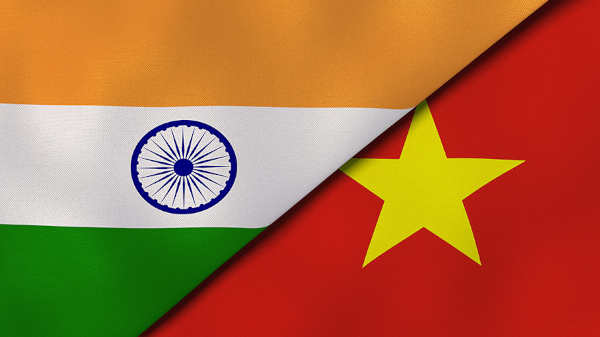
India and Vietnam have agreed to deepen their defence-industrial partnership through the co-production of Indian defence equipment, marking another significant step in the rapidly expanding strategic relationship between the two countries.
The decision emerged from the 19th India-Vietnam Joint Commission Meeting on Trade, Economic, Scientific and Technological Cooperation held in New Delhi on September 14, 2026. External Affairs Minister S. Jaishankar co-chaired the meeting with Vietnamese Foreign Minister Lê Hoài Trung.
According to the official statement issued after the meeting, the two sides identified a way forward for strengthening defence and security cooperation, including through the “co-production of Indian defence items.” They also discussed increasing trade and investment, strengthening supply chains, improving connectivity and expanding cooperation in areas such as nuclear energy and space.
From Defence Exports to Defence Production
The significance of the latest announcement lies in the transition it represents. India-Vietnam defence cooperation has traditionally centred on military training, capacity building, naval engagement, defence credit and the supply of equipment. Co-production creates the possibility of moving part of that relationship into manufacturing and industrial integration.
The September agreement does not yet identify the defence systems that could be produced jointly, nor does it specify manufacturing locations, production volumes or participating companies. It should therefore be viewed as a political and strategic framework for future programmes rather than an announcement of a particular weapons-production contract.
Nevertheless, the language is important. Instead of merely discussing the purchase of Indian equipment, New Delhi and Hanoi are now formally considering mechanisms under which Indian-designed or Indian-produced defence systems could be manufactured collaboratively.
Part of a Much Broader Defence Partnership
The latest agreement builds on decisions taken earlier in 2026. During high-level India-Vietnam discussions, the two countries agreed to strengthen defence cooperation through joint research, the co-production of new defence technologies, defence-industrial cooperation and increased procurement of defence systems.
The joint statement on the Enhanced Comprehensive Strategic Partnership specifically identified joint research and co-production as areas for future cooperation while also calling for stronger defence-industrial ties and greater defence procurement between the two countries.
In May 2026, Defence Minister Rajnath Singh and Vietnamese Deputy Prime Minister and Defence Minister General Phan Van Giang also reviewed cooperation in maritime security, defence industry, military training and regional security during talks in Hanoi. The two sides emphasised the importance of maintaining peace, stability, security and freedom of navigation in the Indo-Pacific.
The September Joint Commission meeting therefore takes forward a process that has been developing across several rounds of political and military engagement rather than introducing co-production as an entirely new concept.
Industrial Cooperation Has Already Produced Results
India and Vietnam already have experience with defence manufacturing cooperation.
Under India’s $100-million Defence Line of Credit, 12 high-speed guard boats were produced for the Vietnam Border Guard Command. Five were constructed at Larsen & Toubro’s shipyard in India, while seven were manufactured at Vietnam’s Hong Ha Shipyard. The completed vessels were handed over to Vietnam in June 2022.
That programme is particularly relevant to the latest announcement because it demonstrated that an Indian defence project could involve actual manufacturing activity inside Vietnam rather than simply exporting finished equipment from India.
Defence ties have since expanded further. India transferred the former Indian Navy missile corvette INS Kirpan to the Vietnam People’s Navy in July 2023, the first occasion on which India handed a fully operational corvette to a friendly foreign country.
The two countries also signed a Letter of Intent on strengthening defence-industry cooperation in 2025. That framework covered technology transfer, high-technology and core-technology areas, joint research, joint ventures, defence procurement, exchange of specialists and cooperation in equipment design and production.
These arrangements give the proposed co-production initiative an industrial foundation on which future projects can be built.
Vietnam Could Become an Important Partner for India’s Defence Industry
Vietnam is an increasingly important defence partner for India in Southeast Asia. Its requirements for maritime security, coastal defence, surveillance, air defence and modernisation create areas where India’s expanding defence-industrial base could potentially find long-term opportunities.
For India, co-production can offer advantages that conventional exports cannot. Manufacturing part of a system in the customer country can make defence agreements more attractive by generating local employment, developing technical skills, supporting maintenance infrastructure and creating a domestic industrial stake in the programme.
It could also help Indian defence companies establish a deeper presence in Southeast Asian markets.
Vietnam, meanwhile, has consistently sought to strengthen its domestic defence-industrial capability rather than remain entirely dependent on imported finished systems. Partnerships involving technology transfer, local manufacturing and joint development therefore fit naturally with Hanoi’s long-term modernisation requirements.
A Strategic Partnership in the Indo-Pacific
The industrial dimension is closely connected with the wider strategic relationship between India and Vietnam.
Vietnam occupies an important position in India’s Act East Policy, Indo-Pacific approach and MAHASAGAR vision. The two countries have steadily expanded naval exchanges, military training, defence dialogue, maritime cooperation and capacity-building programmes.
Their defence relationship is governed by the Joint Vision Statement on India-Vietnam Defence Partnership Towards 2030 and supported by arrangements covering logistics, submarine search and rescue, defence industry cooperation and military training. India’s Embassy in Hanoi describes defence engagement as having expanded across military dialogue, capacity building, exercises and industrial cooperation.
Co-production therefore adds an industrial pillar to a relationship already supported by operational and strategic cooperation.
REFERENCES
- Embassy of India, Hanoi / Ministry of External Affairs
“19th India-Vietnam Joint Commission Meeting (JCM) on Trade, Economic, Scientific and Technological Cooperation”
New Delhi, September 14, 2026; published September 15, 2026.
Official statement confirms that India and Vietnam identified a way forward for deeper defence and security cooperation, including “co-production of Indian defence items.” - Embassy of India, Hanoi
“19th India-Vietnam Joint Commission Meeting in New Delhi on 14 September 2026”
September 15, 2026.
Official event summary states that the meeting strengthened India-Vietnam defence and security cooperation and sought to increase the supply of Made-in-India defence articles. - Akashvani / News On AIR
“EAM S Jaishankar co-chairs 19th India-Vietnam Joint Commission Meeting with Vietnamese counterpart in New Delhi”
September 14, 2026.
Reports External Affairs Minister S. Jaishankar’s statement on strengthening political, defence and security cooperation and increasing the supply of Made-in-India defence articles. - Government of India / Embassy of India, Hanoi
“Joint Statement on Enhanced Comprehensive Strategic Partnership between the Republic of India and the Socialist Republic of Vietnam”
May 2026.
The joint statement calls for expanded defence-industrial cooperation, including joint research, co-production of new defence technologies and increased defence systems procurement between India and Vietnam.
You may also like
-
India, Myanmar Begin Fifth Edition of IMBAX Bilateral Army Exercise
-
India’s MIGM Gives Navy an Indigenous Smart Seabed Weapon Against Ships and Submarines
-
IAF Unveils Vayu UTtaM to Manage Drone-Dense Airspace and Identify Rogue UAS
-
Malaysia Confirms Talks With India on BrahMos Air-Launched Missile Acquisition
-
IAF Akash and SPYDER Successfully Engage SPICE and HAMMER Stand-Off Weapons in Air-Defence Trials
