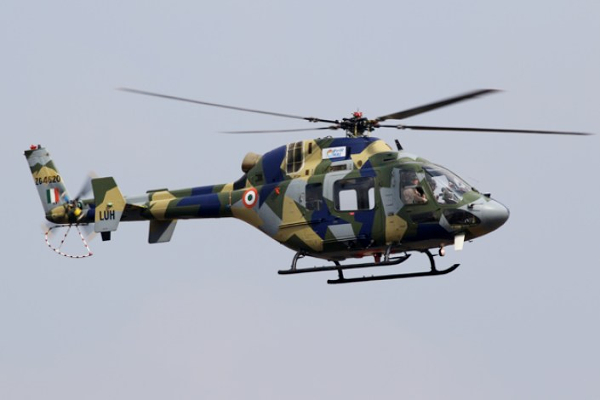
Hindustan Aeronautics Limited’s indigenous Light Utility Helicopter has reportedly achieved a substantial reduction in vibration following structural optimisation, potentially improving crew comfort, avionics reliability and the helicopter’s effectiveness during long-duration operations in difficult high-altitude environments.
Recent defence reporting in September 2026 says engineering changes to the LUH have produced an approximately 30–40% reduction in overall vibration response, while vibration in a critical vertical range has reportedly fallen by nearly 50%.
The figures represent an encouraging engineering result for the three-tonne-class helicopter, although HAL has not yet issued a public press release confirming the specific 30–40% and 50% reductions. The results should therefore be described as reported engineering findings rather than a formally announced HAL performance milestone.
Structural Optimisation Targets a Fundamental Helicopter Challenge
Vibration is an unavoidable engineering challenge in helicopters because the rotating main rotor, tail rotor, transmission and aerodynamic loads continuously introduce oscillating forces into the airframe.
These forces can be transmitted through the fuselage to the cockpit, crew seats, avionics and mission equipment. Excessive vibration can increase pilot fatigue and place additional long-term stress on mechanical and electronic components.
Reducing vibration is therefore not simply a matter of providing passengers with a smoother ride. It can affect crew endurance, equipment reliability, structural fatigue and maintenance requirements.
The latest reported work on the LUH appears to have focused on modifying the structural response of the helicopter so that vibration generated by the rotor system is transmitted less strongly into critical areas of the aircraft.
HAL Designed LUH Around a Hingeless Main Rotor
The reported improvement also builds upon the LUH’s underlying rotor architecture.
HAL’s official technical literature confirms that the helicopter uses a hingeless main-rotor system, which the company says provides high agility and manoeuvrability. The main and tail rotor blades use composite materials designed to provide damage tolerance.
The LUH is a new-generation, single-engine helicopter developed entirely by HAL’s Rotary Wing Research and Design Centre for Indian military and potential civilian requirements.
HAL describes the aircraft as being designed specifically for India’s diverse operating environment, including demanding high-altitude missions in the Himalayas.
The latest structural optimisation, if the reported test results are confirmed, suggests HAL engineers are continuing to refine the basic helicopter even after its initial development and certification programme.
Why a 50% Reduction Could Matter
The most striking figure in the recent report is the nearly 50% reduction in a critical vertical-vibration range.
Vertical vibration is particularly relevant in helicopters because oscillating rotor loads can pass through the rotor mast and transmission into the fuselage. The occupants, seats, instruments and equipment mounted within the cabin can consequently experience repeated vertical acceleration.
Reducing this response could make extended missions significantly less tiring for pilots and passengers.
That matters for the LUH because the helicopter is designed for missions such as reconnaissance, surveillance, casualty evacuation, troop movement and utility transport, many of which may involve extended flying over mountainous terrain. HAL’s official brochure lists these among the aircraft’s principal roles.
Lower vibration could also benefit electro-optical sensors, communications systems and other sensitive equipment fitted to future operational variants.
India Is Also Indigenising an Active Vibration Control System
There is an additional official indication that vibration management remains an important part of the LUH programme.
In March 2022, the Ministry of Defence included an Active Vibration Control System for the LUH and Advanced Light Helicopter among 107 important subsystems selected for indigenisation.
The system was placed on HAL’s indigenisation roadmap with an import-embargo timeline extending to December 2027.
An active vibration-control system typically works by sensing vibration and introducing counteracting forces to reduce the vibration transmitted into an aircraft structure.
Structural optimisation and active vibration control are therefore complementary approaches. The first attempts to reduce vibration through the physical behaviour of the airframe itself, while the second can actively counter remaining vibration during operation.
Designed for India’s High-Altitude Requirements
The LUH has been developed primarily to replace the Indian Armed Forces’ ageing Cheetah and Chetak helicopters.
Its most demanding operating environment is expected to be India’s Himalayan region, where helicopters routinely fly from small landing areas at extreme elevations.
HAL says the LUH’s Ardiden 1U turboshaft engine provides sufficient power margins for high-altitude operations, while the aircraft incorporates a glass cockpit and Health and Usage Monitoring System.
The aircraft completed an extensive certification campaign covering hot-weather, cold-weather, sea-level and hot-and-high trials before receiving Initial Operational Clearance for the Army variant in February 2021.
Such missions place unusual demands on both machines and crews. Pilots flying repeatedly in mountainous terrain must contend with turbulence, difficult approaches, thin air and rapidly changing weather.
A meaningful reduction in airframe vibration could consequently have particular value in the LUH’s intended operational environment.
LUH Production Infrastructure Already Established
HAL has also created dedicated manufacturing infrastructure for the helicopter.
The company’s large greenfield helicopter factory at Tumakuru in Karnataka was formally dedicated to the nation in February 2023 and was established with the LUH as its initial production platform.
The facility was designed initially for around 30 helicopters annually, with capacity intended to expand first to 60 and eventually as high as 90 helicopters per year as production increases.
HAL’s current official information states that five LUHs have been produced under the Limited Series Production programme.
This makes continuing engineering refinement particularly relevant as the programme prepares for larger-scale production and operational induction.
Lower Vibration Could Reduce Lifecycle Costs
For military aviation, vibration also has an economic dimension.
Repeated mechanical loading can contribute to fatigue in brackets, wiring, electronic equipment and structural components. Lower vibration can potentially reduce inspection and maintenance demands while increasing the service life of some systems.
Modern helicopters carry increasingly sophisticated electronics, including mission computers, displays, communications equipment, navigation systems and sensors.
Providing these systems with a more benign vibration environment can improve reliability and potentially reduce failures caused by prolonged mechanical stress.
For an aircraft expected to replace large numbers of older Cheetah and Chetak helicopters, improvements in reliability and maintenance requirements can become significant over an entire fleet’s operating life.
A Promising Engineering Gain for the LUH Programme
The reported reduction in LUH vibration represents an encouraging engineering advance for HAL’s indigenous helicopter programme.
A 30–40% reduction in overall vibration response and nearly 50% reduction in a critical vertical range, if validated in the final technical documentation, would point to a substantial improvement in the helicopter’s dynamic behaviour and could translate into better crew comfort, lower structural stress and improved reliability of onboard equipment.
HAL has already developed the LUH around an indigenous hingeless rotor architecture, completed extensive certification and high-altitude trials, and is progressing the helicopter through production. An Active Vibration Control System is also part of HAL’s indigenisation roadmap, showing that vibration reduction remains an important part of the platform’s continuing development.
Taken together, these developments suggest that the LUH is not merely moving towards induction but is continuing to mature technically as well.
You may also like
-
India and Russia Move Into Titanium Sponge Production as Rosatom’s Giredmet Partners Hyderabad-Based ALT Metals
-
NRL’s World-First Bamboo 2G Ethanol Plant Produces Fuel, Moves Toward Commercial Operations
-
IAF Opens Race to Develop Indigenous High-Altitude Pseudo Satellite for Persistent Surveillance
-
BDL Confirms ASRAAM Missile Facility Fully Operational as Major IAF Requirement Looms
-
DRDO’s Junput Missile Test Facility Back on Track as Bengal Clears 8.73-Acre Coastal Range
