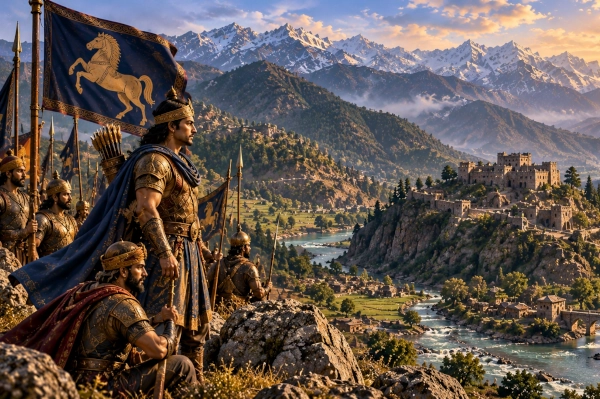
Among the mountain kingdoms of the northwestern Mahabharata world, Abhisara occupied a strategically important position between the Kashmir highlands and the Punjab plains. Ancient geographical traditions place it in the rugged country around present-day Rajouri, Poonch, Nowshera and adjoining parts of the western Pir Panjal, an area divided today between India and Pakistan. Some broader reconstructions extend the Abhisaran political sphere towards the Jhelum and Hazara country, although the ancient region known as Urasa or Uraga is more specifically associated with Hazara in several scholarly identifications.
Abhisara appears in the Mahabharata as one of the northern territories encountered by Arjuna during his Digvijaya, or campaign of conquest, undertaken before Yudhishthira’s Rajasuya sacrifice. Centuries later, a similarly named kingdom appears prominently in Greek accounts of Alexander’s campaigns in the northwestern subcontinent. The combination of epic references, later Sanskrit traditions and Classical accounts makes Abhisara one of the more intriguing geographical names connecting ancient Indian literature with the historical landscape of the western Himalayas.
The Mountain Country of Abhisara
The core of Abhisara was mountainous rather than an open river plain. The historian and Sanskrit scholar Aurel Stein identified the ancient kingdom with the lower and middle hill country between the Vitasta, or Jhelum, and the Chandrabhaga, or Chenab, including the territory around Rajapuri, modern Rajouri. Other historical geographical traditions similarly associate Abhisara with Rajouri, Poonch, Bhimber and adjoining hill districts.
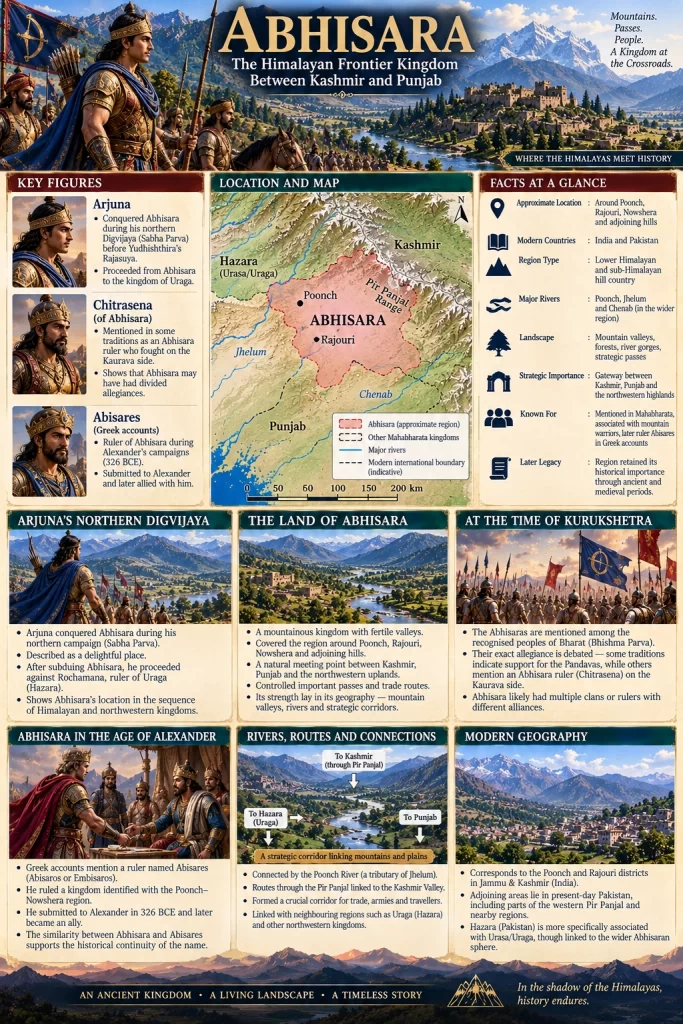
The official history of Rajouri published by the Government of Jammu and Kashmir also records an old tradition identifying Rajouri, Bhimber and Nowshera with the territory of Abhisar, describing it as one of the ancient hill states of the Punjab region.
This was a transitional landscape. To the northeast rose the higher mountains leading towards Kashmir. To the south and southwest lay the Punjab plains. Farther west were the Jhelum and Indus corridors, while routes through the Pir Panjal provided access towards the Kashmir Valley.
Abhisara consequently occupied a natural meeting point between several geographical worlds.
The landscape around modern Poonch and Rajouri still illustrates the geographical character that would have shaped an ancient hill kingdom: narrow river valleys, forested slopes, terraced agricultural land and mountain passes linking otherwise separated communities.
Abhisara in Arjuna’s Northern Digvijaya
One of the most important references to Abhisara comes during Arjuna’s northern conquest in the Sabha Parva.
Before Yudhishthira could perform the Rajasuya, the Pandavas sought recognition and tribute from kingdoms in the four directions. Arjuna was entrusted with the north and advanced through a remarkable succession of Himalayan and northwestern territories.
During this campaign, the text records his arrival at Abhisari or Abhisara, described in the traditional translation as a delightful place. Arjuna brought the territory under his authority and then proceeded against Rochamana, ruler of Uraga.
The geographical sequence is extremely important.
Abhisara and Uraga appear as neighbouring but distinct territories. Historical scholarship commonly places Abhisara around the Rajouri-Poonch hills, while Uraga or Urasa is generally associated with Hazara, farther northwest. A recent scholarly discussion similarly identifies the Mahabharata’s Uraga with ancient Urasa and connects it with the Hazara country.
This distinction helps refine the modern geography. Rather than simply equating the whole of Abhisara with Hazara, it is more accurate to see Abhisara and Urasa as adjacent Himalayan or sub-Himalayan regions, with Abhisara centred closer to Poonch-Rajouri and Urasa extending towards Hazara.
A Gateway Towards the Northwestern Highlands
Arjuna’s route after Abhisara also demonstrates the strategic importance of the region.
Historical discussions of the Sabha Parva place Sinhapura close to Abhisara and Uraga and describe the entire group as belonging to the high northwestern Punjab-Kashmir frontier. Nineteenth-century scholarship on the travels of Xuanzang similarly observed that the geographical sequence in Arjuna’s campaign places Abhisara close to Kashmir and the northwestern Punjab.
This was therefore a corridor through which someone travelling from Punjab towards the western Himalayan uplands could move from one mountain principality to another.
The region’s political importance probably depended as much upon controlling passes, valleys and roads as upon possessing large stretches of agricultural territory.
Rivers That Defined Abhisara
The western Himalayan geography of Abhisara was shaped by several river systems.
The Chenab lay towards its southeastern approaches, while the Jhelum formed another major geographical reference farther west. Between them stretched a complex system of mountain streams and valleys descending from the Pir Panjal.
The Poonch River, which eventually joins the Jhelum system, created one of the principal corridors through this mountainous country. Rajouri similarly developed along routes connecting the plains with passes across the Pir Panjal.
Such valleys were extremely valuable in antiquity. They offered agricultural land in otherwise difficult terrain while simultaneously functioning as natural routes for merchants, armies, pastoral communities and travellers.
Abhisara’s strength was therefore rooted in geography.
Abhisara and Kashmir
Ancient writers frequently associate Abhisara with the wider Kashmir frontier.
A modern scholarly compilation of Mahabharata and Puranic references notes that the Abhisaras are mentioned alongside Kashmiri and neighbouring mountain peoples and places their territory in the hill country of the Jhelum and Chenab.
This does not necessarily mean that Abhisara was permanently part of a political kingdom based in the Kashmir Valley. Political relationships in the mountains changed repeatedly. At different periods, the region could be independent, subordinate to Kashmir or connected with neighbouring Punjab powers.
Geographically, however, the association is understandable. Rajouri and Poonch stand along important southern and southwestern approaches towards Kashmir.
The ancient kingdom consequently formed something of a buffer zone between Kashmir and the Punjab.
The Abhisaras at Kurukshetra
The Mahabharata also remembers the Abhisaras as a recognised people during the period of the Kurukshetra War.
The Bhishma Parva, while describing the peoples and regions of Bharat, includes the Abhisaras alongside the Kashmiras, Sindhu-Sauviras, Gandharas, Bahlika and other northwestern communities.
Their presence in this catalogue demonstrates that Abhisara possessed a distinct geographical identity within the epic’s conception of northern Bharat.
The question of Abhisara’s allegiance during the war is more complicated. Some historical reconstructions of epic political geography state that Abhisara supported the Pandavas, making it unusual among the many northwestern territories that largely favoured the Kauravas. A standard historical treatment reproduced by the Indira Gandhi National Centre for the Arts specifically describes Abhisara, located in southwestern Kashmir, as supporting the Pandavas.
Other epic traditions, however, associate warriors or rulers described as Abhisaran with the Kaurava side. Later encyclopaedic interpretations identify an Abhisara ruler named Chitrasena among those fighting against the Pandavas.
The evidence therefore suggests caution. Abhisara may have contained more than one ruler or clan, different recensions may preserve different affiliations, or individual Abhisaran contingents may have fought on opposing sides. The Mahabharata itself repeatedly shows northwestern royal houses divided by political alliances, as happened with Kekaya and other regions.
It is consequently safer to say that Abhisara participated in the wider Kurukshetra political world, but its military alignment may not have been completely uniform.
A Warrior Society of the Mountain Frontier
Some ancient traditions describe the Abhisaras together with other northern mountain peoples as formidable fighters. Their geographical environment would certainly have encouraged a distinctive military culture.
Mountain warfare demanded mobility, familiarity with difficult terrain and control of narrow approaches. A relatively small force occupying a pass or gorge could make movement extremely difficult for a larger invading army.
The importance of such warrior communities becomes particularly understandable when Abhisara’s location is considered. Any political power seeking to move between Punjab, Kashmir and the upper Indus regions had to negotiate a landscape controlled by numerous hill rulers.
Arjuna’s northern conquest reflects precisely this fragmented political geography.
Instead of encountering one vast empire, he repeatedly encountered individual kingdoms and mountain communities occupying separate valleys and strategic routes.
Abhisara in the Age of Alexander
Several centuries after the world represented in the epic tradition, the name appears again in remarkably recognisable form during Alexander’s invasion of the northwestern subcontinent in 326 BCE.
Greek and Roman authors refer to a ruler commonly rendered Abisares, Abisaros or Embisaros. Historians have long connected this king with the Sanskrit geographical name Abhisara.
An authoritative history preserved by IGNCA identifies Abhisara’s kingdom in this period with the Poonch and Nowshera districts and records that the ruler submitted to Alexander rather than risk direct confrontation.
Cambridge historian Waldemar Heckel likewise describes Abisares as one of the rulers operating around the upper Indus world during Alexander’s campaigns and notes his relationship with the territory of Hazara.
The resemblance between Sanskrit Abhisara and Classical Abisares is one of the reasons historians regard the identification as persuasive.
Abisares, Porus and Alexander
The political manoeuvring of Abisares reveals the complicated balance of power that existed in the northwestern subcontinent when Alexander arrived.
The region was divided among several significant rulers, including Ambhi of Taxila and Porus, together with numerous mountain chiefs. Abisares attempted to navigate between these competing powers.
Classical accounts differ slightly in their portrayal of his behaviour. Some traditions suggest connections with Porus, while others emphasise his eventual submission to Alexander. The IGNCA historical account describes him as an astute ruler who judged resistance to Alexander to be impractical and offered submission.
After the Battle of the Hydaspes, Alexander reorganised the surrounding territories. Cambridge’s account of the conquest notes that Abisares entered into alliance with Alexander as the Macedonian king established his political settlement across the region.
These events belong to a securely historical period many centuries removed from the epic narrative. They should not be used to date the events of the Mahabharata.
What they demonstrate instead is something equally valuable: the geographical name Abhisara remained associated with a real northwestern mountain polity into the fourth century BCE.
Rajouri and the Memory of Ancient Abhisara
Among modern locations associated with Abhisara, Rajouri has one of the strongest historical traditions.
The Government of Jammu and Kashmir’s district history records Rajouri as ancient Rajapuri and explicitly associates Rajouri, Bhimber and Nowshera with the old territory of Abhisar. It also records the region’s later importance as a trade and political centre.
Rajouri lies south of the Pir Panjal and commands approaches towards the Kashmir Valley. Its location therefore fits well with the geographical characteristics expected of an Abhisaran centre.
The precise capital of the Mahabharata-period Abhisara cannot be established with certainty, however. Ancient regional names could cover networks of hill principalities rather than one permanently centralised kingdom.
Poonch and the Pir Panjal World
Poonch is similarly central to most reconstructions of Abhisara.
The Poonch Valley lies enclosed by high mountain ranges and connected to neighbouring regions through river valleys and passes. Historically, routes from Punjab could move through Bhimber and Rajouri before continuing towards Poonch and the Pir Panjal, providing access towards Kashmir.
This geography made the region strategically important for far longer than the ancient period.
The hills could simultaneously provide protection and impose isolation. Local rulers controlling individual valleys could retain considerable autonomy while remaining connected through trade and military alliances to much larger kingdoms.
Such a political environment closely resembles the world encountered by Arjuna during his Digvijaya.
Abhisara and Hazara — An Important Distinction
The relationship between Abhisara and Hazara requires particular care because older geographical works sometimes equated the two.
Several nineteenth- and twentieth-century references identify Hazara directly with Abhisara or the Greek kingdom of Abisares. Other scholarship, especially that drawing upon Aurel Stein’s reconstruction, instead places Abhisara around Rajouri and Poonch and identifies Hazara with ancient Urasa or Uraga.
The Mahabharata’s geographical sequence supports the latter distinction because Arjuna is described as proceeding from Abhisara to the kingdom of Rochamana in Uraga.
For a modern geographical reconstruction, the most cautious interpretation is therefore to place the core of Abhisara around Poonch-Rajouri-Nowshera and neighbouring western Himalayan hills, while treating Hazara as an adjoining territory associated more specifically with Urasa, although the political influence of later Abhisaran rulers may sometimes have extended into that region.
Abhisara in Modern Geography
Ancient Abhisara cannot be fitted neatly within today’s political borders.
Its reconstructed territory lies in a region now divided by the Line of Control and the India-Pakistan international political landscape. The eastern part of the ancient geographical zone corresponds particularly with Rajouri and Poonch districts in the Union Territory of Jammu and Kashmir, India, while adjoining portions of the historical hill country lie in areas presently administered by Pakistan.
Farther west lies the Hazara region of present-day Pakistan, which is important to the wider ancient geography but is more securely associated with neighbouring Urasa/Uragā than with the core Abhisaran territory.
A useful modern identification is therefore:
Abhisara — the lower western Himalayan and Pir Panjal country centred broadly around Poonch, Rajouri, Nowshera and adjoining hill regions, spanning areas now in India and Pakistan, with close connections to the neighbouring Jhelum-Hazara region.
The Himalayan Kingdom at the Crossroads
Abhisara’s significance lies partly in the remarkable continuity of its geography.
In the Mahabharata, Arjuna encountered the kingdom while advancing through the northern mountain country before proceeding towards Uraga and other northwestern territories. The epic remembers the Abhisaras among the recognised peoples of Bharat and places them within the complicated political landscape surrounding Kurukshetra.
Centuries later, Classical historians encountered a ruler whose name they rendered Abisares, governing a kingdom in approximately the same northwestern mountain world.
The political entities need not have remained unchanged across those centuries. Kingdoms rise, divide and shift their centres. Yet the persistence of the name and its consistent association with the western Himalayan frontier between Kashmir and Punjab is significant.
Abhisara can therefore be identified most convincingly with the mountain country around modern Poonch and Rajouri and neighbouring parts of the western Pir Panjal, with political and geographical links extending towards the Jhelum and upper Indus world. Its valleys stood astride routes between Kashmir, Punjab and the northwest, making it a natural frontier kingdom—small compared with the great states of the plains, but strategically important in both epic tradition and recorded history.
You may also like
-
India to Build National Digital Repository for Tribal Languages with IITs and Universities
-
Gandhara: The Northwestern Kingdom of Gandhari and Shakuni in the Mahabharata
-
Kekaya or Kaikeya: The Western Punjab Kingdom Divided by the Kurukshetra War
-
Madra: The Ancient Punjab Kingdom of Shalya and Madri in the Mahabharata
-
BRICS Theatre Festival 2026 Opens in New Delhi, Bringing Together Nine Nations to Strengthen Cultural Cooperation
