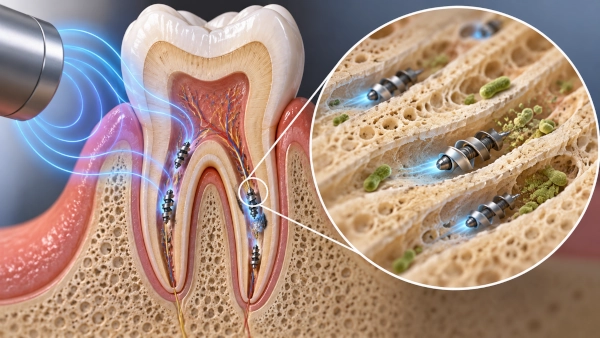
Bengaluru deeptech startup Theranautilus is taking microscopic medical robots closer to clinical use, building on years of research at the Indian Institute of Science (IISc) into machines that can travel through extremely small biological spaces and perform highly targeted interventions.
The company was recently named Top Innovator at the Economic Times Startup Awards 2026, recognising its work on magnetically controlled nanorobots and their potential to create a new class of minimally invasive medical treatments. Theranautilus was founded in 2020 by Ambarish Ghosh, Peddi Shanmukh Srinivas and Debayan Dasgupta, although the underlying research traces back to work begun at IISc more than a decade earlier.
Its first major applications are in dentistry, where one of the biggest challenges is reaching microscopic channels inside teeth that conventional treatments cannot always access effectively.
For root-canal treatment, researchers from IISc and Theranautilus developed tiny helical robots made from silicon dioxide and coated with iron. An externally generated magnetic field can guide the robots through dentinal tubules, microscopic passages inside the tooth where bacteria can remain after conventional treatment.
Experiments showed that the nanobots could travel as deep as about 2,000 micrometres into dentinal tubules. Researchers were also able to remotely heat them using magnetic fields, allowing highly localised destruction of bacteria such as Enterococcus faecalis. Importantly, the robots could subsequently be guided back out of the tooth. The technology has undergone animal testing, with IISc reporting that studies in mice demonstrated safety and effectiveness.
Theranautilus has developed a second approach aimed at dental hypersensitivity. Called CalBots, these magnetically guided particles carry a bioceramic material deep into dentinal tubules, where it forms a durable mineral barrier capable of blocking the pathways that transmit sensitivity to nerves.
Research published in Advanced Science in 2025 showed that the material could be directed deep inside the tubules rather than simply coating the tooth surface. Toxicity testing in mice found no adverse effects, supporting further development toward clinical use.
The company is now approaching an important transition from laboratory research to medicine. According to the latest disclosure accompanying its ET Startup Awards recognition, Theranautilus has completed preclinical studies in mice and is targeting human trials from September 2026. That timetable remains a planned milestone rather than confirmation that human trials have already begun.
Theranautilus ultimately sees dentistry as the first use of a much broader medical-robotics platform. The company is exploring future applications in targeted drug delivery, oncology, ophthalmology and neuromodulation, where remotely controlled microscopic machines could potentially deliver drugs or carry out interventions at highly specific locations while limiting exposure to surrounding tissue. Oncology-related nanorobot trials are currently targeted for a later stage, around 2028.
Rather than manufacture every eventual treatment itself, Theranautilus plans to commercialise its technology through partnerships and licensing arrangements with pharmaceutical, medical-device and healthcare companies. The startup has raised around ₹65 crore including equity-free grants, with backing from investors including pi Ventures, Pravega Ventures and Golden Sparrow.
The ET Startup Awards recognition therefore comes at an important point in Theran01autilus’ development. Its nanorobots have progressed beyond a futuristic laboratory concept into peer-reviewed research, animal testing and preparation for clinical evaluation. The next critical milestone will be demonstrating that the precision and safety achieved in preclinical research can be reproduced reliably in human patients.
You may also like
-
BDL Reveals Expanded Godrej Partnership Across Missiles, Launchers and Advanced Propulsion
-
Made-in-India Nissan Tekton Begins Global Export Journey With First Shipments to South Africa
-
EtherealX Pushes Indian Rocket Reusability With Novel Engine Cycle
-
Inside PRAGYA: India’s First Private Tokamak Begins Producing Plasma
-
DRDO’s Next Pinaka Leap: 370-mm Rocket Motor Points to Future 300-km-Class Guided Rocket
