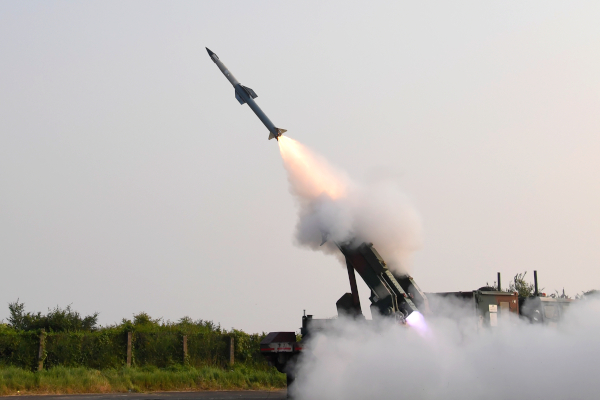
India’s Quick Reaction Surface-to-Air Missile, or QRSAM, is emerging as one of the most important components of the Indian Army’s transition from legacy foreign-origin battlefield air-defence systems towards a predominantly indigenous, networked and highly mobile air-defence architecture.
Developed by the Defence Research and Development Organisation for the Indian Army, QRSAM is specifically intended to provide air-defence protection to moving mechanised formations and strike columns. Unlike static or semi-mobile surface-to-air missile systems primarily designed to defend airfields, command centres or cities, QRSAM has been engineered around the requirement to accompany tanks, infantry fighting vehicles, artillery and other formations as they manoeuvre across the tactical battlefield.
Its defining capability is therefore not simply missile range. QRSAM can search for targets while moving, track them while moving and engage them after a short halt, allowing the system to remain closely connected to rapidly advancing formations instead of establishing a comparatively static air-defence position. Bharat Dynamics lists an engagement range of 5 to 30 kilometres, an altitude envelope of up to 6 kilometres, simultaneous engagement of six targets and an indigenous active-radar terminal seeker.
This combination places QRSAM in an interesting position internationally. It has considerably greater missile reach than specialised close-in systems such as Russia’s Tunguska-M1, while remaining more tactically focused than medium-range systems such as IRIS-T SLM and some NASAMS configurations. Israel’s SPYDER family probably provides the closest conceptual foreign comparison, although even there the architecture and intended service role differ significantly.
QRSAM Was Designed Around India’s Mechanised Army
The requirement behind QRSAM is directly connected with the speed at which modern land warfare takes place. An armoured formation advancing across open terrain cannot depend entirely on fixed air-defence batteries positioned tens of kilometres behind it. Tanks and mechanised infantry may rapidly move outside those protective envelopes and become exposed to attack helicopters, fighter aircraft, armed drones, loitering munitions and low-flying cruise missiles.
The air-defence system accompanying those formations consequently has to move almost as quickly as the units it protects.
DRDO designed QRSAM around precisely this requirement. Its major components, including the missile launchers, surveillance radar, multifunction radar and automated command-and-control system, are mounted on high-mobility vehicles. The system can acquire and track targets while the battery is moving and transition rapidly into an engagement sequence when required. (pib.gov.in)
This allows QRSAM batteries to move with Army formations rather than forcing battlefield commanders to choose between maintaining air-defence coverage and maintaining the tempo of an advance.
The capability becomes particularly important in the plains and desert sectors where Indian armoured and mechanised formations could potentially manoeuvre over substantial distances within relatively short periods.
30-Kilometre Engagement Range
Bharat Dynamics gives the QRSAM missile a minimum engagement range of approximately 5 kilometres and maximum range of 30 kilometres, with target interception possible at altitudes of up to 6 kilometres. The missile weighs approximately 270 kilograms, is about 4.4 metres long and uses a single-stage solid-propellant rocket motor.
Each mobile launcher carries six canisterised missiles in an inclined-launch configuration.
Canisterisation has several advantages for a tactical missile system. It protects the missile during transportation and storage, reduces handling requirements and allows missiles to remain sealed and ready for launch during field deployment.
The launcher does not need to expose individual missiles permanently to weather, dust and battlefield conditions, which can improve reliability and reduce maintenance requirements.
QRSAM’s 30-kilometre range also creates a much larger defensive bubble around a mechanised formation than very-short-range guns or shoulder-fired missiles can provide.
A battery positioned within an advancing formation can therefore engage hostile aircraft before they reach the extremely close ranges at which guns and MANPADS become the final layer of defence.
Indigenous Active Radar Seeker
One of the technologically significant elements of QRSAM is its indigenous active radio-frequency seeker.
The missile initially flies using inertial navigation supported by target updates from the ground-based weapon system. During the terminal stage, the onboard active radar seeker searches for and homes on the designated target.
An active seeker is particularly useful in a multi-target battlefield environment because the missile does not have to depend on continuous illumination of the target from the ground throughout the entire engagement.
Ground radars can provide target information and mid-course corrections before the missile’s own seeker takes responsibility during the terminal phase.
This architecture makes simultaneous engagements easier and reduces the degree to which individual ground radars must remain dedicated to guiding one missile against one target.
BDL lists the system as capable of simultaneously engaging six targets.
Developing the active RF seeker domestically is strategically important because seekers represent one of the most sophisticated and tightly controlled technologies inside modern surface-to-air missiles.
Two Radar Layers Support the Battery
The QRSAM weapon system includes a Battery Surveillance Radar and Battery Multifunction Radar, together with a fully automated command-and-control system.
The surveillance radar performs the broader search function, continuously looking for incoming threats, while the multifunction radar supports precision tracking and missile engagements.
During the Army evaluation trials conducted in September 2022, DRDO tested QRSAM in its final deployment configuration with its indigenous missile, RF seeker, mobile launcher, automated command-and-control system, surveillance radar and multifunction radar operating together.
This is important because an air-defence system is much more than its missile.
The speed at which threats can be detected, classified, prioritised and assigned to launchers often determines whether an interception succeeds. A missile with excellent aerodynamic performance provides limited protection if its radar does not identify a low-flying attacker quickly enough.
QRSAM therefore represents an indigenous sensor-to-shooter architecture, rather than merely an indigenous interceptor attached to imported radars.
Six Army Evaluation Flights Tested Very Different Threat Profiles
DRDO and the Indian Army conducted six important evaluation flight tests in September 2022.
The tests were designed to represent a wide variety of battlefield engagements, including long-range medium-altitude targets, short-range threats, high-altitude manoeuvring targets, low-radar-signature targets, receding targets, crossing targets and salvo engagements involving two missiles fired in rapid succession. Day and night operations were also evaluated.
DRDO stated after the trials that all mission objectives had been achieved and that the system was ready for induction into the Indian Army.
The range of scenarios is significant because battlefield air defence cannot be optimised against only one type of target. A helicopter approaching at low altitude behaves very differently from a fast fighter crossing the formation at high speed, while a drone or cruise missile can present a much smaller radar signature.
The ability to prosecute several such profiles is therefore central to QRSAM’s intended battlefield role.
QRSAM Is Now Officially Known as Anant Shastra
The programme has since moved from development towards acquisition.
A January 2026 government review of DRDO programmes confirmed that Acceptance of Necessity had been accorded for the Quick Reaction Surface-to-Air Missile system under the name “Anant Shastra.” This represents formal in-principle approval for procurement under India’s defence acquisition process.
Separate defence reporting in September 2025 stated that the Army had issued a Request for Proposal to Bharat Electronics for a procurement potentially valued at around ₹30,000 crore, covering several QRSAM regiments. Those numbers have been widely reported but have not been detailed through a final Ministry of Defence contract announcement, and should consequently still be treated as reported procurement parameters rather than a signed contract value.
Bharat Electronics is expected to play the principal system-integration and electronics role, while Bharat Dynamics is positioned as a key missile-production agency.
QRSAM Is Already Being Integrated Into a Larger Indigenous Air-Defence Architecture
A major indication of QRSAM’s future role came in August 2025, when DRDO conducted the maiden flight test of its Integrated Air Defence Weapon System.
The demonstration combined three indigenous layers: QRSAM, VSHORADS and a high-power laser-based Directed Energy Weapon, coordinated through a centralised command-and-control centre.
That architecture illustrates where QRSAM sits in India’s emerging battlefield air-defence network.
Very-short-range systems and directed-energy weapons can engage drones and other threats closer to the defended formation. QRSAM pushes interception outward towards 30 kilometres. Medium-range systems such as MRSAM provide another defensive layer further beyond it.
Modern air defence increasingly depends on this kind of overlapping protection because no individual missile is economically or operationally appropriate against every threat.
Using an expensive medium-range interceptor against every small drone is unsustainable, while relying only on guns or MANPADS would allow combat aircraft and cruise missiles to approach dangerously close before they could be engaged.
Why India Still Needs Tunguska Alongside QRSAM
The Ministry of Defence signed a ₹445-crore contract with Russia’s Rosoboronexport in March 2026 for Tunguska Air Defence Missile Systems for the Indian Army. The government said the procurement would strengthen layered defence against aircraft, drones and cruise missiles.
At first glance, buying a Russian short-range system while preparing to induct QRSAM might appear contradictory.
The two systems, however, perform different parts of the air-defence mission.
The Tunguska-M1 is a tracked gun-and-missile system that combines surface-to-air missiles with twin 30-mm automatic cannon. The US Army’s ODIN equipment database gives the improved Tunguska-M1 missile a maximum range of approximately 10 kilometres and notes that it was specifically improved against smaller threats such as cruise missiles.
QRSAM reaches three times farther with its missile.
Tunguska, however, provides something QRSAM does not: rapid-fire guns for extremely close-range defence.
It can therefore remain valuable around armoured formations as a final defensive layer against helicopters, drones and other low-level threats that penetrate longer-range missile cover.
The relationship is better understood as layered defence rather than duplication.
SPYDER Is the Closest Foreign System Already Used by India
Israel’s SPYDER is probably the most relevant foreign-origin comparison because India itself operates the Low Level Quick Reaction Missile version of the system.
The Ministry of Defence confirmed the induction of the SPYDER LLQRM into the Indian Air Force, equipped with Python-5 and Derby missiles and designed to respond to saturation attacks involving multiple targets.
Modern SPYDER configurations illustrate the flexibility of the Israeli concept. Rafael’s current SPYDER All-in-One system can carry up to eight missiles in different combinations, including Python-5, I-Derby and I-Derby ER. Published manufacturer specifications give maximum engagement ranges of approximately 15 km with Python-5, 20 km with I-Derby and 40 km with I-Derby ER, depending on configuration.
That should not be interpreted as meaning India’s earlier SPYDER LLQRM batteries have exactly the same configuration as the latest All-in-One product.
Nevertheless, the comparison illustrates an important difference in philosophy.
SPYDER makes extensive use of missiles derived from proven air-to-air weapons. QRSAM was developed specifically around the Indian Army’s requirement for a mobile ground-based tactical SAM system.
Both use active-radar-capable missiles within their respective configurations, but QRSAM has been optimised from the outset around the movement and command structure of Indian mechanised formations.
IRIS-T SLM Reaches Much Higher and Farther
Germany’s IRIS-T SLM demonstrates what happens when the air-defence requirement moves one layer above QRSAM.
Diehl Defence gives IRIS-T SLM an engagement range of approximately 40 kilometres and altitude coverage of around 20 kilometres. It uses an imaging infrared seeker and provides 360-degree coverage against aircraft, helicopters, cruise missiles and drones
Its altitude envelope is therefore more than three times that publicly listed for QRSAM.
However, IRIS-T SLM is primarily a medium-range area-defence system. A fire unit consists of launchers, radar and tactical operations centre distributed across separate vehicles.
QRSAM is more tightly focused on keeping pace with manoeuvring Army formations.
The comparison therefore demonstrates an important principle in air defence: longer range is not automatically better for every mission.
A system optimised to defend cities, airbases and strategically important infrastructure has different mobility and deployment requirements from one expected to accompany tanks during offensive manoeuvres.
NASAMS Emphasises Distributed Network Architecture
The Norwegian-American NASAMS represents another approach.
Developed by Kongsberg and Raytheon, NASAMS is a distributed medium-range air-defence architecture built around a Fire Distribution Center connected to radars and multiple launchers. It can employ different missiles, including AMRAAM, AMRAAM-ER and AIM-9X.
Its principal strength lies in networking.
Kongsberg notes that NASAMS radar and launcher elements can be positioned more than 20 kilometres away from the Fire Distribution Center, allowing batteries to disperse across a wide geographical area while remaining connected electronically.
The AN/MPQ-64 Sentinel radar used in NASAMS provides 360-degree coverage with an instrumented surveillance range of up to 120 kilometres, although radar detection range should not be confused with missile engagement range.
NASAMS is therefore especially strong as a distributed defence network protecting important geographical areas.
QRSAM follows a different philosophy. Its overriding priority is battlefield mobility and keeping the entire engagement chain sufficiently mobile to travel with Army strike formations.
QRSAM Compared With Selected International Systems
| Feature | QRSAM / Anant Shastra | SPYDER family | Tunguska-M1 | IRIS-T SLM | NASAMS |
|---|---|---|---|---|---|
| Country | India | Israel | Russia | Germany | Norway / United States |
| Primary role | Mobile battlefield SHORAD for mechanised formations | Mobile short/medium-range air defence | Very-short/short-range tracked gun-missile defence | Mobile medium-range area defence | Distributed networked medium-range defence |
| Public missile range | 5–30 km | 15–40 km depending on missile in current All-in-One configuration | ~10 km | ~40 km | Depends on effector; AMRAAM, AMRAAM-ER or AIM-9X |
| Public maximum altitude | 6 km | Up to 12 km depending on missile | Short-range tactical layer | ~20 km | Depends on effector |
| Terminal seeker | Active RF | Imaging IR and active RF depending on missile | Command/optical-radar guided architecture | Imaging IR | Active RF with AMRAAM family; IR with AIM-9X |
| Launcher load | 6 canisterised missiles | Up to 8 on current All-in-One | 8 missiles plus twin 30-mm guns | Multiple vertically launched missiles | Typically distributed multi-missile launchers |
| Search/track while moving | Designed specifically for search and track on move | Highly mobile; deployment-dependent | Designed to accompany mobile forces | High tactical mobility | Highly mobile but normally deployed as distributed battery |
| Fire philosophy | Fire after short halt | Rapid deployment | Missile and gun engagement | Deployed mobile area defence | Networked distributed engagement |
| Simultaneous engagement | Up to 6 targets | Current All-in-One lists up to 4 | Close-range individual/multiple threat defence | Multiple target capability | Multiple simultaneous engagements |
| Key advantage | Indigenous, mobile sensor-to-shooter system optimised for Indian Army strike columns | Flexible missile mix and mature export architecture | Combines missiles and guns on a tracked vehicle | Much greater altitude coverage | Extremely flexible network architecture |
| Main difference from QRSAM | — | Less specifically tailored to Indian Army mechanised doctrine | Much shorter missile range but adds guns | Operates one layer higher | More distributed area-defence orientation |
Published figures come from manufacturer or government sources and are not directly equivalent test conditions. Effective combat range varies with target altitude, aspect, speed, electronic warfare conditions and missile configuration.
QRSAM Versus SPYDER
Of the four foreign systems, SPYDER is the closest overall comparison.
Both are quick-reaction wheeled missile systems capable of engaging aircraft, helicopters, UAVs and other low-level targets. Modern SPYDER configurations also have missile options spanning roughly the same range category as QRSAM.
SPYDER’s principal advantage is flexibility. Rafael can integrate several different interceptors into the same architecture, allowing the user to choose between the infrared-guided Python-5, radar-guided I-Derby and extended-range Derby variant.
QRSAM’s advantage for India is different. It is a purpose-built indigenous Army system whose radars, command network, launchers, missile and seeker have been developed around the same operational requirement.
That creates greater sovereignty over upgrades, integration, missile stocks and future electronic-warfare modifications.
QRSAM Versus Tunguska
QRSAM overwhelmingly exceeds Tunguska in missile engagement range, with 30 kilometres compared with approximately 10 kilometres for Tunguska-M1.
But Tunguska remains valuable because it combines missiles with heavy automatic cannon.
A mechanised formation protected by both systems would theoretically have QRSAM engaging aircraft, helicopters or drones farther away while Tunguska and other close-in systems provide the last defensive layer.
This helps explain why India’s 2026 Russian procurement does not automatically represent competition with QRSAM.
The Army is building layers.
QRSAM Versus IRIS-T SLM
IRIS-T SLM has a substantially larger vertical engagement envelope, reaching approximately 20 kilometres altitude compared with QRSAM’s published 6 kilometres, and also extends farther horizontally.
That makes IRIS-T SLM more suitable for broad-area air defence.
QRSAM, however, was not designed to win a maximum-range competition with systems such as IRIS-T SLM. Its requirement is to remain operational while accompanying mechanised forces.
An Army commander may therefore prefer a shorter-range system that can remain physically integrated with a moving formation rather than a larger system that provides greater engagement reach but is optimised around a different operational structure.
QRSAM Versus NASAMS
NASAMS is perhaps the strongest of the comparison systems from the perspective of network-centric flexibility.
Its radars, launchers and fire-control centres can be distributed geographically, different missile types can be integrated and the architecture can accept new sensors and interceptors over time.
QRSAM instead places greater emphasis on tactical mobility.
The Indian system is designed around search and tracking while moving and firing after short halts. That capability is particularly valuable when a brigade or division is itself moving rapidly.
NASAMS is an excellent system for constructing a distributed defended zone. QRSAM is fundamentally designed to move the defended zone along with the Army.
QRSAM Is Not Intended to Replace Akash or MRSAM
India’s air-defence architecture becomes easier to understand when QRSAM is viewed as one layer rather than as a universal missile system.
VSHORADS and guns provide the closest defensive layer against low-altitude threats. Tunguska-type systems add mobile gun-and-missile protection. QRSAM pushes the Army’s mobile engagement zone towards 30 kilometres.
The Akash family provides another mobile short-to-medium-range layer for vulnerable points, vulnerable areas and formations, while MRSAM extends engagement substantially farther.
Above these sit longer-range strategic systems.
The Ministry of Defence’s July 2026 approval for additional VSHORADS and MRSAM systems for the Army demonstrates that India intends to retain precisely this layered architecture rather than rely on a single interceptor.
Drones Have Changed the Economics of Air Defence
The rapid proliferation of drones has complicated the mission for systems such as QRSAM.
A sophisticated surface-to-air missile can destroy a drone, but using expensive guided missiles against large numbers of inexpensive unmanned aircraft can quickly become economically unsustainable.
Modern Army air defence therefore requires several complementary effectors.
Electronic warfare can disrupt some drones without firing a missile. Guns can engage low-cost threats at short range. Directed-energy weapons may eventually provide extremely low cost-per-shot against suitable targets. VSHORADS can deal with threats at short range, while QRSAM remains available for more dangerous aircraft, helicopters, cruise missiles and higher-value unmanned threats.
DRDO’s decision to integrate QRSAM with VSHORADS and a laser directed-energy weapon during the 2025 IADWS trial shows that India is already moving towards this mixed-effector approach.
Operation Sindoor Reinforced the Importance of Layered Air Defence
The operational importance of such a network was demonstrated during Operation Sindoor in May 2025, when India confronted large numbers of drones and other aerial threats.
Official government accounts state that India employed an integrated air-defence and counter-UAS architecture involving indigenous systems such as Akash together with legacy systems including Pechora, OSA-AK and low-level air-defence guns.
QRSAM was not publicly identified as an operational participant in those engagements, and it would therefore be incorrect to claim that it fought during Operation Sindoor.
The conflict nevertheless demonstrated precisely the environment for which QRSAM is becoming increasingly relevant: aircraft, missiles, drones and unmanned systems approaching simultaneously from different directions and requiring rapid sensor-to-shooter coordination.
A future Army formation cannot depend on one radar and one missile type to defeat that spectrum of threats.
Indigenous Production Is QRSAM’s Strategic Advantage
When comparing QRSAM with SPYDER, NASAMS or IRIS-T, missile range and altitude are only part of the equation.
QRSAM’s greatest strategic advantage for India is that the missile, RF seeker, radars, command-and-control architecture and launcher system have been developed domestically. DRDO specifically stated during the 2022 evaluation trials that the final deployment configuration consisted of indigenously developed subsystems.
This provides India with considerably greater control over production, stockpile expansion, software modification, electronic-counter-countermeasures and integration with future sensors.
It also allows the Army to expand missile inventories without depending entirely on foreign production schedules or export approvals.
For a missile system expected to be used during a high-intensity conflict, the ability to replenish stocks domestically can be as strategically important as headline range.
BEL and BDL Could Anchor a Large Industrial Supply Chain
QRSAM is also important for India’s defence-manufacturing ecosystem.
Bharat Electronics has been involved in radar, command-and-control and system-integration work, while Bharat Dynamics is positioned to manufacture the interceptor missile.
Behind them sits a much wider supply chain involving RF electronics, seekers, propulsion, warheads, power systems, launch canisters, computing hardware, communications equipment, vehicle integration and mechanical assemblies.
A procurement covering several Army regiments would therefore create sustained production rather than a small batch of specialised equipment.
This distinction matters because defence self-reliance ultimately depends not merely on demonstrating prototypes but on manufacturing them repeatedly in operationally useful numbers.
The System Still Has a Clearly Defined Limitation
QRSAM should not be portrayed as a replacement for every short- or medium-range SAM available internationally.
Its publicly stated 6-kilometre altitude ceiling is considerably lower than the 20-kilometre envelope claimed for IRIS-T SLM, while its 30-kilometre maximum range is shorter than the extended engagement envelopes available with several modern medium-range systems.
That is not necessarily a design weakness. It reflects the operational layer for which the system was developed.
QRSAM is primarily intended to defeat threats approaching Army formations at tactical altitudes and ranges while remaining highly mobile.
For targets flying higher or attacking from greater standoff distances, India requires MRSAM and other longer-range systems.
QRSAM’s Real Strength Is Mobility Plus Sovereignty
On a simple comparison chart, QRSAM does not possess the greatest range, altitude or missile load among modern air-defence systems.
IRIS-T SLM reaches farther vertically. Current SPYDER configurations offer a flexible combination of missiles. NASAMS provides exceptionally mature distributed networking, while Tunguska combines missiles with guns in a single tracked platform.
QRSAM’s strength lies elsewhere.
It combines a 30-kilometre missile envelope, indigenous active radar seeker, six-missile launcher, simultaneous six-target engagement capability, mobile surveillance and fire-control radars, automated command and control, search and track on the move, and fire-on-short-halt operation within an Indian-controlled technology and production ecosystem.
For the Indian Army, that combination is particularly valuable because it addresses one of the hardest air-defence problems: keeping a protective missile umbrella over formations that refuse to remain stationary.
From Imported Battlefield Air Defence to an Indigenous Network
For decades, India’s short-range air-defence inventory depended heavily on foreign-origin systems such as OSA-AK, Tunguska and SPYDER. Some continue to provide important operational capabilities, and India’s latest Tunguska procurement shows that they will not disappear immediately.
QRSAM represents the transition towards a different model.
Instead of purchasing a foreign missile and adapting Indian doctrine around it, India has developed a complete air-defence system around the specific requirements of its Army.
Combined with indigenous VSHORADS, Akash, MRSAM production, counter-drone systems, Akashteer-style command networks and emerging directed-energy weapons, QRSAM could become part of an increasingly dense domestic air-defence architecture.
The system’s importance therefore extends beyond its 30-kilometre range.
It represents India’s attempt to gain sovereign control over one of the most critical layers of modern land warfare: the mobile air-defence shield that moves into battle alongside the Army itself.
You may also like
-
RRP Defense Partners ESC BAZ to Bring Advanced AI-Enabled Diamond Surveillance System to India
-
Technotreon Develops Indigenous Anti-Skid Tracks for T-72, T-90 Bhishma and BMP Armoured Vehicles
-
MIDHANI Secures GE Aerospace S400 Approval, Strengthening India’s Aerospace Materials Ecosystem
-
India Considering Further Liberalisation of Defence FDI Rules to Attract Global Manufacturers
-
From Firefly to Honeybee: Pixxel Prepares Next Leap in Indian Hyperspectral Satellite Technology
