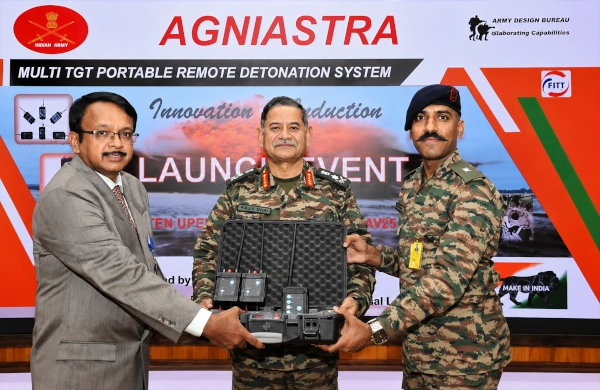
AgniAstra, developed by Indian Army officer Major Rajprasad R.S. of the Corps of Engineers, is a portable multi-target remote detonation system designed to give troops greater safety, flexibility and precision while carrying out military demolitions and explosive-disposal tasks. The invention represents another striking example of a battlefield problem being identified and solved from within the ranks of the Indian Army itself.
Official Ministry of Defence records identify AgniAstra as a Portable Multi Target Detonation Device developed by Major Rajprasad. Unlike older demolition systems that could impose significant limitations on stand-off distance and simultaneous engagement of multiple targets, the new electronic system was conceived to allow troops to control several explosive charges from a safer location and initiate selected targets individually or together according to the operational requirement.
The Army has identified applications for the system across both conventional warfare and sub-conventional operations, including situations in which combat engineers or assault teams must destroy fortified positions, breach obstacles, neutralise hazardous explosive threats or conduct controlled demolition while reducing the exposure of soldiers.
Solving a Battlefield Problem Faced by Combat Engineers
Military demolitions are an essential function of the Corps of Engineers. Engineers may be required to breach defensive obstacles, destroy structures that have military value, clear routes, deal with explosive hazards or support troops fighting through fortified positions.
The challenge is that conventional demolition frequently requires personnel to work relatively close to the explosive charges or remain dependent on physical firing arrangements extending from the target to the firing point. In contested areas, every additional minute spent near a suspected IED, terrorist hideout or defended structure increases the risk to soldiers.
Major Rajprasad’s solution was to create a portable electronic system capable of controlling multiple demolition targets from stand-off distances, thereby moving personnel farther away from the immediate danger area.
The underlying principle is straightforward: wherever possible, the explosive effect should occur at the target while the soldier responsible for initiating it remains protected at a safer location.
Several Targets Controlled From One Portable System
One of AgniAstra’s defining features is its ability to support multiple targets rather than a single demolition point.
The system allows separate explosive charges associated with different targets to be controlled through the same portable architecture. Those targets can be initiated independently when a particular sequence is required or together when simultaneous demolition is operationally preferable.
This capability gives combat engineers considerably greater flexibility during complex missions. A demolition operation may involve several distinct points rather than one target—for example, multiple parts of an obstacle or several positions within a broader defensive complex.
AgniAstra provides a way of coordinating such operations without requiring separate conventional firing arrangements for every individual target.
The Indian Army has described the technology as having considerable potential for room intervention, remote destruction of bunkers or hideouts and reserve demolitions, demonstrating that it was designed around practical field requirements rather than as a purely experimental electronic device.
UAVs and UGVs Can Carry the System Forward
Another important aspect of AgniAstra is its compatibility with unmanned platforms.
The detonation equipment associated with a target can be placed manually or delivered using Unmanned Aerial Vehicles and Unmanned Ground Vehicles, allowing troops to reduce direct exposure in particularly hazardous situations.
This creates an interesting link between AgniAstra and another invention by Major Rajprasad, the Xploder UGV. Xploder was developed as an all-terrain robotic platform for reconnaissance, IED disposal, room intervention and delivery of explosive payloads. When technologies of this type are combined, an unmanned vehicle can move into an area considered too dangerous for immediate human entry while soldiers retain control from a protected position.
The concept reflects a wider transformation taking place within modern armies. Unmanned systems are increasingly being used not merely for surveillance but to undertake some of the most dangerous physical tasks that would previously have required soldiers to enter exposed areas.
Useful in Both Conventional and Counter-Terrorism Operations
AgniAstra was not developed for only one type of battlefield.
The Ministry of Defence has specifically stated that AgniAstra and Xploder have extensive applications in conventional and sub-conventional operations.
In conventional warfare, controlled demolitions can support the destruction of military infrastructure, obstacles and fortified positions. Combat engineers may also be required to prepare demolition arrangements that can be activated when demanded by the tactical situation.
Counter-terrorism and counter-insurgency operations present a different problem. Troops may encounter fortified rooms, hideouts, booby-trapped structures or suspected explosive devices in confined areas. A remotely controlled system can potentially increase the distance between personnel and the most dangerous part of such an operation.
This versatility is one reason AgniAstra moved relatively quickly from an Army-developed innovation towards production.
From a Soldier’s Prototype to Industrial Production
The most important stage in the story of AgniAstra came when the Army decided that the innovation had potential beyond a locally fabricated prototype.
The Transfer of Technology was completed in August 2024, allowing the system to move towards industrial manufacture. The process was facilitated through the Foundation for Innovation and Technology Transfer at IIT Delhi, which has worked with the Indian Army to move soldier-developed intellectual property into commercial production.
Government records subsequently confirmed that the Portable Multi Target Detonation Device developed by Major Rajprasad had entered production and was being inducted into the Indian Army.
The Ministry of Defence later identified Red Kite Digital Tech as the industrial partner for AgniAstra and confirmed that the system had been rolled out following the technology transfer. The Chief of Army Staff, General Upendra Dwivedi, unveiled AgniAstra during the Army Commanders’ Conference in October 2024.
This transition is crucial. Military units routinely produce ingenious field modifications and local solutions, but relatively few reach the stage at which the intellectual property is formalised, transferred to an industrial manufacturer and converted into equipment capable of being produced repeatedly to a common standard.
AgniAstra successfully crossed that barrier.
Part of the Army’s Innovation-to-Induction Model
AgniAstra also demonstrates the growing role of the Army Design Bureau in connecting soldiers, operational formations, academia and Indian defence companies.
The Indian Army has increasingly encouraged personnel to identify operational problems and develop their own solutions. Promising inventions can then undergo field evaluation, intellectual-property protection, engineering refinement and eventual transfer to industry.
The Ministry of Defence’s 2024 review highlighted AgniAstra among a small group of soldier-developed technologies that had progressed from innovation towards induction. The same review recorded that ten intellectual-property applications arising from Indian Army innovation were filed during the year, while the Army Design Bureau had mapped more than 1,700 industries and established links with hundreds of academic and research institutions.
AgniAstra is therefore more than an isolated device. It is evidence of a developing system intended to turn knowledge accumulated by soldiers in operational environments into equipment that can eventually benefit the wider force.
Major Rajprasad’s Growing Family of Army Innovations
AgniAstra is particularly notable because Major Rajprasad has produced several technologies addressing very different battlefield problems.
His Xploder UGV provides a robotic means of reconnaissance, IED disposal, room intervention and delivery of payloads into dangerous areas. Vidyut Rakshak is an Internet of Things-enabled system for monitoring, protecting and controlling military generators and has already been inducted in the Army’s Northern Command.
The Ministry of Defence records AgniAstra and Xploder together as two service-personnel innovations for which technology transfer to private industry was undertaken, while Vidyut Rakshak progressed separately into operational induction.
What connects these inventions is not a single technological discipline but a common design philosophy: identify a recurring problem encountered by troops, develop a practical engineering solution and then refine it sufficiently for Army use.
A Strong Example of India’s Soldier-Inventor Tradition
AgniAstra demonstrates why soldiers themselves can become an important source of defence innovation.
A combat engineer understands demolition operations differently from an engineer who has never operated alongside troops. Soldiers know where existing equipment becomes cumbersome, where response times become excessive and, most importantly, where existing procedures unnecessarily expose personnel to danger.
Major Rajprasad converted that operational understanding into a portable multi-target system intended to increase stand-off distance and give troops greater control over complex demolition tasks.
The subsequent journey—from an in-house Army innovation to technology transfer, private-sector manufacture and induction—makes AgniAstra particularly significant.
It is not simply an experimental invention demonstrated at a defence exhibition. Official Ministry of Defence records state that the system entered production and is being inducted into the Indian Army.
Together with Xploder and Vidyut Rakshak, AgniAstra places Major Rajprasad R.S. among a growing group of Indian military personnel whose battlefield experience has resulted in technologies capable of moving from the soldier’s workshop into operational service.
For India’s broader drive towards defence self-reliance, that may be the most important aspect of AgniAstra: it demonstrates that indigenous military innovation need not originate only in laboratories and large defence companies. Sometimes, the person best positioned to invent the next piece of military equipment is the soldier who has already experienced the problem it is intended to solve.
You may also like
-
Solar Industries to Acquire Sivasakthi Industrial Explosives for ₹115 Crore, Expands Manufacturing Business
-
India and Vietnam Strengthen Counter-Terrorism and Cybersecurity Cooperation at 4th Security Dialogue in New Delhi
-
GRSE Signs ₹1,032 Crore Contract with ONGC to Build Four Hybrid Platform Supply Vessels
-
Mumbai-Based Kusumgar Signs Long-Term Aerospace Supply Agreement with France’s Safran
-
India and Mongolia Strengthen Defence Cooperation at 14th Joint Working Group Meeting in Ulaanbaatar
