Behind some of India’s most celebrated space missions lies a less visible technological achievement: an expanding family of indigenously designed and manufactured semiconductor devices capable of surviving the extreme conditions of spaceflight. From the Chandrayaan-3 lunar lander and Aditya-L1 solar observatory to the navigation and guidance computers aboard Indian launch vehicles, domestically produced chips are becoming an increasingly important part of India’s space technology architecture.
The Government of India highlighted this capability on 23 August 2026, National Space Day, detailing the contribution of the Semiconductor Laboratory at Mohali to India’s space programme. SCL develops and manufactures flight-grade semiconductor devices including radiation-hardened integrated circuits, processors, sensors, electro-optical imaging devices and application-specific integrated circuits for satellites and launch vehicles.
Among the technologies already flown are an Indian-made imaging-related chip aboard the Chandrayaan-3 lander, radiation-hardened analogue-to-digital converter chips aboard Aditya-L1 and indigenous Vikram processors used in ISRO launch vehicles. Together, these devices illustrate how India’s pursuit of self-reliance in space extends far below the level of complete rockets and satellites to the semiconductor components controlling and sensing some of their most critical functions.
The Semiconductor Technology Hidden Inside Indian Spacecraft
Spacecraft electronics operate in an environment fundamentally different from that encountered by conventional consumer electronics. Satellites and launch vehicles face intense vibration during launch, wide temperature variations and energetic radiation capable of disrupting or permanently damaging ordinary semiconductor devices.
Electronics intended for such applications must consequently undergo extensive design, fabrication, packaging, screening and qualification before they can be cleared for flight.
SCL has developed capabilities specifically for these high-reliability applications. The laboratory produces radiation-hardened chips, pressure sensors, acceleration sensors, temperature and acoustic sensors, CCD and CMOS imaging devices and specialised ASICs, according to the government’s National Space Day assessment.
This capability gives India greater domestic control over components that sit deep inside spacecraft architectures and are difficult to replace once a mission has launched.
Chandrayaan-3 Carried an Indian-Made Camera Chip
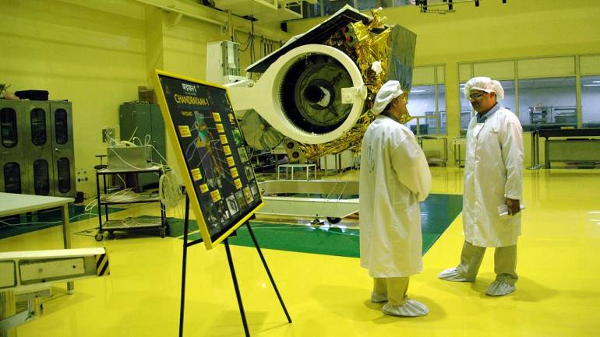
One of the clearest demonstrations of this capability came aboard Chandrayaan-3, whose Vikram lander successfully touched down near the lunar south polar region on 23 August 2023.
Government records confirm that the lander module carried an Indian-developed camera-related semiconductor device manufactured by SCL Mohali. SCL’s own mission records identify the device as its CMOS Camera Configurator, product SC1216-0, flown aboard the Chandrayaan-3 lander module.
The device supported the imaging architecture of the lander, placing an indigenous semiconductor component inside one of India’s most technologically demanding planetary missions.
Imaging was fundamental to Chandrayaan-3’s operation. Cameras were required during the descent and surface phases for navigation, hazard assessment, documentation and mission operations. The presence of domestically developed semiconductor technology within this system demonstrates that Indian participation extended beyond the spacecraft structure and propulsion system into specialised electronics.
Indian Electronics Travelled All the Way to the Lunar Surface
The achievement has particular significance because lunar missions impose strict reliability requirements. Once a spacecraft begins its journey towards the Moon, failed electronic hardware cannot be replaced or serviced.
Every critical component must survive launch vibration, the space environment, orbital manoeuvres, lunar descent and the thermal conditions encountered during surface operations.
Chandrayaan-3’s successful landing consequently provided operational validation not merely for the complete lander but also for the enormous number of underlying Indian-developed components working within it.
The SCL device aboard the lander forms part of this wider story of component-level indigenisation, where technologies that receive little public attention nevertheless contribute directly to the success of flagship national missions.
Aditya-L1 Uses Radiation-Hardened Indian ADC Chips
India’s first dedicated solar observatory, Aditya-L1, provides another example of indigenous semiconductor technology operating in deep-space conditions.
SCL records confirm that radiation-hardened analogue-to-digital converters were supplied for the Aditya-L1 mission. The laboratory lists multiple ADC technologies associated with the spacecraft, including radiation-hardened devices designed to convert analogue sensor signals into digital data that onboard electronics can process.
An analogue-to-digital converter performs a deceptively important function. Many spacecraft instruments initially generate continuously varying electrical signals representing physical measurements. Computers, however, operate on digital information. ADCs convert those analogue signals into numerical data that can then be processed, stored and transmitted.
For a scientific observatory such as Aditya-L1, reliable conversion electronics are essential because the scientific value of the mission ultimately depends upon the integrity of the measurements returned by its instruments.
Radiation Hardening Is Essential Beyond Earth
The electronics aboard Aditya-L1 operate in a particularly demanding environment. The spacecraft circles the Sun-Earth L1 region approximately 1.5 million kilometres from Earth, where it maintains a nearly uninterrupted view of the Sun.
Outside much of the protection provided by Earth’s immediate environment, spacecraft electronics are exposed to energetic particles capable of causing temporary errors or permanent semiconductor damage.
Radiation-hardened devices are engineered to tolerate these effects through specialised design and manufacturing techniques.
SCL has developed Radiation Hardness by Design technologies specifically for space applications. Such indigenous expertise allows Indian engineers to design electronics around the radiation environment expected during a mission rather than depending entirely upon imported radiation-tolerant semiconductor components.
As India moves towards longer-duration lunar, planetary and solar missions, this capability becomes increasingly important.
Vikram Processor Controls Critical Launch-Vehicle Functions
Perhaps the most strategically important example of indigenous space-grade semiconductor development is the Vikram processor family.
ISRO and SCL have spent years building microprocessors specifically for Indian launch vehicles. The indigenous VIKRAM1601, a 16-bit processor, has been used in the avionics systems of ISRO rockets since 2009, with the fully Indian-manufactured version subsequently entering service after semiconductor fabrication capability became available at SCL.
The processor has flown in the navigation, guidance and control architecture of PSLV and other missions. SCL records show VIKRAM1601 devices aboard launch vehicles associated with missions including Chandrayaan-3, Aditya-L1 and INSAT-3DS.
This is a particularly important area for technological self-reliance because the navigation and guidance computer is among the most mission-critical electronic systems aboard a launch vehicle.
VIKRAM3201 Marks a Major Indigenous Processor Milestone
India has since moved to a more capable generation with the VIKRAM3201, developed jointly by ISRO’s Vikram Sarabhai Space Centre and SCL.
VIKRAM3201 is India’s first fully Make-in-India 32-bit microprocessor qualified for the harsh environmental conditions encountered aboard launch vehicles. The processor was fabricated using SCL’s 180-nanometre CMOS semiconductor process.
The first production lots of VIKRAM3201 and another processor, KALPANA3201, were formally handed over to ISRO in March 2025.
VIKRAM3201 represents a substantial advance over the earlier VIKRAM1601. It incorporates 32-bit processing and floating-point computational capability and is supported by an indigenous software ecosystem developed by ISRO.
The associated assembler, linker, simulator, Integrated Development Environment and Ada compiler have all been developed domestically, giving India control not merely over the silicon but also over much of the software toolchain required to program it.
From Imported Components to an Indian Processor Ecosystem
The significance of VIKRAM3201 extends beyond the manufacture of a single semiconductor.
High-reliability processors suitable for aerospace and strategic applications represent an area where unrestricted access to international technology cannot always be assumed. Export controls, supply-chain disruptions and long manufacturing lead times can create vulnerabilities for national programmes.
An indigenous processor architecture provides India with much greater control over qualification, production, software development, future modifications and long-term availability.
The Vikram programme consequently represents the semiconductor equivalent of indigenising a rocket engine or navigation system. The component itself may be physically small, but the technological sovereignty associated with controlling its design and production is substantial.
Indian Vikram Processors Have Already Flown on Operational Missions
The processor programme is not confined to laboratory prototypes.
SCL’s records show the VIKRAM1601 aboard the PSLV-C57 vehicle that launched Aditya-L1 in September 2023 and aboard the LVM3-M4 vehicle used for Chandrayaan-3. The processor was also flown aboard GSLV-F14 for the INSAT-3DS mission in February 2024.
SCL additionally lists the newer VIKRAM3201 together with 2 MB SRAM against the PSLV mission associated with the SpaDeX launch in December 2024.
Flight use is especially important in the space industry because heritage accumulates only when hardware performs successfully under actual launch and orbital conditions.
Every successful mission therefore builds confidence in the underlying Indian semiconductor technologies and makes their use in subsequent programmes easier.
SCL Provides More Than Microprocessors
The contribution of Semiconductor Laboratory extends far beyond the Vikram family.
SCL provides end-to-end capabilities spanning integrated circuit design, fabrication, assembly, packaging, testing and reliability assurance. Its work includes ASICs, optoelectronic devices and micro-electromechanical systems designed for demanding space and strategic applications.
Its facilities include semiconductor fabrication lines supporting CMOS and MEMS processes, while specialised processes have been developed for high-reliability and radiation-resistant devices.
This allows ISRO engineers to work with a domestic fabrication partner capable of producing components tailored to requirements that may be unusual or commercially unattractive for large global semiconductor manufacturers.
Space missions often require relatively small volumes of highly specialised chips rather than millions of identical consumer devices. Maintaining a domestic strategic fabrication capability therefore fills a very different role from conventional high-volume semiconductor manufacturing.
Sensors Are Equally Critical to Space Missions
Processors receive much of the attention in semiconductor discussions, but sensors are equally fundamental to the operation of spacecraft and rockets.
Launch vehicles need accurate information on pressure, acceleration, temperature and other parameters throughout flight. Satellites require sensors to monitor spacecraft health and enable their scientific or observational missions.
SCL develops several categories of these devices, including pressure, acceleration, temperature and acoustic sensors intended for demanding environments.
The laboratory also produces electro-optical devices based on CCD and CMOS technologies, enabling specialised imaging applications.
Building this broad range of components domestically gives India’s space programme an increasingly complete semiconductor technology base rather than dependence on one or two isolated indigenous products.
Custom ASICs Allow Electronics to Be Built Around the Mission
Another important capability is the development of Application Specific Integrated Circuits, or ASICs.
Unlike a general-purpose processor intended to perform many kinds of computations, an ASIC is designed around a specific task. This allows engineers to optimise power consumption, physical size, performance and reliability for the exact requirements of a spacecraft subsystem.
Such optimisation is especially valuable in space, where every gram of mass and every watt of electrical power must be carefully managed.
Domestic ASIC capability allows Indian mission designers to develop specialised electronics around national requirements rather than redesigning spacecraft around whichever foreign commercial components are available.
It also reduces exposure to obsolescence, an important issue because space programmes can remain under development for many years while commercial semiconductor product cycles move far more rapidly.
Space-Grade Chips Cannot Simply Be Replaced by Commercial Processors
The semiconductor industry often measures progress by increasingly small manufacturing nodes, but space electronics operate under a different set of priorities.
For a launch vehicle or spacecraft, absolute reliability can be more important than transistor density. A processor controlling a rocket does not need the enormous computational capability of a modern smartphone chip if that additional performance introduces unacceptable reliability or radiation vulnerabilities.
Space-qualified semiconductor designs therefore prioritise robustness, predictable behaviour, radiation tolerance, temperature performance and long operational life.
SCL’s 180-nanometre fabrication capability may appear relatively mature when compared with the leading-edge nodes used in smartphones and artificial-intelligence accelerators, but such processes remain highly useful for specialised aerospace, industrial, automotive and strategic electronics.
The technological challenge lies not simply in making transistors smaller, but in producing semiconductor devices that continue functioning predictably in environments where ordinary chips can fail.
₹4,500-Crore Modernisation to Strengthen SCL
India is now preparing a substantial expansion of this strategic semiconductor capability.
The Government announced in November 2025 that ₹4,500 crore would be invested in the modernisation and expansion of Semiconductor Laboratory, Mohali. The initiative is intended to strengthen SCL’s fabrication capabilities and reinforce its position within India’s semiconductor ecosystem.
The government has also made clear that SCL will continue to serve as a strategic national institution rather than being privatised.
Modernisation has significance beyond ISRO. Semiconductor technologies developed for space can have applications in defence, nuclear systems, telecommunications, industrial control, navigation and other strategic sectors requiring high-reliability electronics.
Investment in SCL therefore strengthens a technological capability that cuts across several areas of national importance.
India Is Building the Complete Technology Stack
India’s space self-reliance programme has progressively moved deeper into the underlying technology stack.
At an earlier stage, indigenisation focused prominently on complete satellites and launch vehicles. India subsequently developed indigenous propulsion systems, cryogenic engines, navigation equipment, sensors and sophisticated scientific payloads.
Semiconductors represent an even deeper layer.
A satellite may appear Indian from the outside, but genuine technological autonomy depends on controlling increasingly important portions of the electronics operating inside it. Indigenous processors, ADCs, sensors and imaging devices move India closer to that objective.
This also strengthens resilience against global semiconductor shortages and restrictions affecting strategic electronic components.
Chandrayaan-3 Demonstrated the Value of Deep Indigenisation
The success of Chandrayaan-3 offers a particularly powerful demonstration of what this approach can achieve.
The mission’s global visibility centred on the Vikram lander and Pragyan rover reaching the lunar surface. Behind that achievement, however, stood a large network of Indian laboratories, suppliers and technology programmes responsible for everything from propulsion and navigation to materials and semiconductor electronics.
SCL’s contribution through its CMOS camera-related device is part of that larger industrial and scientific ecosystem.
The mission therefore represents not merely India’s ability to conduct lunar exploration but its growing capacity to control many of the technologies required to carry out such missions independently.
Aditya-L1 Extends Indian Electronics Towards the Sun
Aditya-L1 extends that semiconductor story even farther from Earth.
Radiation-hardened Indian ADCs now operate aboard a spacecraft positioned around the Sun-Earth L1 region, supporting India’s first dedicated solar observatory as it studies the corona, photosphere, chromosphere and energetic processes associated with the Sun.
The mission has already begun producing important scientific discoveries, demonstrating that the indigenous hardware aboard the spacecraft is contributing to a functioning scientific observatory rather than serving merely as a technology demonstration.
From the Moon with Chandrayaan-3 to the Sun with Aditya-L1, Indian semiconductor devices are consequently accumulating flight heritage across increasingly ambitious mission profiles.
Launch Vehicles Turn Indigenous Chips into Strategic Infrastructure
The Vikram processor adds a different dimension because launch vehicles form the gateway through which virtually every Indian spacecraft reaches orbit.
An indigenous processor integrated into navigation, guidance and control systems therefore becomes part of the country’s core space-access infrastructure.
India’s launch programme now spans PSLV, GSLV, LVM3 and SSLV, while new vehicles and human-spaceflight technologies are under development. Future launch systems will require increasingly sophisticated and reliable onboard computing.
Experience gained through VIKRAM1601 and VIKRAM3201 provides a domestic technological foundation upon which these future systems can be developed.
The processor programme also creates expertise in areas extending from computer architecture and semiconductor fabrication to programming tools, qualification and mission-critical embedded computing.
Small Chips With Strategic Significance
The physical scale of these devices can obscure their importance.
A processor, ADC or imaging chip weighs only a tiny fraction of a launch vehicle or spacecraft. A failure in one critical semiconductor component, however, can compromise an entire mission worth hundreds or thousands of crores of rupees.
Space-grade semiconductor capability must therefore be viewed as strategic infrastructure.
By developing processors, sensors, ADCs, imaging devices and ASICs domestically, India is reducing one of the less visible dependencies within its rapidly expanding space programme.
The benefits extend beyond supply security. Domestic control also allows ISRO engineers to customise electronics around mission requirements, maintain production over long programme cycles and create future generations of hardware without depending completely on external suppliers.
From the Moon to the Sun, Indian Silicon Is Going With ISRO
The National Space Day disclosure highlights an important evolution in India’s space story. The country is no longer demonstrating self-reliance only through complete rockets and spacecraft; it is increasingly building the specialised electronics deep inside those systems as well.
An SCL-developed imaging device reached the lunar surface aboard Chandrayaan-3. Radiation-hardened Indian ADCs travelled to the Sun-Earth L1 region aboard Aditya-L1. Vikram processors are flying inside the navigation and guidance architecture of Indian launch vehicles.
These achievements represent different applications of the same underlying capability: India’s ability to design, fabricate, qualify and operate semiconductor electronics under some of the harshest conditions encountered by modern technology.
As ISRO progresses towards more ambitious Earth-observation missions, human spaceflight, lunar exploration, planetary science and increasingly capable launch vehicles, demand for radiation-resistant and high-reliability electronics will continue to grow.
The rockets may provide the thrust and the spacecraft may dominate the photographs, but deep inside them, an increasingly important part of India’s journey into space is being powered by Made-in-India silicon.
You may also like
-
India and Uzbekistan Advance Long-Term Uranium Supply Partnership as Nuclear Cooperation Deepens
-
Indian Navy Commissions INS Nipun, Strengthening Deep-Sea Diving and Submarine Rescue Capability
-
India’s Telecom Base Crosses 1.35 Billion as Broadband Connections Near 1.1 Billion
-
How India’s Indigenous RuPay Credit on UPI Could Challenge Visa and Mastercard in India
-
India to Push Cross-Border Digital Payments and CBDC Linkages at BRICS Summit
