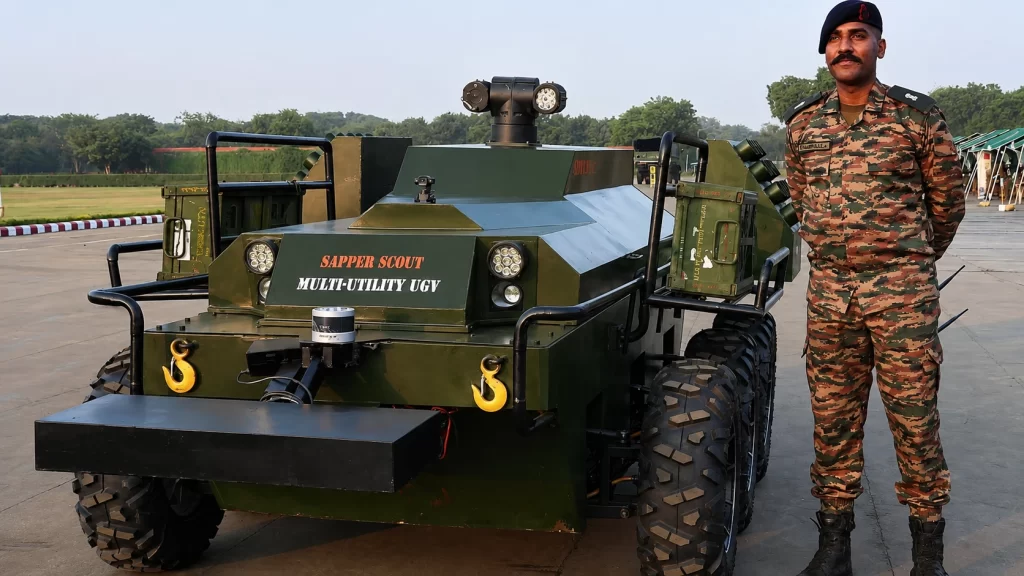
The Indian Army has developed SapperScout 2.0, an indigenous multi-utility unmanned ground vehicle designed to undertake hazardous battlefield tasks including mine detection, reconnaissance, surveillance, logistics support, casualty evacuation and engineering missions while reducing the exposure of soldiers to hostile fire and explosive threats.
Developed in-house within the Indian Army by Major Rajprasad R.S. of the Corps of Engineers, the robotic platform represents a significant step in the Army’s growing effort to integrate unmanned ground systems into frontline formations. SapperScout 2.0 has been conceived as a modular vehicle rather than a single-purpose robot, allowing different mission payloads to be installed on a common all-terrain chassis.
The platform is based on a six-wheel, independently driven configuration with articulated suspension, giving it the mobility required to negotiate uneven and difficult terrain. Defence officials have said the UGV incorporates environmental sensing and obstacle-detection capabilities, enabling it to operate ahead of troops in areas where sending personnel first would involve unnecessary risk.
An In-House Indian Army Battlefield Robot
SapperScout 2.0 is significant because it has emerged directly from within the Indian Army rather than through a conventional external development programme. Its designer, Major Rajprasad R.S., belongs to the Corps of Engineers, whose battlefield responsibilities include mobility support, mine warfare, demolitions, route clearance, obstacle creation and specialised engineering operations.
The Army describes SapperScout as its first in-house-developed multi-utility UGV of this type, designed around the operational requirements of combat engineers and frontline formations. India has developed other unmanned ground systems in the past, including DRDO’s MUNTRA family and industry-developed platforms, but SapperScout represents a different development model in which a serving Army officer has created a modular robotic vehicle around specific field requirements.
Major Rajprasad has previously been associated with several service innovations, including systems intended for demolition, monitoring and explosive-handling applications. SapperScout extends this soldier-led innovation approach into the increasingly important field of battlefield robotics.
Designed as a Multi-Role Platform
The defining feature of SapperScout 2.0 is its modularity. Rather than designing separate vehicles for reconnaissance, mine detection, logistics and casualty evacuation, the Army is exploring whether these tasks can be performed using different payloads mounted on the same robotic mobility platform.
Defence officials have identified mine detection, payload carriage, reconnaissance and surveillance, vehicle-based mine scattering and casualty evacuation among the primary roles envisaged for the system.
The same chassis can also be configured for specialised mission equipment, including remotely operated weapon systems and counter-unmanned aircraft system payloads. This does not mean that every SapperScout vehicle will permanently carry weapons or counter-drone equipment. The concept is instead to provide a common robotic platform that can be configured according to the operational requirement.
Such modularity could significantly simplify logistics and maintenance if the system eventually enters wider service. A common chassis, propulsion arrangement, control system and suspension architecture could support multiple battlefield roles without requiring the Army to maintain completely different robotic vehicles for each mission.
Six-Wheel Independent Drive for Difficult Terrain
SapperScout 2.0 uses a six-wheel independently driven configuration combined with articulated suspension.
This arrangement is intended to improve mobility over broken terrain by allowing individual wheels to maintain better contact with the ground as the vehicle crosses obstacles, uneven surfaces and difficult tracks.
The design is especially relevant to the Indian Army because its formations operate across unusually diverse environments, ranging from deserts and plains to mountain tracks and high-altitude areas.
A battlefield UGV must be capable of operating beyond prepared roads if it is to accompany combat formations. A system intended for mine reconnaissance, casualty evacuation or forward logistics may have to negotiate loose soil, stones, depressions, damaged roads and other obstacles before reaching its objective.
The articulated six-wheel configuration gives SapperScout a relatively stable platform on which different sensors and mission payloads can be mounted while retaining sufficient mobility for field operations.
Environmental Sensing and Obstacle Detection
The vehicle is equipped with environmental sensing and obstacle-detection capabilities, enabling it to identify hazards while moving through unfamiliar terrain.
These capabilities are important because a ground robot cannot rely solely on an operator’s direct visual line of sight. Terrain features, vegetation, structures and battlefield debris can obscure the vehicle from its controller, particularly when it is operating forward of a formation.
The sensing architecture is intended to help SapperScout identify obstacles and support safer navigation while conducting reconnaissance or engineering missions.
The Army has not yet publicly released a detailed technical breakdown of the complete sensor suite, communications architecture or degree of autonomous navigation built into SapperScout 2.0. It is therefore more accurate at present to describe the vehicle as a remotely operated and sensor-assisted unmanned platform with obstacle-detection capability rather than attributing specific autonomous functions that have not been formally disclosed.
Mine Detection Could Become a Core Combat Engineer Role
Mine detection is one of the most important applications envisaged for SapperScout.
Combat engineers frequently have to operate close to suspected minefields and explosive hazards while identifying safe routes for infantry and vehicles. These missions can expose personnel to concealed mines, improvised explosive devices, artillery fire and observation by enemy forces.
A remotely controlled UGV equipped with an appropriate mine-detection module can move ahead of soldiers and investigate suspicious areas while the operator remains at a safer distance.
The value of such a system lies primarily in risk reduction. Even if a robotic platform is damaged or destroyed by an explosive device, the loss of equipment is preferable to exposing a soldier to the same hazard.
SapperScout could therefore become particularly useful for route reconnaissance, minefield investigation and engineering support ahead of advancing formations.
Vehicle-Based Mine Scattering
The Army has also identified vehicle-based mine scattering as one of the possible mission configurations.
This would give the UGV a counter-mobility function in addition to its mine-detection role.
Military engineers are responsible not only for clearing obstacles for friendly forces but also for creating obstacles intended to restrict or channel enemy movement. An unmanned ground platform capable of undertaking such work remotely could reduce the exposure of engineering troops operating in contested areas.
The use of a modular vehicle is particularly advantageous in this role because the mine-scattering equipment can be treated as a mission payload rather than a permanent feature of the vehicle.
Reconnaissance Ahead of Troops
SapperScout is also intended to carry out reconnaissance and surveillance missions ahead of troops and vehicles.
A ground robot can move into terrain where commanders suspect mines, ambushes, enemy observation posts or other threats before committing soldiers to the same route.
Although aerial drones have transformed battlefield reconnaissance, ground robots provide a different perspective. A UAV can observe a wide area from above, while a UGV can examine terrain, walls, vegetation, buildings and obstacles from approximately the same level at which soldiers and vehicles will eventually operate.
The two systems are therefore complementary.
Aerial drones can identify suspicious areas across a broader zone, while a ground vehicle such as SapperScout can subsequently move closer to examine individual routes, structures or obstacles.
This combination of aerial and ground robotics could significantly improve situational awareness for advancing formations.
Battlefield Logistics Without Exposing Drivers
Payload carriage is another important role envisioned for SapperScout 2.0.
Frontline formations require a continuous supply of ammunition, batteries, food, water, fuel and other equipment. The final portion of the supply route is often the most dangerous because it may be exposed to enemy observation, drones, artillery and direct fire.
An unmanned ground vehicle can transport critical supplies across these exposed areas without placing a driver or accompanying soldiers inside the vehicle.
This role is becoming increasingly important as modern battlefields become more transparent. Small reconnaissance drones can observe roads, trenches and supply routes for long periods, making conventional logistics vehicles vulnerable even several kilometres behind the immediate front line.
A compact robotic carrier capable of moving supplies to forward troops can reduce both human exposure and the logistical burden on soldiers who would otherwise have to carry heavy equipment themselves.
Casualty Evacuation From High-Risk Areas
SapperScout 2.0 has also been designed to support casualty evacuation.
Recovering an injured soldier from an exposed battlefield position can place additional personnel at considerable risk. A rescue team may have to cross the same minefield, open terrain or enemy fire zone in which the casualty was originally injured.
A UGV configured with a casualty-evacuation module could move forward remotely, carry the injured soldier away from the immediate danger area and return towards a protected location where medical personnel could provide treatment.
The vehicle would not replace battlefield medics. Its purpose would be to reduce the distance over which soldiers have to expose themselves while retrieving a casualty.
This could be particularly useful in areas subjected to sniper fire, artillery observation, drone surveillance or suspected mine contamination.
Provision for Weapon Payloads
The modular architecture of SapperScout 2.0 has also been designed to accommodate weapon systems.
A remotely operated weapon station mounted on an unmanned chassis could allow the Army to position firepower in exposed locations without requiring a soldier to remain physically beside the weapon.
Such a configuration could potentially support perimeter defence, observation posts, route protection or selected combat-support tasks.
However, the Army has not publicly announced a standard weapon configuration for SapperScout 2.0. Weapon carriage should therefore be regarded as a modular future or mission-specific capability rather than an indication that the platform is presently fielded as an armed combat robot.
Any operational weapon integration would also require appropriate fire-control architecture, communications security and human command procedures before the vehicle could be used in such a role.
Counter-Drone Payloads Could Expand Its Battlefield Role
Defence officials have also identified the possibility of integrating Counter-Unmanned Aircraft System equipment onto the SapperScout chassis.
The proliferation of small reconnaissance drones, FPV strike drones and loitering munitions has made mobile counter-drone capability increasingly important for land forces.
A robotic ground vehicle could carry selected sensors, electronic-warfare equipment or other counter-UAS payloads and deploy them closer to vulnerable positions without requiring an operator to remain alongside the system.
This would allow counter-drone equipment to move with formations and reposition as the threat changes.
The exact counter-UAS system intended for SapperScout has not been publicly identified, and no particular radar, jammer or interceptor should therefore be considered part of the standard configuration at this stage.
Part of the Army’s Manned-Unmanned Teaming Push
SapperScout fits into the Indian Army’s broader effort to develop manned-unmanned teaming, in which robotic systems operate alongside conventional troops rather than attempting to replace them.
Under this concept, unmanned systems perform jobs that are particularly dangerous, repetitive or physically demanding while human soldiers retain command and decision-making responsibility.
A SapperScout operating with an infantry or engineering formation could scout a route before soldiers advance, examine a suspected minefield, carry ammunition to an exposed position and later help evacuate a casualty.
The same vehicle could potentially support a mechanised formation by watching a vulnerable flank or carrying specialist sensors.
The concept gives commanders additional options without requiring a crewed vehicle for every task.
A Different Approach From Earlier Indian UGVs
India has significant previous experience with unmanned ground vehicles.
DRDO developed the MUNTRA family, based on a modified BMP-II tracked platform, for roles including surveillance, mine detection and nuclear, biological and chemical reconnaissance. MUNTRA incorporated electro-optical sensors, radar, navigation equipment and remotely controlled mobility.
Indian industry has also developed modular UGVs for logistics, reconnaissance and autonomous mobility, while smaller robotic systems have been created for explosive-ordnance disposal and urban intervention.
SapperScout therefore should not be described simply as India’s first unmanned ground vehicle.
Its distinction lies in being an Indian Army-developed multi-utility UGV conceived as a common modular platform for several combat-support roles.
This reflects a different philosophy from large specialised vehicles such as MUNTRA. SapperScout is intended to provide a comparatively adaptable platform capable of changing missions through payload integration.
Soldier-Led Innovation Shapes the Design
The development of SapperScout inside the Corps of Engineers gives the project an important operational advantage.
The system originates from personnel who directly understand the problems faced by combat engineers and forward formations.
That can shorten the development cycle between identifying an operational requirement and modifying the equipment to address it.
If mine-clearance teams require a different sensor position, logistics units need changes to the cargo arrangement or infantry formations require better surveillance coverage, the platform can potentially be redesigned around direct user feedback.
This flexibility is particularly valuable during the prototype stage.
The larger challenge comes later, when an innovation has to transition from a successful prototype into a standardised military system capable of being manufactured, supported and maintained across a large organisation.
Battlefield Robotics Is Expanding Beyond Bomb Disposal
Military ground robotics originally developed largely around highly specialised missions such as explosive-ordnance disposal.
The operational concept is now becoming much broader.
Modern armies increasingly want robots capable of accompanying formations throughout an operation rather than appearing only when a bomb needs to be examined.
SapperScout reflects this transition.
The same platform can potentially participate before, during and after direct combat. It can conduct reconnaissance before troops advance, investigate mines and obstacles during movement, carry supplies during sustained operations and support casualty evacuation after soldiers are injured.
Future specialised payloads could further expand its role.
This makes the system less a single-purpose engineering robot and more a general battlefield-support platform.
From Prototype to Battlefield System
The true significance of SapperScout 2.0 will ultimately depend on whether the Army can successfully convert an innovative prototype into a robust production system.
Military equipment must survive conditions far beyond those encountered by commercial robotic vehicles. It must tolerate dust, mud, vibration, temperature extremes, rough handling, damaged roads and extended deployment without constant specialist maintenance.
A production SapperScout would also require standardised spare parts, operator training, technical documentation, repair infrastructure and an industrial partner capable of manufacturing vehicles consistently.
An Indigenous Platform Built Around Indian Battlefield Requirements
SapperScout 2.0 ultimately represents a broader change taking place within the Indian Army.
Rather than viewing unmanned ground systems as isolated specialist equipment, the service is exploring how modular robots can become routine tools for reconnaissance, engineering, logistics and battlefield support.
Its six-wheel articulated architecture provides the mobility foundation, while its interchangeable payload concept allows the same vehicle to be adapted for different missions.
Mine detection can reduce the exposure of combat engineers. Reconnaissance can place sensors ahead of soldiers. Payload carriage can move supplies through dangerous areas. Casualty evacuation can reduce the risk involved in recovering wounded personnel. Counter-UAS and weapon modules could eventually give the platform additional operational roles.
The system still has to complete the transition from successful in-house innovation to a fully validated and potentially mass-produced military platform.
Nevertheless, its development demonstrates how the Indian Army is increasingly combining indigenous engineering, soldier-led innovation and unmanned technology to address practical battlefield requirements.
The underlying philosophy is straightforward: wherever possible, send the robot into the danger zone before sending the soldier.
References
The Times of India, “Army develops unmanned ground vehicle for mine detection, reconnaissance and surveillance,” February 23, 2026.
https://timesofindia.indiatimes.com/city/pune/army-develops-unmanned-ground-vehicle-for-mine-detection-reconnaissance-and-surveillance/articleshow/128688458.cms
The Week, “Meet Sapperscout 2.0, the war robot developed by Major Rajprasad RS of Indian Army that can scout, supply and save lives,” December 6, 2025.
https://www.theweek.in/news/defence/2025/12/06/meet-sapperscout-20-the-war-robot-developed-by-major-rajprasad-rs-of-indian-army-that-can-scout-supply-and-save-lives.html
Press Information Bureau, Ministry of Defence, Year End Review 2024. Background on Indian Army service innovations and technology transfer.
https://www.pib.gov.in/PressReleasePage.aspx?PRID=2088180
Defence Research and Development Organisation, technical background on unmanned ground vehicles and the MUNTRA programme.
https://www.drdo.gov.in/drdo/sites/default/files/technology-focus-documrnt/TF_Mar-Apr_2018_web.pdf
Department of Defence Production, Ministry of Defence, background on indigenous artificial-intelligence and unmanned ground vehicle programmes.
https://www.ddpmod.gov.in/sites/default/files/2023-11/ai.pdf
You may also like
-
AXISCADES Expands Indigenous Aerospace Manufacturing Footprint with ₹234-Crore Cloud Wave Acquisition
-
Indian Navy Orders Magnetic-Bearing Compressor AC Plant from Shree Refrigerations
-
Tata Advanced Systems Chosen as Prime Indian Partner for Future Javelin Missile Co-Production
-
Avantel Wins ₹117.88-Crore DRDO Contract to Develop Ground-Segment Hub for Voice and Data Communications
-
Ethereal Machines: Building India’s Precision Manufacturing Backbone with Five-Axis CNC Technology
